


 Francais
 Deutsch
 Italiano
Refine Your Search
Baltimore Maryland USA 1958 stock footage and images
- Showing 8515 to 8520 of 25435 results more
more Hide
Hide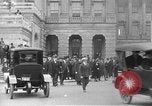
Gathering of officials outside the U.S. capitol building on occasion of President Wilson's address to the Senate
A crowd arrives at the Capitol building in Washington DC, on the occasion of President Wilson's address to the Senate regarding the Treaty of Versailles. Exterior of the building. Cars arrive towards the building. People gather in a large number outside the building. Cars parked along a side of the street. The President's 1919 Pierce-Arrrow limousine is seen leaving the area at the conclusion of his address.
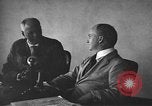
Two Officials, in President Wilson's Administration,converse while seated at a table. One answers a telephone call.
Two officials in President Wilson's Administration, seated at a table, conversing. Joshua W. Alexander, Secretary of Commerce holds a lighted cigar. The other answers a telephone call.
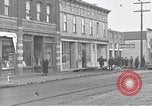
Washington State Governor calls up contingent of the National Guard to maintain order in Centralia, Washington, following Armistice Day riot on November 11th, 1919
Opening scene shows some some people gathered near pieces of debris on the sidewalk outside the Roderick Hotel and a 1-cent to 1 dollar store in Centralia, Washington. This is in the wake of the Armistice Day riot in that city that took place in that city, on November 11, 1919. It involved clashes between members of the The Industrial Workers of the World (IWW) union and members of the American Legion. A man steps out of a shattered and empty store front on the street. The Washington National Guard was called up by Governor Hart to restore order. Company F of the 3rd Infantry, was sent to Centralia by train on the evening of the 11th from Fort Lewis in Tacoma, Washington. Soldiers of that Company are seen assembling and receiving orders from their officer in Centralia. Next, the soldiers begin marching as guards, on the street in front of the local police station. Some pedestrians watch from a sidewalk. A group of local people crowd together to watch something of interest in a building
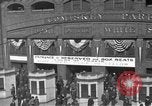
1917 World Series game one: The Chicago White Sox versus the New York Giants from Comiskey Park in Chicago, Illinois.
Scenes from the 1917 baseball World Series. Game 1 in Chicago, Illinois. A large crowd gathering at Comiskey Park to watch the game. Fans lined up in front of sign for bleacher seating with sign "Bleachers 50 cents". Scenes from the field before the game. Managers Pants Rowland of the White Sox and John McGraw of the Giants reviewing ground rules. Pitchers Eddie Cicotte and Slim Sallee during warm-ups. White Sox dugout is seen with Happy Felsch on the far left, John "Shano" Collins beside him, then Fred McMullin and Reb Russell (just past the big baseball). Joe Jackson and Nemo Leibold may be standing outside the dugout, with Eddie Cicotte in the background and Chick Gandil and Byrd Lynn in front of Cicotte. African American man on the Giants bench around one-minute mark may be J. L. Mackall, the team's trainer. Manager John McGraw is sitting in front of the dugout, with Art Fletcher on his right and Red Murray on his left. Scenes from the game in progress, and view of cheering fans in the packed stadium. At about 1:43: Bottom of the 3rd. Single by S. Collins, and Cicotte is thrown out at 3rd base. The next play seen is a double by McMullin scoring S. Collins, who had taken 2nd base on the throw that got Cicotte out. At 2:13: Top of the 5th inning. Single by Sallee scoring McCarty from 3rd base. White Sox win game 1 over the Giants by a score of 2 to 1. Scene changes to New York, with Giants fans jammed in the streets of New York City watching the large scoreboard being updated during the game, mounted on the building of the New York American Newspaper offices. Cars and trucks pass slowly by in the area jammed with baseball fans.
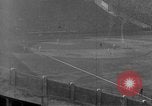
Game 1 of the 1916 Baseball World Series - Boston Red Sox versus Brooklyn Robins at Braves Field in Boston
Scenes from baseball World Series game 1 in 1916 with the Boston Red Sox versus the Brooklyn Robins (later the Brooklyn Dodgers). View from stands during first four innings of play (Boston Red Sox ultimately rallied with 4 runs in 9th inning to defeat the Brooklyn Robins). A large crowd of 40,000 gathered at Braves Field in Boston, with the game played there instead of Fenway Park so that more fans could attend. Game in progress. Men watching from the stands. Crowd waving hats and cheering. Scenes include: 0:04 Top of the 2nd inning double play by Boston after hit by Brooklyn's George Cutshaw; 0:11 Bunt single by Boston's Larry Gardner and Lewis advances to second base; 0:25 Sacrifice bunt by Boston's Everett Scott; 0:32 slate text on film reads, "In the third Duffy Lewis, famed for breaking up World Series' games drives a two base hit sending Hoblitzel home with the first run; score 1-0." (spelling should be Hoblitzell). This play is then seen; 0:40 Same play seen from different angle in the ballpark; 0:52 A play from before the previous play -- this is a triple by Hoblitzell with no one on base; 1:05 Top of the fourth inning: Go ahead run is at 3rd. Cutshaw hits a fly to right field. Harry Hooper catches the ball and throws out Zack Wheat at the plate. Men in stands cheering and waving hats.
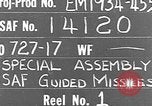
The launching of the first pilot-less aerial torpedo at Carlson Field in Arcadia, Florida.
A review of research and development in guided missiles by the United States Air Force from 1919 to 1948. A civilian technician assembles first pilot-less aerial torpedo at Carlson Field, in Arcadia Florida. A launching track and gear. Technicians work on the missile beneath camouflaged netting. Attempted launching of the missile results in a crash due to track failure. The missile is launched and takes off. First successful launching of the aerial torpedo on October 24, 1919. The missile crashes immediately after the take off. First successful flight on October 2. Aerial view of hangars and airstrips of Wright Field in Ohio during early 1940s.
CRITICALPAST.COM: About Us | Contact Us | FAQs - How to Order | License Agreement | My Account | My Lightboxes | Shopping Cart | Advanced Search | Featured Collections | Website Terms & Conditions | Privacy Policy ©2026 CriticalPast LLC.
License Agreement |
Terms & Conditions |
Privacy Policy
©2026 CriticalPast LLC.