


 Francais
 Deutsch
 Italiano

Refine Your Search
Baltimore Maryland USA 1958 stock footage and images
- Showing 1015 to 1020 of 25463 results more
 Hide
Color Sound
United States aircraft carrier USS Independence (CVL-22) damaged in Operation Crossroad "Test Able," risk in daily lives and discussion of radioactivity.
'Radioactive contamination' about the hazards posed by the sinking of a United States aircraft carrier and the methods to control radioactivity. United States Navy F6F-3 Hellcat aircraft taking off from United States aircraft carrier USS Independence (CVL-22) in the Pacific Ocean during World War II. F6F-3 Hellcat firing rockets in air. Landing signal operator LSO using flags while guiding plane for landing on USS Independence. Kamikaze attacks at Tarawa. Anti aircraft guns on carrier cut down kamikaze planes as they attack. USS Independence flying USA flag at Tokyo Bay. Scene of surrender of Japanese at Tokyo Bay aboard the USS Missouri. Aerial view of atomic bomb blast at Bikini in 1946. The wrecked carrier Independence being towed away after it was used as a target for an atomic bomb test in 1946 as part of Operation Crossroads. Men at a construction site talk about contamination caused in sea water due to sinking of Independence containing radioactive waste. They comment, "she's all full of that radioactive poison" and with respect to eating fish in water near the ship, "would you eat fish again?" Two women dressed in furs, in a car, also discuss radioactivity. One woman says, "from what I've heard it's very dangerous. " View of 1940s car backing into oncoming traffic and almost causing an accident. An aerial view of atomic explosion at Bikini. Damaged USS Independence ship after TEST ABLE. Signs on board warn of radioactivity with words, "Keep Clear, Danger! Very Radio-Active" and "Radioactivity. Do not remain more than 2 hours." Men in small boat near USS Independence examine damage to the ship. Parts of the USS Independence being tested for radioactive contamination at the Naval Radiological Defense Laboratory NRDL, Hunter's Point Naval Shipyard in San Francisco, California. The USS Independence being sunk in 1951. View of Bikini atomic bomb blast within a bay surrounded by ships. Simulation shows the effect a similar blast would have on a coastal city as a radioactive cloud covers the city. Officers holding handkerchiefs to their mouths as they enter an office building from outside. Firemen climb ladders while putting out a large fire. A house wife working in a kitchen and responding to a pot boiling over on the stove burns her hand. A man slips on a bar of soap in the shower while singing. An officer honking at an oncoming car as he is run off the road. Woman driver dressed in furs exclaims to her friend about the bad driving of men. Officer just run off the road by woman driver exclaims, "Women !" with frustration. Aerial view of test nuclear explosion at Bikini Atoll.
Germany bombs London during Blitz, and United States sends Lend-Lease war materiel to England (WW2)
The London Blitz. Sections of London ablaze from German bombing during Battle of Britain. US President Franklin Roosevelt signing H.R. 1946, Lend-Lease legislation in World War II. View of last page of H.R.1946, signed by Sam Rayburn, Speaker of the U.S. House of Representatives, and by President Roosevelt. United States sends war material to England. 'USA' written on Lend-Lease boxes being loaded on lorry after arrival in Britain. Huge crates of Lend-Lease war materiel on railroad flat cars pulled by locomotive. Smoke rises up from the engine. 'Machine tools, BULLARD, Bridgeport Conn.' written on crate in transit.
American staff car enters through a gate of a Russian Embassy building in Tehran, Iran.
American staff car on the streets of Tehran, Iran. 'USA' written on the car. Buildings in the background. The car enters a gate. A guard on the gate. The car arrives in front of a Soviet Embassy building during the Tehran Conference (project "Eureka"). A guard stands on stairs. British soldier Honor Guard stands in front of Embassy. Squad of British and Russian soldiers marches past Embassy. Cameramen take pictures. (World War II period).

President of Cuba Dr.Ramon Grau San Martin is forced to resign in crisis, Havana, Cuba.
President of Cuba Dr.Ramon Grau San Martin with cabinet officials at the Presidential Palace in Havana, Cuba. A group of Cuban Government officials seated and standing in two rows pose for photograph. Dr.Ramon Grau San Martin, President of Cuba, who is forced to resign in a crisis, seated with other officials on Terraza Norte (North Terrace) of the Presidential Palace on Avenida de las Misiones in Havana. (Among the cabinet is Secretary of Interior, Dr. Antonio [Tony] Guiteras --born in Philadelphia, USA.) A large crowd gathered outside. Vehicles among the crowd. Government officials climb up the stairs and enter the building. Guards stand on either side of the stairs. The officials inside the building. The officials on North Terrace of the Presidential Palace and a large crowd outside.
Views of London, England, when it is filled with Allied military personnel during World War II. Various organizations supporting the Allied military in the city.
American troops are seen boarding a transport ship in the opening scene, heading for the war front in Europe during World War 2. Closeup of the ship leaving the dock in the United States. Closeup of soldiers on deck looking back as they depart. Glimpse of upper deck of the ship completely filled with soldier passengers. Soldiers in their multi-bunk rooms aboard ship. Soldiers on ship's deck wearing life preservers. An impromptu band of soldier musicians entertains the troops. Others pass the time in card games,and sharing letters from home. Next, soldiers are seen watching as the troop ship arrives in Liverpool, England. A British army band plays to welcome them. View from the ship of American soldiers descending a gangplank to the Liverpool dock, where U.S. army trucks and an ambulance awaited them. Sailors, and a Women's Army Corp (WAC) Sergeant, feed pigeons on dock. One sailor poses with a small English girl. Film shifts to scenes of wartime London which occupy the remainder of the film. Several U.S. Army officers walk along a London sidewalk A British woman army sergeant and a local policeman. An English Bobbie (police officer with tall helmet) poses for the camera with several sailors and an American WAC Sergeant. U.S. soldiers and Military police (MPs) posing in front of a shop with U.S. Marine Corps logo on the window. Street scene with U.S. soldier walking past a sign reading: "USA cars, No Entry." More street scenes showing various British military and police in the city. A sign reading, "American Red Cross Services for Women." Another sign reading, "A uniformed Red Cross woman. Sign identifying the "Yugoslav Relief Society" headquarters. Canadian soldiers near the headquarters of the "RCAF Overseas." A Norwegian sailor with cap reading,"Norske Marine." Street sign pointing toward :"Canadian Red Cross and Maple Leaf Club." Headquarters of the "Newfoundland Caribou Club." Uniformed women from a Canadian province. Three Canadian soldiers lighting cigarettes. A local park in the background. Sign above "Merchant Navy Comforts Club." Sign reading: "St. Columbia Catholic Services Club." An Australian soldier walking on the sidewalk. Two uniformed women consulting a guide book with two American MPs. A Scottish soldier wearing a kilt accompanying a woman. Brief glimpses of various Allied soldiers from the British Commonwealth. British soldier wearing a busby hat. "Lion Services Club" sign with lion image. "Armoured Royal Corps Club" sign. "New Zealand Forces Club.""United Nations' Forces' Club."
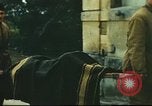
Effects of typhus on an Italian patient in the city of Naples during World War II.
Typhus epidemic strikes the city of Naples during World War II. Two men carry a patient on a stretcher into a hospital. Improvised history form of a patient who suffers from typhus. Rashes all over the chest of the patient. The eyes of the patient are checked. The patient's tongue is sticking out. The head of the patient is lifted up. The body temperature chart of the patient after diagnosis. Affected legs of the patient. Laboratory tests are carried out in critical diagnosis. Tube tests are carried out. A USA Typhus Commission 6-point typhus control chart.
CRITICALPAST.COM: About Us | Contact Us | FAQs - How to Order | License Agreement | My Account | My Lightboxes | Shopping Cart | Advanced Search | Featured Collections | Website Terms & Conditions | Privacy Policy ©2026 CriticalPast LLC.
License Agreement |
Terms & Conditions |
Privacy Policy
©2026 CriticalPast LLC.