


 Francais
 Deutsch
 Italiano
Refine Your Search
Baltimore Maryland USA 1958 stock footage and images
- Showing 10237 to 10242 of 25435 results more
more Hide
Hide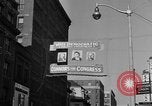
Excerpt from film about national elections in the United States. This segment covers election of November 7, 1944, in World War II
Excerpt from film about national elections in the United States. Opening scene show a banner stretched across a downtown street, reading: "Vote Democratic, vote for full employment. Below that are pictured two local candidates and Franklin D. Roosevelt (running for an unprecedented 4th term as President). Underneath, the banner reads:"Conners for Congress.Glimpses of other political signs are shown, on telephone poles, buildings,and automobile windows. Citizens discuss the elections in various places: A man and woman in their living room; workers in a machine shop; men in a diner restaurant; a man and woman at home; a farmer and a delivery man; a housewife speaks to another homemaker over a back fence; a dentist and his patient; school boys; and politicians. Representative Clare Booth Luce speaking. New York Governor, Thomas E. Dewey, at a podium. Vice Presidential candidate Harry Truman about to speak. People gathered in local forums and other political campaign activities. President Roosevelt driving along a city street, on a rainy day, in an open car with Secret Service agents riding on the running boards of his car. Crowds jamming the sidewalks in spite of the weather. Other gatherings of people waving American flags and showing support for their politcal parties and candidates. Philip Murray, President of the CIO Labor Union and AFL Head, William Green. Radio broadcast antenna shown denoting importance of radio for political communications. Harry S. Truman (Democrat), Thomas E. Dewey (Republican) and incumbent President Roosevelt are seen delivering speeches in front of numerous microphones. Various views of many men, women, children, and families gathered around radios listening to radio campaign speeches, in various places, including American soldiers at the front (This election is during World War 2) and Nurses in a hospital. President Roosevelt speaking at a political dinner. Views of people at political party conventions. Next, people are seen calmly walking in and out of polling places. Three members of an election board begin counting votes. After checking, one member telephones the results from their precinct to headquarters. Views of recorded votes being reported by telephone. People using tabulating machines to compile the results. Views of spectators in vote posting centers awaiting the results. Final results being brought to news media for dissemination to the nation. People gathered in Times square, New York, where news is posted in moving lights on the Times building marquee. Others gathered around their radios. Marquee Lights on the Times Building announce the reelection of President Roosevelt.
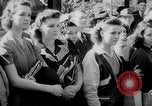
Women's Army Auxiliary Corps enlistments in Muncie, Indiana.
United States Army Recruitment Drive in Muncie, Indiana. Several women stand in a group. Young boys and old men stand in the group and look on. A member of Women's Army Auxiliary Corps (WAAC) sits at a desk. 'US Army Recruitment Service' written on a bus in the background . WAAC recruits. Trucks and jeeps pass on a street. Platoons with rifles marching down street with U.S. flag. A band plays trumpets. Buildings and trees in the background. The Platoon stops. A woman comes out.
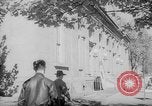
A post office houses the U.S. Army, U.S. Navy and U.S. Marines recruiting office in Muncie, Indiana.
United States Army Recruitment in Muncie, Indiana. A post office in Muncie. The post office includes U.S. Army, Navy and Marines recruiting office. Posters pasted outside. Several people walk into the office. A large sign of Muncie and Indiana monthly Navy enlistments. Recruiting posters. Posters read 'Lets hit 'em with everything we've got' and 'The U.S. Marines wants you'.
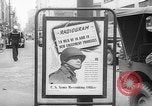
A U.S. Army sergeant interviews applicants in a recruitment office in Muncie, Indiana, during World War II.
United States Army Recruitment in Muncie, Indiana. A U.S. Army recruitment sign near a jeep out front of the building. Buildings and cars in the background. Men walk in the street. Scene inside a recruitment office in Muncie, Indiana. The recruiter sergeant interviews the applicants. Four young men recruits sit for the interview. The recruiter talking to the prospective Army soldiers.
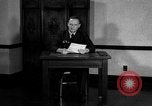
Charles A. Lindbergh speaks against United States participation in European Wars early in World War 2.
Charles A. Lindbergh delivers an anti-war speech early during the outbreak of World War II in Europe. Lindbergh speaks in a studio of the Mutual Broadcasting System. He speaks against American involvement in wars in foreign lands. He states that the Americans should not be asked to fight in foreign countries, but to focus on defense of the United States. Among other things, Lindbergh says: "The doctrine that we must enter the wars of Europe, in order to defend America, will be fatal to our Nation, if we follow it. When men are called upon to fight, and to die, for their country, there must not be even the remotest question of foreign influence involved." He states that Americans have no confidence in decisions of their leaders. He talks about the high number of aircraft and war materiel manufactured to fight in European countries. He talks about the affect on the National debt of the current spending for armaments and war production. He speaks out against the current American leadership (democratic party under Franklin Roosevelt) and how it did not do the right things to see what was coming in Europe and take steps to prevent it. He says that Americans are not confident in their leaders. Lindbergh speaks out against building of untold thousands of military aircraft, but he speaks in favor of a defense-focused American Air Corps.

United States President Franklin Roosevelt checks facts and figures about aid sent to Allied countries.
United States provides aid to Allies. United States President Franklin Roosevelt seated in his office. Lend Lease Administrator Edward R. Stettinius reports to President Roosevelt about the aid provided to her allies. Lend-Lease shipments prepared and shipped. Merchandise, tanks, planes sent to Soviet Union and Britain. Rail cars carry crates of machine tools made by Bullard Company in Bridgeport, Connecticut. These crates are seen being loaded in a ship destined for the Soviet Union. A ship at sea. Smoke rises up from smokestack. (World War II period).
CRITICALPAST.COM: About Us | Contact Us | FAQs - How to Order | License Agreement | My Account | My Lightboxes | Shopping Cart | Advanced Search | Featured Collections | Website Terms & Conditions | Privacy Policy ©2026 CriticalPast LLC.
License Agreement |
Terms & Conditions |
Privacy Policy
©2026 CriticalPast LLC.