


 Francais
 Deutsch
 Italiano
Refine Your Search
Baltimore Maryland USA 1958 stock footage and images
- Showing 12589 to 12594 of 25435 results more
more Hide
Hide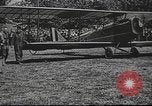
U.S. President Woodrow Wilson at Airmail Service Dedication in Washington DC. and Lieutenant Webb takes off from New York.
U.S. President Woodrow Wilson at Airmail Service Dedication between Washington DC and New York. The new aerial mail service is launched by the Post Office between Washington DC and New York. President talks to the pilot at Washington DC before the take off. The Curtis JN-4 airmail airplane takes off from the Polo field in Washington DC.. At the same time Lieutenant Webb takes off from New York. The airplane halts for six minutes at Philadelphia to collect more mail. The airplane lands New York with the mail after a three hour flight. A man takes out the mail baggage from the airplane.
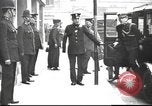
Scenes in London England, following the Armistice ending World War I
U.S. Admiral William Sims, steps from a car and walks toward a building guarded by several British policemen (Bobbies) in London, England. Next, he is seen posing with two of his staff. Scene shifts to London street, where a military officer gives some directions to Winston Churchill who tips his top hat, as he steps into a waiting automobile. In the streets, crowds fill the sidewalks as they watch musicians on the roof of a double-decker bus, celebrate the armistice ending World War 1.
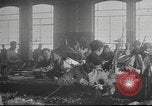
Arms manufacturing in the United States, during World War I
An arms manufacturing plant in the United States during World War 1. War production workers in arms factory woodworking department, manufacture wooden stocks for rifles. Others assemble metal parts of rifles. Still others are seen inserting barrels into wooden rifle stocks. An area staffed almost entirely by women assembling weapon parts. A yard filled with Browning M1917 machine guns.
An armaments factory in the United States during World War I
Men work at fabricating siege mortar shells. A shell blank is heated over a furnace and then transported to a machine where it is formed, while still glowing, into the desired shell shape. A number of finished shells is shown in a yard. Next, men are seen welding the shells. Finally, men are shown filling them with gunpowder. They pound the gunpowder into the shells using wooden rams and wooden mallets (to avoid creating sparks). A worker is seen topping off a shell with gunpowder, from a ladle, pounding it tight, and fastening a cap on the top. (World War I; World War 1; WWI; WW1)
Ammunition manufacturing in the United States during World War I
Men and women work at belt-driven lathes on a crowded machine shop floor in an armaments factory during World War 1. A stack of machined shell cylinders sits on the floor. In another area of the munitions plant, workers are seen with large shells and caps for them. At another machine shop, workers turn large diameter shells in lathes. Camera pans across various work stations where different manufacturing processes are taking place. Closeup of a woman working on a standard size lathe, and of other women working in the machine shop. Men and women sealing hot shells and handling them large tongs. Women working on small caliber ammunition. Women stacking finished shell in trays. Women weighing out gunpowder into sacks, and others loading the sacks into boxes that they dump onto open shells, where women use them to fill shells. A group of women placing objects into shells (fuses?) and sealing them, as a superviser watches. A man taking the shells from a conveyer belt and packing them in boxes. Another area of the plant where items are packed into containers. (World War I; World War 1; WWI; WW1)
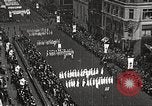
U.S. women nurses parade; Navy Yeomen (female) and women Marines are reviewed, on Red Cross Day, in World War I, May 1918
U.S. Nurses from wartime service units parade on Red Cross Day, in May, 1918, Washington, DC. Views of nurses in white uniforms and others in black, parading on the streets, accompanied by military bands. Red cross flags fly from various places along the streets. A mass of red cross flags near a reviewing stand. Secretary of the Navy, Josephus Daniels, walking with Naval officer and Assistant Secretary of the Navy, Franklin D. Roosevelt, inspecting rows of uniformed U.S. Navy women Yeomen (F) on a field in Washington DC. Behind Roosevelt, is Admiral William Shepherd Benson, the first Chief of Naval Operations (CNO), accompanied by Major General George Barnett, Commandant of the U.S. Marine Corps. The tower of the Post Office Building is visible in background. The women yeomen parade on the field, watched from the sidelines by Secretary Daniels and Assistant Secretary Roosevelt, who is conversing with Admiral Benson. The sequence closes with women U.S. Marines, in uniform, on parade. (World War I; World War 1; WWI; WW1)
CRITICALPAST.COM: About Us | Contact Us | FAQs - How to Order | License Agreement | My Account | My Lightboxes | Shopping Cart | Advanced Search | Featured Collections | Website Terms & Conditions | Privacy Policy ©2026 CriticalPast LLC.
License Agreement |
Terms & Conditions |
Privacy Policy
©2026 CriticalPast LLC.