British car driver Campbell sets new world record. He drives his sport car named Bluebird at 246 miles an hour at Daytona Beach in Florida USA. Other cars escorting the Bluebird. Campbell congratulated.
Film begins showing pristine snow-covered Mount St. Helens in Washington State, U.S.A. View on March 20, 1980, the mountain appears to have less snow on it. Camera pans over the Cascade mountains. Still picture (illustration) of Mount St. Helens erupting in the past. Several hikers are seen sitting on the peak of the mountain. Camera pans over the view, showing Spirit Lake below and, in the distance, Mount Rainier. Slate reads: "Camp Mehan 1959."View of Mount St. Helens overlooking the Y.M.C.A. Boys try rowing a boat with one oar lock unfastened to the gunnel. one boy sailing alone in a small sail boat. Boys playing volleyball. Boys diving from a dock. A camper speaking with a Forest Ranger in the Gifford Pinchot National Forest. Campers in the park at places such as Bear Cove, Cedar Brook, and Donnie Brook. Hikers with full back packs exploring the forest. Campers cooking over a charcoal grill. A man with a fishing rod casting into a lake. Interior of a lodge at the end of a trail. View of Mt. St. Helens in 1979. View of a seismograph recording a moderate earthquake of 4.1 on the Richter Scale, beneath the mountain on March 20, 1980. View of smoke and ash rising from the mountain on March 27, 1980. Forest service vehicles closing roads and access to the Gifford Pinchot National Forest. View from the air, of a newly opened crater on Mount St. Helens. Forest Service workers and cooperating scientists setting up their gear to study the phenomenon. Nearby Ranger stations, such as Pine Creek are seen after being evacuated by the Forest Service. On March 29th, a second crater is seen on the Mountain. Explosive eruptions seen on March 31st. Camera captures these. A bulge in the mountain at Goat Rocks, is show. Narrator states that it is moving at 5 ft. per day. Another view of smoke and ash rising from the mountain. Scientist David Johnson is seen as he describes how the symmetry of the mountain means that volcanic outflows would come down on all sides of Mount St. Helens. A helicopter lowers a large refuse bin to help Spirit Lake youth camp operators hauling out. Outdoor shops are seen hawking Mt. St. Helen souvenirs. On May 18, 1980, a Forest Service tree planting crew is seen at work in a field. Rumbling sounds. A mountain lion is seen running. Tree planters look up as Mt. St. Helens has a violent eruption, which is seen on film, as the field workers run to escape. Narrator states the cloud reached nearly 14 miles into the sky. The cloud and internal bolts of lightning are seen. View of daylight obscured in Eastern Washington. Policeman wearing a face mask, stops a car from proceeding eastward. A helicopter of the 304th Aerospace Rescue and Recovery Squadron depart their Portland Air Base, to search for Geologist David Johnson, who was manning a scientific lookout above Cold Water Creek. View from inside the helicopter in flight. Narrator notes they failed to find him.
A newsreel titled "Universal five wins Olympics basketball final" shows a game between the company team from Universal Pictures and the McPherson Globe Refiners from Globe Oil and Refining Co. of McPherson, Kansas. The McPherson team is sometimes also referred to as the Oilers, or the Refiners. The teams are seen playing in the Olympics Qualifying basketball final in New York's Madison Square Garden. People cheer the two teams. Universal defeats the McPherson Globe Refiners to win the Olympics final. The win entitled the Universal Pictures team to name 7 players to the Olympic basketball team representing the United States in the 1936 Olympics held in Berlin Germany, and McPherson Globe Refiners was able to name 6 players to the team. These two teams beat out five U.S. college teams to earn the spots in the final and determine the makeup of the U.S. Olympic Basketball team. Players in the game in this video clip include Globe Refiners forward Francis Johnson, Centers Willard Schmidt and Joe Fortenberry, and Universal forward Carl Knowles. Universal beat the Globe Refiners by a score of 44 to 43. According to a Time Magazine article of April 13, 1936, the Globe Oil & Refining team, "...have perfected a technique called dunking with which they score by jumping up above the basket, dropping the ball into it." This may be one of the earliest references to dunking, now a staple technique in basketball. The same Time article further stated of the Oilers, "On the defense, they prevent opponents from scoring by batting the ball out of the basket." Again, the Globe Refiners were demonstrating play that later became standard in modern basketball. The idea for the Globe Refiners was a company promotion scheme, thought up in 1934 by Gene Johnson, the Sales Manager of Globe Oil who had several years experience coaching basketball. The Olympic team also included Washington State Huskey player Ralph Bishop. The USA went on to win the gold, defeating Canada 19-8.
Finalists from different countries parade at '1963 Miss Universe' contest at the Miami Beach Auditorium (Miami Beach Convention Center, 1901 Convention Ctr Dr, Miami Beach, FL 33139, United States) in Miami, Florida. Miss Denmark, Miss Brazil, Miss Ireland, and Miss USA walk in the runway. Miss Brazil Iêda Maria Vargas takes title from 15 finalists. Outgoing Miss Universe Norma Nolan of Brazil crowns the winner with the Sarah Coventry Crown. Close view of Miss Brazil Iêda Maria Vargas. Runners-up Miss Denmark Aino Korva, Miss Ireland Marlene McKeown, and Miss Philippines Lalaine Bennett, standing with Iêda Maria Vargas.
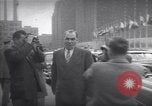
Grace Kelly, Princess of Monaco, visits the United States with her children. The aircraft lands at Idlewild Airport (Present day John F. Kennedy International Airport - Queens, NY 11430, USA). Princess Grace climbs down the air stair of their Pan Am (DC-8-32 “Clipper Caroline”) plane with her two children, Princess Caroline and Prince Albert. A lady-in-waiting, likely Madge Tivey-Faucon, accompanies Princess Grace and her children on the trip. A huge crowd including photographers and press greets her.
Views of construction sites and workers in New York City, under aegis of the Work Projects Administration (WPA) (formerly the Works Progress Administration) during the Great Depression. Several views of work underway with men using shovels at Front Street and Montgomery Street, at East River Drive. Signs at the site read: "USA, Work Program, WPA." Seven story residential apartment building next to work site. Other apartment houses in background. Pedestrians and vehicles passing the work site.
CRITICALPAST.COM: About Us | Contact Us | FAQs - How to Order | License Agreement | My Account | My Lightboxes | Shopping Cart | Advanced Search | Featured Collections | Website Terms & Conditions | Privacy Policy ©2026 CriticalPast LLC.
License Agreement |
Terms & Conditions |
Privacy Policy
©2026 CriticalPast LLC.