


 Francais
 Deutsch
 Italiano
Refine Your Search
Baltimore Maryland USA 1958 stock footage and images
- Showing 13435 to 13440 of 25435 results more
more Hide
Hide
U.S. Army Air Corps aircraft in flight and drop bombs on a battleship underway at sea in the United States.
U.S. Army Air Corps aircraft in formation flight in the United States. A Wright Brothers aircraft in flight. A flight line area and early model aircraft parked in a long row. A pilot and ground crew stand in front of the aircraft. Hangars in the background. A commanding officer turns around and gives signal for men to board the aircraft. A formation of early aircraft flies low over a field. A formation of nine U.S. Army Air Corps Keystone LB-5A in flight. Two formations of bomber aircraft in flight. The fighter aircraft maneuver. The bombers in formation. Men hidden in a clump of trees. A formation of bombers overhead. Troops fire rifles at the aircraft. A fighter aircraft flies over an open field and lays a smoke screen. Ground soldiers advance across the open field. They are hidden by the smoke screen. Several early model aircraft take off together. The aircraft in flight overhead. Formations of bombers overhead. Fighters flying top cover. A battleship underway at sea. The battleship firing heavy guns. A formation of LB-5A in flight. The fighters are above the bombers. Bombs fall toward a simulated battleship in a desert area. A bomb strikes a battleship in water. Direct hits and misses scored upon the vessel. A formation of early model two engine bombers Curtiss models with twin wings and twin tail in flight overhead. A bomber aircraft shows a bombardier's hand throwing a switch releasing bomb load. The bombs explode on a bridge.
An army aircraft sprays poisonous powder over a cotton field to kill boll weevil in Griffin, Georgia.
Boll weevil is examined at a Chemical Warfare Laboratory in Griffin, Georgia. Men in a laboratory examine the boll weevil A cotton field. Men at work in the cotton field. A boll weevil. A U.S. Army aircraft. The crew members prepare the aircraft for a take off.. The army aircraft spray poisonous powder on cotton fields.
Farmers harvest grains, transfer grains to barges and the grains being unloaded at a seaboard terminal in the United States.
The benefits to farmers in the United States from the Inland Waterways Corporation System (IWC). Crops grown in a farm. Horses tow a harvest machine. Farmers on the harvesting machine. They harvest grains. A farmer rides a horse dawn carriage which is loaded with grain. A train on tracks. Smoke comes out from an engine. Grains come out of an elevator and are transfered to IWC barges. The barges at a seaboard terminal. Buildings in the background. Grains being unloaded from the barges at the sea board terminal.
A U.S. soldier demonstrates the use of a U.S. Army air mask in the United States.
A training film shows how air is purified by the U.S. Army gas mask in the United States. A U.S. soldier holds a U.S. Army gas mask in his hands. The soldier points out his finger on the part of the mask from where the poisonous air comes in. He holds a box. The soldier points out at the tube of the mask. He points at a mouthpiece and puts it in his mouth. The outlet valve of the mask. He shows the nose clip and puts the mouthpiece in his mouth and nose clip on his nose. He then holds the nose clip in his hand, puts it on his nose and then removes it.
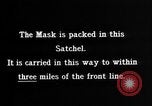
A U.S. soldier demonstrates how to carry a mask and wear the mask in an alert position during World War I.
A World War 1 training film shows how to carry and don a gas mask. A U.S. soldier stands at attention. He carries a mask in a satchel. The satchel is slung over the shoulder of a soldier. He shows the satchel. He turns. The soldier demonstrates the way to carry the satchel in trenches. The satchel is slung around his neck. He opens the satchel, takes out a string and ties it around. He opens the satchel and takes out the mask . He puts his chin forward and wears it.
German prisoners of war board a bus at Camp Evelyn and get down in forest area in Munising, Michigan.
Activities of German prisoners of war at Camp Evelyn in Munising, Michigan during World War II. The prisoners of war get on a bus at the camp. The prisoners are wearing coats and woolen hats. They get on the bus. Snow covered area in the background. The prisoners get off from the bus in a forest area. A prisoner holds a saw in his hand and stands. German prisoners chop huge pine trees with axes and saws.
CRITICALPAST.COM: About Us | Contact Us | FAQs - How to Order | License Agreement | My Account | My Lightboxes | Shopping Cart | Advanced Search | Featured Collections | Website Terms & Conditions | Privacy Policy ©2026 CriticalPast LLC.
License Agreement |
Terms & Conditions |
Privacy Policy
©2026 CriticalPast LLC.