


 Francais
 Deutsch
 Italiano
Refine Your Search
Baltimore Maryland USA 1958 stock footage and images
- Showing 13711 to 13716 of 25435 results more
more Hide
Hide
U.S. President Eisenhower briefs press about his 2 1/2 week trip to nine countries during a press conference in Washington DC
U.S. President Dwight Eisenhower's 175th press conference in Washington DC, United States. Several correspondents from different nations arrive for the President's 175th press conference. Men prepare cameras mounted on tripod stands at the back of a hall. President Eisenhower with an official walks past the newsmen seated in the hall. The President makes an announcement of his two and a half weeks' trip starting from December 4, 1959. The newsmen taking notes. The President says that he would be visiting nine countries and would be making brief informal visits to Rome, Ankara, Karachi, Kabul and would be in New Delhi for the inauguration of the American Exhibit at the World Agricultural Fair on December 11. He says he will visit Tehran and Athens on his way to Paris for the Western Summit meeting. He gives details of the 3 main days. December 4 - when they would be developing legislative program for the coming year, December 11 - the beginning of the World Agricultural Fair, and December 19 - when he would be in Paris for a meeting. A newsman asks the President the purpose of this extensive visit. The President states the importance and need of being the first U.S. President to make an extensive visit to a strategic continent like Asia. He expresses his interest in visiting India and millions of people who are struggling to raise their standard of living. He says that he will visit Pakistan, Afghanistan, Iran and other nations on the way. The President further says that he hopes to build in that region of Asia and in many other parts, a better understanding of the United States. A correspondent asks the President whether Mrs. Eisenhower and his family members would be joining him for the visit. The President says that some of his family members would be joining him but may be not his wife.
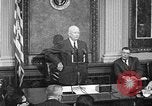
U.S. President Dwight Eisenhower talks about fixed or rigged TV quiz shows during his 175th press conference in Washington DC.
U.S. President Dwight Eisenhower's 175th press conference in Washington DC, United States. One of the pressmen present at the conference asks the President if he could give his reaction to the House Committee testimony dealing with fixed TV quiz shows. The President says that he shares American general reaction of bewilderment that people could conspire to confuse and deceive American people. He says that as soon as he heard about it he asked the Justice Department to see whether there were any laws violated and what they could do and whether they should propose any new laws. The President says that the Justice Department tells him that it would give its conclusion soon. The Federal Trade Commission has moved into it since this seems to be deceitful advertising and they seem to have some function in correcting it. The President also says that everybody was astonished and dismayed when they heard about it and he thinks that the producers, performers and the actors and the public would be satisfied only when the mess is cleared up. The pressmen take down notes during the conference.
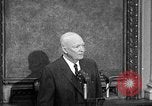
U.S. President Dwight Eisenhower answers a query on Communist menace in Cuba during a press conference in Washington DC.
U.S. President Dwight Eisenhower's 175th press conference in Washington DC, United States. One of the pressmen asks the President that a note delivered to the Cuban Government had a discussion on the menace of communism. He asked the President as to why it was included in the note. The President says that he thinks Communism to be a very obvious subject to bring up whenever there is a troubled area where it might take hold. Everybody knows that the Communists like to fish in troubled waters and there are certainly troubled waters in Cuba. He says that he thinks it wouldn't have been right if anything had not been mentioned to call attention to the seriousness of the Communist menace.
U.S. President Dwight Eisenhower answers a query on the spirit of Camp David during a press conference in Washington DC.
U.S. President Dwight Eisenhower's 175th press conference in Washington DC, United States. One of the pressmen asks the President that in the discussions about a date for an East-West summit conference with General Secretary of the Communist Party of the Soviet Union Mr. Nikita Khrushchev the point arises to preserve the momentum at the end. The Russians talk about the need to preserve the spirit of Camp David. He asks the President what he would like to maintain -- the spirit of Camp David or the momentum. The President says that he has heard of the expression the spirit of Camp David but he does not know what it means. He says that whenever he and Mr. Khrushchev spoke, they spoke in principle and in generality more. There was an agreement when they spoke about problems which the ministers will very likely take up. The President says he thinks that the spirit of Camp David must mean that they can talk together without being mutually abusive. About momentum, he says that that was a word used in discussions on development of foreign relations and agreements. If momentum is kept up it helps not to be rushing into things without being fully prepared.
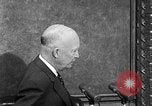
U.S. President Eisenhower answers a query on internationalizing the Panama Canal during a press conference in Washington DC.
U.S. President Dwight Eisenhower's 175th press conference in Washington DC, United States. President Eisenhower stands in front of a microphone before the newsmen during the press conference. One of the press women asks the President if he agrees to the internationalizing of the Panama Canal and whether he was considering building another canal in that area and if they did would they be able to hold it. Pressmen seated at the conference. The President says that the second question takes a lot of study but for the previous 14 years he has been in favor of building another canal, but that was something that he shall not recommend. Regarding the internationalizing of the Panama Canal he says that it is something he would not even think of at that moment. He says that they have got a treaty with Panama, the provisions of which have been obeyed and they have had a model relationship with Panama for the last 50 years. He says that he believes that a particular incident should not become a reason for breaking a relationship that has worked so well. View of the pressmen talking. The President talking to the officials and the pressmen.

The U.S. Army Quartermaster Corps with their loads of supplies at times of war overseas (during World War 2).
The United States Army Quartermaster Corps in the United States during World War 2. Supplies for the Quartermaster Corps like boots, dresses, cigarettes and hardware. A tent encampment. A soldier standing in a wooded region. An officer seated at a table in an office. The flag with the Quartermaster Corps insignia flutters from a pole. Point of view shot at nearly eye level with large column of U.S. Army soldiers marching toward camera position, holding rifles as they march in formation. The soldiers eat seated at tables in a dining hall or mess area. The Quartermaster Corps unload boxes of supplies during a war overseas. A number of boxes of supplies on a beach. Several Quartermaster Corps unloading boxes from landing crafts on the beach. View of a pair of boots which is part of the necessary uniform equipment. A large number of cabbages in a heap. Pieces of hardware hung on stands on a wall. The boxes of supplies are stacked in a store before distribution. The corps distributed uniforms. United States Army Soldiers on tanks moving on a path. The soldiers arrive at landing crafts on a beach. Large columns of U.S. Army soldiers march in formation. Women's Army Corps (WAC) and nurses move in formation. Women working in textile webbing factory with large spools of webbing or string during manufacture process. The soldiers march. Ships in a harbor. Supplies at a dock for army and navy requirements.
CRITICALPAST.COM: About Us | Contact Us | FAQs - How to Order | License Agreement | My Account | My Lightboxes | Shopping Cart | Advanced Search | Featured Collections | Website Terms & Conditions | Privacy Policy ©2026 CriticalPast LLC.
License Agreement |
Terms & Conditions |
Privacy Policy
©2026 CriticalPast LLC.