


 Francais
 Deutsch
 Italiano
Refine Your Search
Baltimore Maryland USA 1958 stock footage and images
- Showing 15919 to 15924 of 25435 results more
more Hide
Hide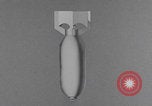
Animation depicts bombs used by the United States Army during WWII
Types of explosive bombs used during World War II. Animation of an “explosive bomb” depicting its anatomy and mechanism. High explosives are seen inside the bomb. Animation shows a bomb falling and exploding on impact, creating a crater. A cartoon showing the five sizes of demolition bombs compared to a soldier. The largest demolition bombs weigh around 1000 lbs. and 2000 lbs. The smaller demolition bombs weigh 500 lbs., 300 lbs., and 100 lbs. A 100 lbs. demolition bomb packed in an angle iron crate.

Ordinance Department personnel fits tail on bomb during WWII
Personnel from the Ordinance Department handling and packing bombs during World War 2. An Ordinance Department personnel fits the tail into a 100 lbs. explosive bomb. Nose plug of a bomb. Animation depicting fragmentation, demolition, chemical (except phosphorus) and chemical phosphorus bombs. A hand points to the table of contents of the Ordinance Department Training Regulation. Pen underlines “Quantity-distance tables”. A scene depicting the ideal distances between military establishments, inhabited buildings, railways, public highways and fuzing area for bombs.
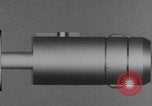
Animation depicts bomb fuse safety, internals of bomb used during World War II
Animation depicting the safety of bomb fuses used during World War 2. An artistic rendition of a bomb’s fuse. Animation depicts the inner parts of the fuse- the pin, striker, arming pin, arming spring, and arming wire. Animation shows the arming wire withdrawn, causing the arming spring to fall and ejects the arming pin. Sheer wire inside fuse is resistant to air pressure but light enough to break upon impact. Pin breaking through the sheer wire upon impact, detonating the fuse.
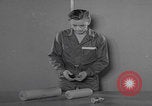
Man assembles a fragmentation bomb during World War 2.
A man assembles a fragmentation bomb used by the United States during World War 2. Man assembles bomb by hand. The man unscrews the screw in the bomb body. Man fastens the parachute container over the fragmentation bomb. The adaptor is screwed and tightened. The man puts down the fragmentation bomb. Man uses a screwdriver to tighten bolt to complete rear assembly. Man proceeds to fuze the bomb. Man removes closure plug, inserts and tightens the M104 fuze.
Man assembles a fragmentation bomb; bomber drops bombs during World War 2.
A bomber flying at low altitude. Bomber drops fragmentation bombs in flight. Parachutes delay the descent of fragmentation bombs. Fragmentation bombs fall with parachutes. A man assembles pins on fragmentation bomb. Man loosens a set screw of fragmentation bomb using a screwdriver. The fin assembly is placed into the tail of the bomb body. The fin turns carefully into the bomb body. Man locks the fin and bomb body into place by tightening the set screw.
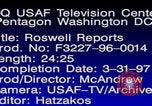
United States Air Force propaganda film about the Roswell Incident and Project Mogul weather balloon experiments.
The Roswell incident according to the United States Air Force. Roswell Daily Record newspaper shows article about flying saucers. Popular books on the Roswell incident such as “Roswell Ufo Crash Update: Exposing the Military Cover-Up of the Century” and “A History of UFO Crashes” by Kevin D. Randle and “The Roswell Incident” by Charles Berlitz. Magazines People and Omni featuring UFO stories. The International UFO Museum (114 N Main St, Roswell, NM 88203, United States) in Roswell, New Mexico. An “EYES ONLY” document prepared for President-Elect Dwight D. Eisenhower. Forensic experts examine a strange body believed to be alien remains. Foreign books on the Roswell incident written in French and Japanese. A New Mexico magazine shows a UFO flying saucer and the words “UFO The Roswell Incident” on its cover. The sliding door of the United States Air Force archives closing. New Mexico Congressman Steven Schiff on a newspaper article about UFO. View of the United States Capitol in Washington DC. The Washington Post January 14, 1994 article with title “GAO Turns to Alien Turf in Probe”. An accompanying photo depicts a flying saucer and alien remains. View of the Pentagon. A man and a woman uncover records and files from a United States Air Force archives. Archive shelving inside the United States Air Force. Archivists pushing a trolley. Map shows the location of Roswell in New Mexico. Pages of a report being flipped. Page of a report reads “WHAT THE ROSWELL INCIDENT WAS NOT”. Another page reads “An Extraterrestrial Craft”. Page of a report reads “to project “Mogul” be classified “TOP SECRET”. An atomic bomb explosion with red skies in the United States. The Japanese bombing of Pearl Harbor on December 14, 1941, during World War 2. Debris and fire from surprise attack. An acoustic sensor used in Project Mogul. A radar reflecting target being carried by a white weather balloon during Project Mogul. Weather balloons on the beach. A scientist holds a radar target tied to a weather balloon. Scientist lets go of the weather balloon with radar target. A man standing on top of a United States Army bus with satellite dish observe the weather balloon flying upwards. Photographs of “flying disk” fragments from Roswell in 1947. A man holds a fragment claimed to be from a “UFO”. “Flying Disk” debris that are debris made of aluminum foil, rubber, paper, and sticks. Army Air Force officials identifying debris from radar targets and weather balloons found in Roswell. Brigadier General Roger M. Ramey, Commanding Officer of the Eighth Air Force, inspects the remains of a weather balloon and Rawin radar target on July 8, 1947. Colonel Thomas J. DuBose, the Chief of Staff of the Eighth Air Force, sits on the right. Roswell Daily Record front page reads “Gen. Ramey Empties Roswell Saucer”. Brigadier General Roger M. Ramey with weather balloon debris.
CRITICALPAST.COM: About Us | Contact Us | FAQs - How to Order | License Agreement | My Account | My Lightboxes | Shopping Cart | Advanced Search | Featured Collections | Website Terms & Conditions | Privacy Policy ©2026 CriticalPast LLC.
License Agreement |
Terms & Conditions |
Privacy Policy
©2026 CriticalPast LLC.