


 Francais
 Deutsch
 Italiano
Refine Your Search
Baltimore Maryland USA 1958 stock footage and images
- Showing 19549 to 19554 of 25435 results more
more Hide
Hide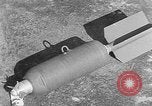
Optimum mix of fragmentation and incendiary bombs is determined during tests at Eglin Field, Florida, during World War II
Conclusions of tests conducted by U.S. Army Air Forces, at Eglin Field, Florida, seeking best way to attack Japanese homeland during World War 2. Actor Lee J. Cobb, portraying an Air Force Captain, smoking a pipe in his "office." Views of M-41 fragmentation bomb and a bundle of M-69 incendiary bombs. The Captain holds a model of a B-17 bomber and uses it to discuss bombing techniques. B-17 in flight. Views of effects of fragmentation bomb, showing numerous small holes produced by it. Aerial view of the test area houses. Mixture of M-69 incendiary bombs and M-41 frag bombs being dropped by the plane on the test area. Various views of resulting damage and effects. Test report is shown, concluding that demolition bombs are not effective against congested wooden structures; that M-41 frag bombs deter early firefighting efforts; and that a mix of 80 percent M-69 incendiaries and 20 percent M-41 frag bombs is optimum. Views of Japanese cities burning, from such bombing, during the war.
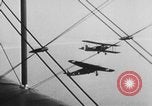
The U.S. Army Air Service Fokker C-2A named "Question Mark" being refueled in midair from a Douglas C-1, in 1929.
Mid air refueling experiments in January, 1929. A U.S. Army Air Service Douglas C-1 tanker plane, with hose trailing below it, flies above a modified Atlantic-Fokker C-2A named "Question Mark." The hose is let down to the Question Mark, where a crew member seizes it and makes a connection for fuel transfer. After transfer of fuel is complete, the crew member throws the fuel line off and it is retrieved by the tanker plane. The Question Mark lands at Metropolitan Airport, Van Nuys, California on January 7, 1929, and taxiis in to park. The crew members, including Major Carl A. Spaatz, Captain Ira C. Eaker, Lieutenant Harry A. Halverson, Lieutenant Elwood R.(Pete) Quesada, and Staff Sergeant Roy W. Hooe, all exit the airplane and gather under the wing with well wishers. The five crew members pose for photographs beside their airplane, the "Question Mark." Ground crew tows the aircraft with a tractor.
Launching of the USS Iowa (BB-61) in New York, and of her sister ship, USS New Jersey (BB-62),in Philadelphia, during World War II..
Camera pans vertically from top to bottom over the bow of the USS Iowa (BB-61) as she is ready for launching at the Brooklyn Navy yard in New York City, on August 22, 1942. Sponsor of the ship, Ilo Browne Wallace, wife of Vice President Henry A. Wallace, Christens the Iowa by breaking a bottle of champagne over her bow, and the ship moves down the ways toward the East River. The Williamsburg Bridge is seen dimly in the background, as the Iowa plunges into the water. Camera focuses, next, on the USS New Jersey (BB-62) ready for launching at the Philadelphia Navy Yard on December 7, 1942. Men knock supports from below the New Jersey, in preparation for her launching. Next, she is seen moving down the ways. Closeups of some shipyard workers smiling as the New Jersey is launched. The New Jersey is seen well out into the Delaware River, with some smoke rising from one of her funnels. (World War 2, WWII, WW2)
American citizens celebrate "I am an American Day" in New York City during World War II.
Opening slate reads “New Americans Celebrate their Citizenship.” Huge Crowd is gathered in New York City’s Central Park, on “I am an American Day,” which also includes newly naturalized American citizens (although they are not featured, as such, in the film). New York Mayor, Fiorello LaGuardia, presides and delivers a speech from a podium. New York clergymen are seated with one another on a front row seat where patriotic bunting is draped. Vice President Henry R. Wallace is also seen in that front row. Various views of U.S. military units parading along 5th Avenue in New York City. The units include huge columns of United States soldiers, including one large group of African American soldiers.
People line the railroad tracks as the funeral train leaves Warm Springs, Georgia.
Shows the Capitol building in Washington, D.C., as Franklin D. Roosevelt's voice is heard in the background. American flag flying at half mast. American flags on other buildings. Women on wheelchairs outside building. People line rail road tracks as the funeral train leaves. British and Soviet flags at half mast.
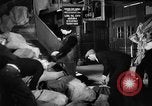
Mail transported by train and airmail by airplanes.
United States Post office employees sort mail sacks filled with letters. A locomotive train approaching camera position and passing by at high speed. Map of United States connecting destinations and a flying plane. A man examining models of various airplanes used for air mail service. Shows postmaster General James A. Farley emerging from a plane with other men to examine the latest technology and advances in airplanes for airmail service. View of exterior of Newark Air Mail Post Office building. Men emerging from plane. A plane takes off. Men load postal mail sacks on plane. View of a pilot reenacting the look of one of the original night mail pilots.
CRITICALPAST.COM: About Us | Contact Us | FAQs - How to Order | License Agreement | My Account | My Lightboxes | Shopping Cart | Advanced Search | Featured Collections | Website Terms & Conditions | Privacy Policy ©2026 CriticalPast LLC.
License Agreement |
Terms & Conditions |
Privacy Policy
©2026 CriticalPast LLC.