


 Francais
 Deutsch
 Italiano

Refine Your Search
Baltimore Maryland USA 1958 stock footage and images
- Showing 193 to 198 of 25463 results more
 Hide
Color Sound
New President Lyndon Johnson in a file interview talks about his contributions to public life in United States
Newly appointed President of United States Lyndon Johnson in a file television interview as the then Vice President at his ranch in Texas. He talks about his achievements in public life over the years. He speaks about how as a Senator he worked for the many causes including construction of a dam over the Colorado River, Civil Rights Bills, and his role in the Johnson-McCormack act in 1958. He also talks about his contribution to various ongoing projects like equal employment,man on moon program.
U.S. Air Force Strategic Air Command aircraft stationed in various parts of the world.
Klaxon horns sound alert signals and U.S. Air Force Strategic Air Command (SAC) flight crews, on alert, stop what they are doing and rush from their quarters to jeeps, that take them to their aircraft. They are seen clambering aboard their bomber aircraft. Closeup of a B-47E-30-LM Stratojet bomber, tail number 52-264, taxiing. Closeup of its wheels. The B-47 taking off from a base in the continental United States. In Alaska, a B-52 bomber taxis on a plowed taxiway in a snowy airfield. Local people watch as two B-52 bombers take off from a SAC base in Africa. Formations of B-52 bomber in flight. View of Air Force personnel inside the SAC headquarters Command and Control Center at Offutt Air Force Base, Nebraska. Scene shifts to a B-47 bomber flying directly overhead and an Atlas missile being launched. Glimpse of pilot and copilot inside the cockpit of a SAC bomber in flight. A nuclear bomb dropping from an open bomb bay viewed from inside the aircraft. An atomic explosion during one of the tests conducted by the United States, in the Pacific, from 1946 to 1958.
Barrel jumping on ice at Grossinger's Resort in the Catskill Mountains of New York State
Contestants line up for 7th annual barrel-jumping event at Grossinger's Catskill Resort in the Catskill Mountains, near the Village of Liberty, New York. They skate toward the camera. Spectators watch the event. Behind them is posted a contestant's name, "Coallier," and the mumber of barrels he will attempt to jump (14). Officials in striped shirts stand near a line of barrels as a skater Speeds toward them and clears all but the last and falls upon landing. Another skater tries, but lands in the midst of the barrels. Several more barrel jumpers are seen, most failing to clear all the barrels in their attempts. But even those who do, end up sliding across the ice into barriers designed to cushion their impact. Finally, the defending champ, Leo Lebel, of Hartford, Connecticut, who also won in 1956, clears 16 barrels to win the event. (Note: Leo Lebel went on to win this event in 1958 and 1959, as well.)
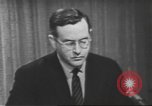
Vice President Nixon and Senator Kennedy debate over Quemoy and Matsu issue prior to presidential elections in the U.S.
The fourth presidential election debate held between Democratic nominee Senator John F. Kennedy and Republican nominee U.S. Vice President Richard Nixon in New York, United States on 21st October 1960. ABC News correspondent Quincy Howe speaks during the debate and allows NBC correspondent John Chancellor to pose a question to Richard Nixon a . Correspondent Chancellor asks a question about Quemoy and Matsu issue. Vice President Nixon points out inconsistency of Senator Kennedy. He further explains it by saying that Senator Kennedy signed a resolution in 1955 which gave the president the power to use United States forces to defend Formosa (Taiwan) and offshore islands. But he also voted for an amendment which was lost, an amendment which would have drawn a line and left out those islands. Vice President Nixon supports President Eisenhower's position. Correspondent Howe asks Senator Kennedy to comment on the topic. He speaks about President Eisenhower sending a mission to persuade Chiang Kai-shek in the spring of 1955 to withdraw from Quemoy and Matsu because they were exposed. The President was unsuccessful. He refers to the fact that in 1958, as a member of the Senate Foreign Relations Committee, he was very familiar with the position that the United States took in negotiating with Communist China (PRC) on these two islands. He further that the U.S. was unable to persuade China's Chiang Kai-Shek to withdraw and thus it was decided by the U.S. to defend the islands.
George Edward Pendray launches The American Interplanetary Society's first liquid fueled rocket from Staten Island in New York, United States.
The American Interplanetary Society's first liquid fuel rocket is launched from Staten Island in New York, United States in 1933. George Edward Pendray of the AIS, and his associate preparing for the launch. The 7 1/2 foot rocket is placed on a stand. Other men look on. The rocket, fueled with gasoline and liquid oxygen, takes off. Its fuel tank overheats and explodes moments after takeoff and the rocket crashes to the beach below. (From a November 10, 1958 newsreel recounting events 25 years earlier. The world's first successful liquid fuel rocket was launched by Robert Goddard in Auburn, Massachusetts, on 16 March 1926. This film records the first such attempt under auspices of the American Interplanetary Society, in 1933. )
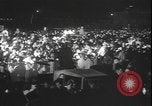
Flight achievements of 1933 - Wiley Post completing solo journey around the world and Roscoe Turner speed record coast-to-coast
American aviator Wiley Post returns to Floyd Bennett Field in New York after completing his solo flight around the world in a just under 8 days. People gather in a large number to welcome him. They gather around his aircraft. Scene shifts to streets of New York City where Wiley Post is honored with a ticker tape parade for his Around The World achievement. The aviator seated aboard a jeep passing by. People celebrate and greet him. He is bestowed with the Medal of Valor by New York City Mayor John P. O'Brien. Next segment shows plane of American aviator Roscoe Turner landing, after his record-setting flight from New York to Los Angeles in 10 hours and 5 minutes flying his Wedell-Williams Model 44 (WW-44) aircraft. This won him the 1933 Bendix Trophy. Close view of Roscoe Turner smiling from the cockpit of his aircraft. From a November 10, 1958 newsreel recounting events 25 years earlier.
CRITICALPAST.COM: About Us | Contact Us | FAQs - How to Order | License Agreement | My Account | My Lightboxes | Shopping Cart | Advanced Search | Featured Collections | Website Terms & Conditions | Privacy Policy ©2026 CriticalPast LLC.
License Agreement |
Terms & Conditions |
Privacy Policy
©2026 CriticalPast LLC.