


 Francais
 Deutsch
 Italiano
Refine Your Search
Baltimore Maryland USA 1958 stock footage and images
- Showing 2299 to 2304 of 25435 results more
more Hide
Hide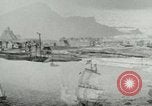
Series of still illustrations showing early phases of colonization and tracing American immigration and development from 17th Century to 19th Century.
Film shows early sailing ships near New Amsterdam and the initial layout of the city. Scene transitions to larger later map of the city. Numerous views of illustrated 17th century sailing ships in various conditions including severe storms at sea. Deck plan of a slave ship with maximum number of occupants shown in extreme close quarters. Ship deck filled with persons immigrating to America. American harbors filled with sailing ships. A skirmish at outset of American Revolution. Scene of American frontier wilderness with images of plow and flintlock rifle overlaid on it. Settlers traveling on river in a barge. The Boston massacre of March 5, 1770. City policemen subduing rioters. Settlers heading west in wagons. Immigrants leaving foreign shore board a ship. View of them on deck of the ship to America. New York City waterfront in 19th Century with sailing ships lined up side-by-side and pier clogged with cargoes. Workers on construction project using makeshift wooden plank bridges to traverse stream and work at the job site. Views of various building tradesmen engaged in construction project. View of city harbor filled with ships, now including some steam ships, and many substantial buildings.

Still photos show America from 1876 through the turn of the century, focusing on immigrants, westward expansion, hard labor, and pioneer spirit.
Newspaper headlines from 1876 note Kansas as a territory for pioneer settlement...."Farms and Homes in Kansas!" and "To the Black Hills" Farmers with their families in front of prairie homes. Barn raising. A village along the side of a river. School children. A child's coffin. Men drinking together. A string quartet. A man making violins. Railroad construction crews laying rails, clearing rocks, and building trestle bridges, including Chinese workers and laborers during expansion or railway to the west. European immigrants on ships and just arrived on land, possibly at Ellis Island. Logging camps and loggers cutting trees. Large scale farming and market. Coal mining and other mining activities. Child coal miners and child labor. Industrial steel forging. Factory with train switch yard. Immigrant ghettos in American cities. Immigrant women sewing piece work. Immigrant children.
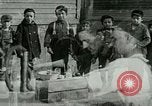
Montage of scenes regarding worker's rights, early labor disputes in the U.S., and the 1963 March on Washington for Jobs and Freedom
Clip opens with footage of factory workers in an American factory in the early 1900s operating machinery or assembly operations. Next scene shows American workers demonstrating for better working conditions during a time of labor strife circa decade of 1910. American workers hold a sign that says, "8 hours rest and 8 hours sleep." Next scene shows a family bundled in warm clothing on a cold day, riding on a sled in a winter outdoor area. Their faces look desperate and they appear to be cold. Next brief scene of only a few seconds shows two different bearded Jewish men being helped down or possible pushed down from a stand or stage (the context is not clear). Next scene briefly shows a couple kissing. Next scene shows scenes from the March on Washington for Jobs and Freedom, in August 1963. Camera shows crowd assembled on Washington Monument grounds, and also shows marchers with signs such as "We march for higher wages" as they are seen marching in the street. Close-up views of faces of various protestors and attendees, both white and African American, and young and old, as they listen to speeches delivered from the steps of the Lincoln Memorial during the event.
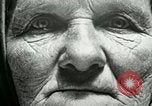
Close-up views and still photos of faces of various Americans in the early 1900s
Ordinary people, immigrants, and citizens of the United States in the early 1900s. An old woman, a man with a hat, a man with a cigar in his mouth. His son reads a book. A farmer with his wife. A woman in her traditional dress and a father with his daughter on a chair. Credits for the documentary.
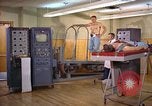
Brigadier General James Stewart observes pilots being physically tested and examined at the U.S. Air Force Aerospace Research Pilot School in Edwards Air Force Base, California.
Interior of a physical testing and examination room at the U.S. Air Force Aerospace Research Pilot School in Edwards Air Force Base, California. A white coated physician or technician observes as a pilot begins walking on a treadmill. The pilot has instruments fastened to his wrists and waist to transmit data to large machines standing nearby. Another pilot is lying, strapped to a cot in the room. That cot begins to rotate, placing the occupant in a head-down position, just as Brigadier General James Stewart enters accompanied by a guide in a business suit, who points to the heads-down pilot and explains something about what is happening. At this point, the entire sequence is re-shown. And it is repeated once more, again. Closeup of General Stewart speaking, as the pilot on treadmill continues walking in the background. Stewart looks down at the pilot (not seen) on the tilted cot and then turns toward the pilot on the treadmill, and finally, back, again, to the man (not seen) on the tilted cot.
X-15 on ground. Bell X-1 mach 1, October 14, 1947. The X-1D, nose wheel collapse, July 24, 1951
The high frontier of X-15 in United States. Rocket powered aircraft X-15 is towed and taken out from a hangar. Various symbols on X-15. A sign reads 'North American Aviation Inc'. Models of aircraft from earliest to most recent are shown. B-29 launching Bell X-1 rocket plane on October 14, 1947. View inside cabin of B-29. Airspeed indicator in the X-1 shows Mach 1 plus. View of X-1D rocket plane landing in Mojave desert, July 24, 1951, as nose wheel collapses and the plane sends up plumes of sand as it spins around before coming to rest, facing backwards. Test pilot Jean Ziegler is seen afterwards in the cockpit, breathing a sigh of relief. Jet fighter seen exceeding mach 2 airspeed. Animation of B-52B Stratofortress launching X-15. and its landing on desert.
CRITICALPAST.COM: About Us | Contact Us | FAQs - How to Order | License Agreement | My Account | My Lightboxes | Shopping Cart | Advanced Search | Featured Collections | Website Terms & Conditions | Privacy Policy ©2026 CriticalPast LLC.
License Agreement |
Terms & Conditions |
Privacy Policy
©2026 CriticalPast LLC.