


 Francais
 Deutsch
 Italiano

Refine Your Search
Baltimore Maryland USA 1958 stock footage and images
- Showing 439 to 444 of 25463 results more
 Hide
Color Sound

Baseball players train in northern U.S. states during World War II, 1943
Newsreel clip entitled "Ball Players Train in North" shows major league baseball teams holding spring training in 1943. Teams were not allowed to travel south to Florida because of World War 2 travel restrictions. First part of clip shows men (presumably baseball players) riding in a horse and buggy along a tree-lined road. Giants seen running on field and meeting with manager and Hall of Fame outfielder Mel Ott. Players pose for camera, all wearing long sleeves. Closeup of Giants Hall of Fame pitcher Carl Hubbell. Giants players seen throwing at posters of Benito Mussolini, Adolf Hitler and Hideki Tojo -- Leaders of the Axis powers during the war. Players look at the posters after throwing; note patriotic war patch on Giant player's sleeve. Clip shifts to Washington Senators training camp the same year. Coach and renowned baseball clown Nick Altrock leads players in warmup drills. Players warm up in outfield, near what looks like a heating plant. Closeup of Senators pitcher Dutch Leonard throwing. Closeup of Senators owner Clark Griffith (in overcoat) talking with manager Ossie Bluege. Closeup of Bluege. Players marvel over of 7-foot player Richard Ahrens, who was signed by the Senators that spring as a possible publicity stunt; he never appeared in a minor or major league game. Washington players pretend to warm themselves up by small campfire on the field. Another shot of Altrock. (Note: There is no indication where these clips were taken but the Giants trained in Lakewood, New Jersey that spring and the Senators trained in College Park, Maryland. )

Truman Administration members and politicians play golf with celebrities near Washington DC.
Members of President Truman's administration and other politicians and celebrities play, with golfing professionals, at Columbia Country Club, Chevy Chase, Maryland, near Washington DC. Among the notables seen are: Margaret Truman, the President's daughter; General Omar Bradley; Senator Robert Taft; and singer-movie star, Bing Crosby, who sinks a putt and winks at the camera.

President Richard Nixon presents a car to Soviet leader Leonid Brezhnev at Camp David during his visit to United States.
Leonid Brezhnev, General Secretary, Communist Party of the Soviet Union, visits United States and meets with U.S. President Richard Nixon. A 1973 Lincoln Continental presented by President Richard Nixon to Leonid Brezhnev. A secret servicemen near the car. President Nixon's residence 'Aspen House' at Camp David, Maryland. President puts on a rain coat and meets Brezhnev at the house. The leaders sit in a 1972 Cadillac Limousine and drive away.

U.S. soldiers decontaminate combat vehicles and tanks during training; also flashback WW1 mustard gas aftermath scenes
World War 2 training film teaching U.S. soldiers about decontamination of combat vehicles, at Aberdeen Proving Grounds in Maryland. Soldiers during a decontamination procedure with real mustard gas. The soldiers in armored vehicles. A group of soldiers prepares for the decontamination. An aircraft flying at low height. A stationary U.S. Army Pershing tank. Two soldiers in a jeep. Soldiers wearing gas masks decontaminate a vehicle. Flashback scenes to August 1918 in World War I in France, with many mustard gas attack victims being cared for at a field hospital (which narrator says is Field Hospital number 326). Medic washing eyes and face of a World War 1 gas attack victim. Next view is a soldier in 1942 with mustard gas burns on his hand, being treated by a medic. Next scene returns to World War 1 in 1918, showing mustard gas burns on arms, hands, legs, and feet of U.S. Army soldiers.
Various Chemical Companies of the United States Army during World War II.
A film based on chemical warfare arsenals in the United States and various Chemical Companies of the U.S. Army during World War II. U.S. Army officers walk out of a building at the Edgewood Arsenal in Maryland. Training for U.S. Army officers and enlisted men in the Chemical Warfare Service schools at the Edgewood Arsenal. An explosion as a part of a test. An instructor puts on a gas mask. Officers attend classes. U.S. Army officers enter a chemical warfare board and stand around an officer seated holding a chemical warfare equipment to be sent for future developments. A flame thrower is tested by men. Men work in a Training Aid Station at the Edgewood Arsenal. Personnel supervise making of film strips at the Training Aid Station. U.S. Army Chemical Battalion soldiers march along a road. Gun crews fire mortars. Chemical Air Operations Companies assigned to the U.S. Army Air Force work at an air base. A Smoke Generator Company and a Chemical Field Processing Company. Use of smoke screens in World War II by the U.S.
Bombing runs are conducted on practice target USS Alabama, BB-8, destroying the ship
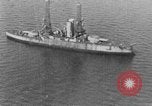
USS Alabama (BB-8) serves as a bombing practice target and is destroyed by Phosphorus bombs in the Chesapeake Bay, off the coast of Maryland, United States. Views of the USS Alabama at sea. A U.S. Army DH-4 single-engine bi-plane bomber of the 1st Provisional Air Brigade is prepared for a bombing run. Army soldier inspecting bombs attached to bottom of plane. The bomber in flight toward the target. Bombs released from the bomber. Huge explosions from phosphorus bombs on the mast birds nest area of the USS Alabama. The ship is completely shrouded in white smoke. Subsequent bombing run on the ship days later. The ship is struck by 2,000 pound bombs and quickly tips sideways and sinks in shallow water. Close views of the wrecked ship with mast toppled and massive destruction on deck.
CRITICALPAST.COM: About Us | Contact Us | FAQs - How to Order | License Agreement | My Account | My Lightboxes | Shopping Cart | Advanced Search | Featured Collections | Website Terms & Conditions | Privacy Policy ©2026 CriticalPast LLC.
License Agreement |
Terms & Conditions |
Privacy Policy
©2026 CriticalPast LLC.