


 Francais
 Deutsch
 Italiano
Refine Your Search
Beirut Lebanon 1958 stock footage and images
- Showing 199 to 204 of 814 results more
more Hide
Hide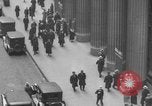
Man exchanges guitar for basket of fruits in the barter system after inauguration of Franklin D Roosevelt in Washington DC.
Great Depression footage after the inauguration of Franklin D Roosevelt as the President of the U.S. in Washington D.C. in 1933. During a bank holiday two day after the inauguration of Franklin D Roosevelt as the President of the US, vehicles move on the streets. Long lines of civilians move on the streets. Man makes a genuine hand made "depression dollar." which is made out of rubber. He demonstrates how it can grow for inflation by stretching. He displays the dollar designed for inflation. Other man stretches the dollar. Man approaches a merchant. He exchanges his guitar for basket of fruits under the barter system which was common in the depression. Footage is from a 1958 newsreel recounting events 25 years earlier.
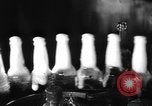
Bartender serves 3.2 beer to the customers at a bank converted into a bar as prohibition ends.
Bottles of beer on an assembly line at the end of Prohibition. Barrels of beer rolling down a ramp outside a brewery. A bartender and his patrons greet each other with raised mugs of beer. A bartender slides mugs of beer down the bar. Barrels of beer are rolled into the former West Highland State Bank on Ashland Ave at 79th Street, which was closed June 9, 1931 and has now been converted into a bar. A sign above the cash register reads, "This Bank gave 3% We give 3.2%" Sign outside the bar reads, "Ladies Entrance." Three women dressed in evening attire are greeted by the doorman as they enter the bar. From a 1958 newsreel recounting events 25 years prior.
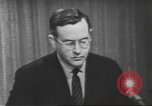
Vice President Nixon and Senator Kennedy debate over Quemoy and Matsu issue prior to presidential elections in the U.S.
The fourth presidential election debate held between Democratic nominee Senator John F. Kennedy and Republican nominee U.S. Vice President Richard Nixon in New York, United States on 21st October 1960. ABC News correspondent Quincy Howe speaks during the debate and allows NBC correspondent John Chancellor to pose a question to Richard Nixon a . Correspondent Chancellor asks a question about Quemoy and Matsu issue. Vice President Nixon points out inconsistency of Senator Kennedy. He further explains it by saying that Senator Kennedy signed a resolution in 1955 which gave the president the power to use United States forces to defend Formosa (Taiwan) and offshore islands. But he also voted for an amendment which was lost, an amendment which would have drawn a line and left out those islands. Vice President Nixon supports President Eisenhower's position. Correspondent Howe asks Senator Kennedy to comment on the topic. He speaks about President Eisenhower sending a mission to persuade Chiang Kai-shek in the spring of 1955 to withdraw from Quemoy and Matsu because they were exposed. The President was unsuccessful. He refers to the fact that in 1958, as a member of the Senate Foreign Relations Committee, he was very familiar with the position that the United States took in negotiating with Communist China (PRC) on these two islands. He further that the U.S. was unable to persuade China's Chiang Kai-Shek to withdraw and thus it was decided by the U.S. to defend the islands.
George Edward Pendray launches The American Interplanetary Society's first liquid fueled rocket from Staten Island in New York, United States.
The American Interplanetary Society's first liquid fuel rocket is launched from Staten Island in New York, United States in 1933. George Edward Pendray of the AIS, and his associate preparing for the launch. The 7 1/2 foot rocket is placed on a stand. Other men look on. The rocket, fueled with gasoline and liquid oxygen, takes off. Its fuel tank overheats and explodes moments after takeoff and the rocket crashes to the beach below. (From a November 10, 1958 newsreel recounting events 25 years earlier. The world's first successful liquid fuel rocket was launched by Robert Goddard in Auburn, Massachusetts, on 16 March 1926. This film records the first such attempt under auspices of the American Interplanetary Society, in 1933. )
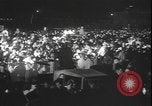
Flight achievements of 1933 - Wiley Post completing solo journey around the world and Roscoe Turner speed record coast-to-coast
American aviator Wiley Post returns to Floyd Bennett Field in New York after completing his solo flight around the world in a just under 8 days. People gather in a large number to welcome him. They gather around his aircraft. Scene shifts to streets of New York City where Wiley Post is honored with a ticker tape parade for his Around The World achievement. The aviator seated aboard a jeep passing by. People celebrate and greet him. He is bestowed with the Medal of Valor by New York City Mayor John P. O'Brien. Next segment shows plane of American aviator Roscoe Turner landing, after his record-setting flight from New York to Los Angeles in 10 hours and 5 minutes flying his Wedell-Williams Model 44 (WW-44) aircraft. This won him the 1933 Bendix Trophy. Close view of Roscoe Turner smiling from the cockpit of his aircraft. From a November 10, 1958 newsreel recounting events 25 years earlier.
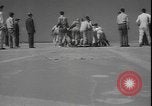
Speed racers Sir Malcolm Campbell and Gar Wood break records in the United States.
New land and sea speed records are set in the United States. People gather in Daytona Beach, Florida. Sir Malcolm Campbell seated in his race car 'Blue Bird'. He drives the car on Daytona beach and sets a new record driving at the speed of 272 miles per hour. People cheer. Close view of him smoking a cigarette in the car after his speed run. Speedboat racer Garfield Arthur Wood seated aboard his speedboat 'Miss America' on the St Clair River near Detroit Michigan. He races the 5000 horsepower mahogany speedboat and wins the Harmsworth Trophy. Close up view of Gar Wood smiling after his race. From a November 10, 1958 newsreel recounting events 25 years earlier.