


 Francais
 Deutsch
 Italiano
Refine Your Search
Berlin Germany 1935 stock footage and images
- Showing 643 to 648 of 6795 results more
more Hide
Hide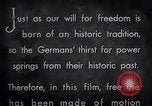
U.S. Army orientation film "Here is Germany" showing the contrast in life of German civilians and victims of German atrocities.
U.S. Army training film titled 'Here is Germany'. Views of pre-war German countryside, German cities including Berlin and others before destruction in World War 2. Shots include famous German landmarks and buildings in major cities including Brandenburg Gate and Victory Column sculpture close-ups and other monuments all before bombing of World War II. German people with families and children in their routine lives. Farmers working fields, mined coal transported by rail, potatoes poured from a full sack, a boy shepherd with geese; a farmer counting pigs descending a ramp at a farm. City port or harbor scene with ships and a modern looking railroad train arriving at a station, sign on side reads Deutsche Reichsbahn (German Reich Railway). High speed highway roads like the Autobahn. German cruise ship at sea. Aerial view of airport with "Berlin" sign on ground. German schools, offices, factories and markets. German woman braiding a girl's hair. German woman taking in washed clothing from a clothesline. German men, women, and children cleaning and polishing work areas and possessions. A German library with people studying and others at book shelves. German classroom with a teacher instructing children and writing on a blackboard. Scenes of German musicians and musical instruments, artisans, masons, cooks. Busy roads with cars. Narrator then presents a darker other side, showing an arms factory, German military officials. Victims of German armies and of the concentration camps. Lumps of dead bodies from massive public shootings, a man being tortured, burning chambers, prisoners of war, concentration camps, human ovens, gas chambers. Survivors of the German custody in relief camps of Red Cross. Evidence of atrocities committed by Nazi Germany. Articles made of human skin and bones. Daily utility items like toys and brushes made from human body parts. Scenes of survivors of concentration camps. Polish people dead from Nazi atrocities at Lublin Castle. Italians and Belgians murdered by Germans, American POWs murdered by Germans. Views of peaceful German citizens juxtaposed with views of German soldiers and military actions. Some famous Americans of German roots: Wendell Willkie, Admiral Chester Nimitz, Henry J. Kaiser.
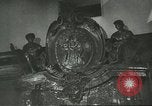
Rise of Hitler and Nazi party in Germany; early footage of Nazi party and figures.
Nazi leaders in the dock at Nuremberg trials, including Hermann Goering; Rudolf Hess; Joachim von Ribbentrop; Alfred Jodl; and others. American prosecutor addressing the court. Image Adolf Hitler overlayed by quote from his book, "Mein Kampf." Views of the brawling streets of Munich during the 1920s. Hitler posing with political associates. A Nazi rally with storm troopers AKA Sturmabteilung (SA). A sign displaying swastika in window of a building identifying it as offices of the N.S.D.A.P.(Nationalsozialistische Deutsche Arbeiterpartei) National Socialist German Workers' Party. Joseph Goebbels in the office, on the telephone. Storm trooper marching band on parade. Goebbels speaking to a crowd early in the Nazi movement. Storm troopers marching on parade and receiving Nazi salutes. Marching storm troopers led by Ernst Rohm. Hitler mingling with the Storm Troopers. Contingent of goose-stepping Storm Troopers. Hitler speaking to a crowd in a forceful and animated fashion. Unrest in streets in Germany. A 1932 newspaper headline reports rumor of a Storm trooper march to Berlin. Nazi Storm troopers set up a machine gun on a sidewalk. Newspaper of January 30, 1933 reports Hitler appointed Reichskanzler (Reich Chancellor) and Goering made Minister of the Interior. View of Hitler together with his cabinet on January 30, 1933, just after Hitler was named Chancellor of Germany. Goering is on his right and Franz von Papen is on his left. Other cabinet members are behind them and around them. Torchlight parade and Hitler saluting to crowd below from the Chancellery window in Berlin on that same night after being named Chancellor. Scene of a Nazi public book-burning.
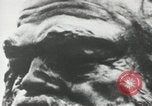
Images pertaining to advance of communism during 20th century, especially in East Germany
Statue of Karl Marx on his grave stone in Highgate Cemetery, London. A picture of Karl Marx. Scenes in Russia around the time of the Russian Revolution circa 1917 and creation of the Soviet Union. Soviet soldiers walking slowly in loose formation. Bolsheviks standing with a large banner. Images spanning many years thereafter: Damaged shops on a street. "One way" street signs in several languages. Large gathering of people carrying signs reading: "Frieden" (Peace, in German). A sign reading: "HALT, Landesgrenze" marking a German provincial boundary. A sign in German, designating the customs border at Furth im Wald, Bavaria ("Zollgrenz-Bezirk, Furth i.Wald"). East German border guards setting obstacles and sentry paths at barbed wire barriers (constituting the Berlin Wall, early on). Picture of Günter Litfin, a twenty-four-year-old tailor, who swam across the Spree Canal to West Germany on 24 August 1961. View of him being fatally shot from across the border, by East German guards, as he is being pulled into West Germany (the first such fatality at the East West German border). Animated map of the world with label references to Berlin,1961; Havana, 1959; Budapest, 1956; Coyoacan, 1940; and Kronstadt, 1921.

During Berlin Crisis, East Berlin soldiers on border and West Berlin Mayor Willy Brandt addresses crowd.
East Berlin Military trucks park at and block the Brandenburg Gate and passage between East and West Berlin in Germany. Communist Army forces in trucks and tanks. East German Army officer looks through binoculars. East German forces march and align on the street at the Brandenburg Gate. They spray with water cannon at the observers on the West Berlin side. In West Berlin Mayor Willy Brandt addresses a large crowd about the growing tensions and closure of the border.
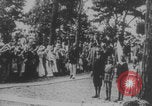
Kaiser Wilhelm II annual cruise aboard SMY Hohenzollern II and arrival in Berlin
Kaiser Wilhelm II of Germany on his annual Nordlandfahrt cruise sailing the North Sea in 1914. Kaiser Wilhelm II shakes hands with dignitaries before boarding a car. The Imperial yacht, SMY Hohenzollern II, departs from port, heading back to Germany. German crowds line shore to watch the arrival of the SMY Hohenzollern II. Kaiser Wilhelm II descends gangplank from ship and enters waiting car. Cavalry marshals control crowds in Berlin waiting for Kaiser Wilhelm II arrival. Kaiser Wilhelm II rides an open topped royal carriage to travel back to the New Palace (Neues Palais), in Potsdam. Crowds wave with their hats to Kaiser Wilhelm II.
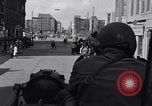
Soldiers keeps a watch across Friedrichstrasse towards East Berlin during Berlin Crisis.
Civilians watch in West berlin, Germany. Sergeant in tank turret looking through binoculars into the Eastern side during Berlin Crisis. East German police stand at the crossing point at Friedrichstrasse.
CRITICALPAST.COM: About Us | Contact Us | FAQs - How to Order | License Agreement | My Account | My Lightboxes | Shopping Cart | Advanced Search | Featured Collections | Website Terms & Conditions | Privacy Policy ©2026 CriticalPast LLC.
License Agreement |
Terms & Conditions |
Privacy Policy
©2026 CriticalPast LLC.