


 Francais
 Deutsch
 Italiano
Refine Your Search
Berlin Germany 1935 stock footage and images
- Showing 739 to 744 of 6795 results more
more Hide
Hide
Ronald Reagan talks about how Radio Free Europe pierced Iron Curtain and appeals for help to keep it operating, in New York.
Public Service Announcement (PSA) for Crusade for Freedom in New York. Ronald Reagan, famous Hollywood actor, talks about how Radio Free Europe has pierced the Iron Curtain (approaching people beyond reach in Communist countries). Reagan stands beside a poster advertising the campaign. Close-up view of the "World Freedom Bell" ringing atop Berlin City Hall or Rathaus Schöneberg (John-F.-Kennedy-Platz, 10825 Berlin, Germany) in West Berlin, Germany. View of the 135,000-watt radio transmitter and radio tower. Personnel in radio studio working on transmitter and radio station in West Germany. Views of various men speaking into microphone in radio studio. Dramatized view of people handing over letters of gratitude to Radio Free Europe, "smuggled past the secret police" under hats identifying Communist informers by name. View of a letter being cut into multiple pieces for safe transport in secret. U.S. Army General Lucius Clay steps to podium during unveiling ceremony for the bell unveiling ceremony on October 24, 1950. Animated map shows Radio Free Europe transmission tower and locations of planned future transmitter towers to penetrate the Iron Curtain (during Cold War). Another map is shown with a transmitter location east of China "to establish Radio Free Asia to stop the spread of Communism in the far east." Ronald Reagan appeals for help to keep Radio Free Europe operating. He holds up a large envelope with the New York City mailing address to send contributions for the radio campaign: "General Clay, Crusade for Freedom, Empire State Building, New York City."
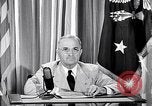
President Harry S Truman of United States addresses the nation after his return from Berlin after Potsdam Conference.
President Harry S. Truman of United States addresses the nation by radio after his return from Berlin and the Potsdam Conference. President Truman speaks of ruined city of Berlin Germany. He expresses his worries about the common German civilians. He discusses establishment of U.S. military bases over various parts of the world to maintain World Peace.
General Lucius Clay talks about the Berlin Blockade in United States.
General Lucius Clay, Military Governor of United States Zone of Germany, arrives in United States. General Clay salutes as he gets off a plane. He talks about the Berlin Blockade. He reveals about the strong position of American troops. He states that sufficient supplies are being carried to the people during the blockade via Berlin Airlift.
Film juxtaposing German defeat in World War 1, with its defeat in World War II, and comparative postwar impacts.
Film begins stressing the historic aggressive military traditions of Germany. A brief view of thousands of Adolf Hitler's Nazi troopers assembled in dramatic formation at the Nazi party rally grounds in Nuremberg, Germany. Explosion of the Nazi eagle, with swastika symbol, atop the Zeppelintribüne grandstand at Zeppelinfeld in Nuremberg, being blown up by U.S. Army soldiers at the end of World War 2 in Europe. Germans celebrating the armistice ending World War One. German soldiers captured, in unconditional surrender, ending World War Two. Huge open field filled with defeated German soldiers in the second world war. German armies parading through Berlin at the end of World War One. American troops occupying the entire country of Germany after the second world war. A Nazi eagle being destroyed on a German government building at end of the second world war. Old photograph of the German general staff, led by Helmuth von Moltke the Younger, that was still intact, after World War I. In contrast, after World War 2, the entire Nazi military was held and subject to trials at Nuremberg. Großadmiral Erich Raeder seen being taken in custody. Closeup of Field Marshal Wilhelm Keitel. German industry unimpaired by World War I, contrasted with utter destruction in the second world war. American officer coordinating resumed operation of of a postwar plant. View of German diplomats remaining in office after WWI. Proclamation barring Nazi party members from all offices after WWII. German Kaiser Wilhelm II in peaceful exile in Holland after the first world war. A Nazi officer war criminal, is taken in custody by American Military Policemen, and executed by a firing squad. World War 1 did not affect German schools and curriculums. After World War 2 all Nazi doctrines were destroyed. New text books and curriculums were prepared by the Allies for German use. Map shows small area of post World War 1 occupation, in contrast the the entire Germany after WWII. Weimar Republic government, post WWI is contrasted with post World War 2 government by the Allied military powers. British Marshal Bernard Montgomery, American General Dwight D. Eisenhower, Soviet Marshal Zhukov, and French General Charles de Gaulle, are shown. Views of American soldiers interacting with German citizens during their occupation of Germany. Images of Germans: Frederick the Great, Otto von Bismarck, and Kaiser Wilhelm. Views of German farmer sowing seed, postman delivering mail, policemen escorting children. Normal activities resumed in Germany, in areas of culture such as orchestral concerts, etc.

United States B-24, P-47 and German ME-110, ME-109 in aerial action over Berlin, Germany during Second World War
United States B-24 Liberator, drops bombs on German targets during Second World War. Bombs impact as B-24 goes into a dive. American P-47 aircraft in aerial action against German fighters. German ME-109 and ME-110 being shot down explode in mid air.
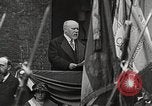
Poincaré resigns from Reparations Commission. Germans object to conditions in Treaty of Versailles
French Prime Minister Raymond Poincaré resigns from his position as President of the Interallied Reparations Commission. Scene shifts to closup, on board a ship, of Reinhold Wulle, leader of a monarchist wing in the conservative German National Peoples Party (DNVP). Scene shifts again, to Berlin, Germany, where well-dressed citizens are gathered on a sidewalk. It shifts again, to German citizens at a newsstand holding many different newspapers, all reflecting unhappiness with restrictions and economic effects from the conditions of the Treaty of Versailles, following World War I. A poster shows a facsimile of the Treaty with arrows pointing to Part 5, requiring demilitarization of the Rhineland. Scene shifts back to the well-dressed gathering, where a photographer stands on an iron fence railing as a car arrives and an official steps into the group waiting for him. Next, a man is seen seated on the roof of a truck driving on Unter Den Linden, with Brandenburg Gate in background. He throws monarchist leaflets to bystanders. Men on bicycles accompany the truck. Leaflets are also seen being thrown from an automobile on a Berlin street. Six men distribute monarchist leaflets from a truck. Leaflets fill the air as traffic, including a tram, moves through main streets of Berlin. A contingent of Berlin police officers begins clearing crowds from sidewalks and streets. Mounted police clearing a square.
CRITICALPAST.COM: About Us | Contact Us | FAQs - How to Order | License Agreement | My Account | My Lightboxes | Shopping Cart | Advanced Search | Featured Collections | Website Terms & Conditions | Privacy Policy ©2026 CriticalPast LLC.
License Agreement |
Terms & Conditions |
Privacy Policy
©2026 CriticalPast LLC.