


 Francais
 Deutsch
 Italiano
Refine Your Search
Berlin Germany 1935 stock footage and images
- Showing 757 to 762 of 6795 results more
more Hide
Hide
German civilians with their luggage walk along the Tangermünde Bridge at conclusion of the Battle of Tangermunde in Germany.
Scenes after the destruction of the Tangermünde Bridge over the River Elbe in Germany at the end of World War II in Europe. Wide view of heavily damaged Tangermunde Bridge. It had been blown-up by German forces a month prior during their retreat toward Berlin. American soldier wearing garrison cap or side cap stands on bridge checking papers of German civilians who are attempting to cross the bridge in advance of incoming Soviet forces (preparing to surrender to American and British allies rather than to Soviet forces). German civilians walk along the damaged bridge. The twisted metal requires that the citizens hold on tightly to their belongings and to small children during the crossing, to avoid falling into the river. A young man holds a young child and belongings as he crosses carefully. Other scenes of men and women holding small children and babies, and luggage and belongings as they cross.

German Chancellor Adolf Hitler addresses the Reichstag on the issue of rearmament in Germany.
On 20th February, 1938 Hitler addresses the Reichstag, meeting in the Kroll Opera House, in Berlin, Germany, on the issue of rearmament. Interspersed are various scenes: people standing in a city; The symbol of the RAD (Reichsarbeitdienst, or National Labor Service) and their members at work digging with shovels; German Army troops parading; Large formations of German Luftwaffe (Air force) aircraft in flight; German Naval operations, with depth charges exploding; Armaments factories; tanks maneuvering; soldiers in vehicles; and a formation of biplanes.
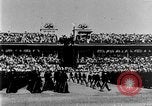
Kaiser Wilhelm II and General Von Hindenberg review parades in Germany before World War I. Also Franz Joseph I.
Political scenario in Europe prior to World War I. Kaiser Wilhelm II reviews troops in Germany. The Kaiser on horseback followed by officers also on horseback. Emperor Franz Joseph I in Austria. He is accompanied by a royal party. A dignitary in a horse driven carriage. German General Von Hindenberg reviews a parade in Berlin. Soldiers march. Cavalry units move in review.
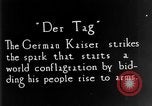
Troops in Germany leave for a war front at the outbreak of World War I.
Outbreak of World War I as a consequence of Archduke of Austria-Este Francis Ferdinand's assassination in Sarajevo. Troops gather in Germany on the bidding of Kaiser Wilhelm II. Soldiers leave Berlin. Soldiers of the Alexandria Regiment march. Family members bid farewell as new recruit soldiers board a railroad train and leave for a war front. Smiling soldiers. A huge crowd at a platform to bid farewell to the soldiers. The train carrying the soldiers pulls away.
Joseph T McNarney,Georgy K Zhukov and Alphonse P Juin attend the Joint Allied Control Commission conference in Germany.
Joint Allied Control Commission Conference in Berlin,Germany. Joint Allied Control Commission Conference in session to resolve the conflicting economic and political policy. Members of board and representatives of four nations General of the United States Air Force Joseph T. McNarney,Marshal of the Soviet Union Georgy Konstantinovich Zhukov and Marshal of France Alphonse Pierre Juin attend conference. United States Secretary of State James Francis Byrnes addresses German civilians on Vital policy at Stuttgart in 1946. U.S. Ambassador Robert P. Murphy,Senators Arthur Hendrick Vandenberg,Matthew Connelly and General Joseph T. McNarney seated at speaker's stand.
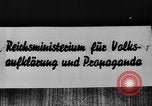
German Chancellor Goebbels confers with officers, decorates civil defense workers, and the evacuees in Germany.
German Chancellor and Reich Minister of Public Enlightenment and Propaganda Goebbels decorates civil defense workers in Germany during World War II. Reich Minister of Public Enlightenment and Propaganda Paul Joseph Goebbels confers with officers. German civilian evacuees load their belongings on trucks and buses. Trains filled with women and children move on tracks evacuating them to safety outside of Berlin. Evacuated German children play and eat in a nursery. Chancellor Goebbels decorates civil defense workers for their efforts.
CRITICALPAST.COM: About Us | Contact Us | FAQs - How to Order | License Agreement | My Account | My Lightboxes | Shopping Cart | Advanced Search | Featured Collections | Website Terms & Conditions | Privacy Policy ©2026 CriticalPast LLC.
License Agreement |
Terms & Conditions |
Privacy Policy
©2026 CriticalPast LLC.