


 Francais
 Deutsch
 Italiano
Refine Your Search
Berlin Germany 1935 stock footage and images
- Showing 871 to 876 of 6795 results more
more Hide
Hide
Death sentence by court to convict Hauptmann for kidnap and murder of son of aviator Charles Lindbergh, Flemington New Jersey.
The kidnapping and murder case of the infant son of aviator Charles Lindbergh, in Flemington New Jersey. Coverage of court ruling in 1935. A huge crowd outside the court during the trial of Bruno Richard Hauptmann for kidnapping and murder termed as 'the crime of the century'. Lindbergh and his wife confront Hauptmann from witness stand. The letters of ransom written by Hauptmann. Lindbergh testifies in the court of trial. Hauptmann cross examined by Attorney General Wilnetz. On February 13, 1935 Judge declares that Hauptmann will receive the death penalty, by electric chair. From a January 1960 newsreel recounting events 25 years earlier.
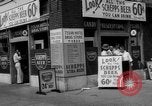
People drink Schepps beer at the Texan Hotel in Dallas, Texas. It is priced at 60 cents for 60 minutes of beer drinking.
A beer drinking offer for Schepps Beer at the Texan Hotel in Dallas, Texas, 1935. Sign out front of the building says "Look! All the Schepps beer you can drink. 60 cents per hour." . A man drinks beer at the bar where for 60 cents he may have as much beer as he can consume in 60 minutes. Several men use straws to drink beer from a pitcher at the same time. Men and women drink beer from huge mugs and salt their beer before drinking it. A group of men and women raise their mugs in toast as they congregate around a woman playing a piano. From a 25 year retrospective in a newsreel dated July 14, 1960. (Note: Schepps Brewing Co. was founded in Dallas in 1934, and sold in 1935. In 1939, it became Time Brewing, Inc. and subsequently Dallas-Fort Worth Brewing Co. 1940-51.)
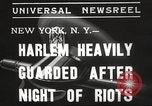
Workers repair broken shops and rioters are arrested by police following Harlem riots in New York City, New York.
Harlem being guarded by New York City police forces after March 19, 1935 race riot in New York City, New York. Workers repair broken glass of the S. H. Kress and Co store. People walk on street outside the damaged shops. Broken glass on the ground. African American men who are the accused rioters come out of police cars and paddy wagons to enter a court room. One of the accused men has a bandage on his head. (This incident is sometimes called the first modern race riot in the United States. A Mayor's Commission investigated the cause and issued a report, "The Negro in Harlem: A Report on Social and Economic Conditions Responsible for the Outbreak of March 19, 1935." The report concluded that the riot was spontaneous and had no organized leadership behind it. It also identified "injustices of discrimination in employment, the aggressions of the police, and the racial segregation" as conditions leading to the riot.)
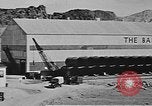
Steel fabrication plant for construction and assembling of giant steel pipes, during Hoover Dam construction in the U.S.
Construction of Hoover Dam in the United States, concluding in 1935. A sign reads 'the Babcock'. Giant steel pipes. Steel plates hoisted by a crane. Steel pipes are assembled in the steel fabrication plant erected on the dam site. Men working on constructing and assembling pipes. Train passes through a 30-foot diameter section. Trailers carry giant steel pipes. The pipes transferred via cable ways. Trailers carry giant steel pipes inside diversion tunnel. Steel pipes are joined at location with cables. Construction equipment work on construction site. Railroad tracks seen. A tram car carrying construction material, passes through the tunnel. Last concrete poured on May 28, 1935 and construction of the Hoover Dam completed two years ahead of schedule. View of completed Hoover dam in mid to late 1930's with 1930s automobiles passing by and parked on top of the dam. From a 1962 production about the dam.
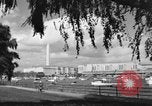
Boating activities at the park on Hains Point, Washington DC. The President's Cup boat race. Equestrians and bicyclists.
View from hains Point, East Potomac Park, of boats in the Washington Channel. Buildings on opposite shore and Washington Monument visible in background. An official boarding a small ferry craft manned by U.S. sailors, on Potomac River shore of the park. Spectators watching the 1935 President's Cup speed boat races from Hains Point. A large yacht is anchored in the Potomac River, as competing boats pass it during the race.(The hydroplane speedboat,"Notre Dame,"powered by a 24-cylinder Duesenberg engine, won the 1935 President's Cup,for owner, Herb Mendelson and driver, Clell Perry.) Equestrians ride horses on park trails,and cross a road,as automobile pauses for them, with Lincoln Memorial in background. Bicycles in a rack and a woman riding a stationary exercise bike. People riding bicycles along Hains Point path.
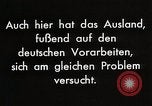
Rocket motor designs by International scientists and inventors, reflecting early work by German rocket researchers
Designs by various international scientists and inventors who have contributed to solving the problems of rocket motor development, based on the German preparatory work. Their combustion chamber designs owe much to the German pioneers in the field. Shown are design sketches by Russian scientist, Konstantin Tsiolkovsky (Ziolkowsky) in 1914; French inventor Henri Melot, in 1920; German Friedrich Zander, in 1931; Bull, 1932; The American Rocket Society, with several designs from 1932; and The Cleveland Rocket Society. Views of rocket combustion research activity by Ernst Loebell of the Cleveland Rocket Society in 1933. He is seen outdoors in the snow with his apparatus. View of Loebell's test firing stand, and a picture of an actual test firing, outdoors. Ernst Loebell with model and rocket motor from his spaceship projects of 1934 and at the International Exposition dedicated to Art and Technology in Modern Life held in Paris, 1937. Cutaway views of the spaceship. The rocket motor wrapped in cooling coils. Rocket motor design by John Shesta of the American Rocket Society, from 1934. Design by Rene Armengaud of France, in 1934 and Deich in 1935.
CRITICALPAST.COM: About Us | Contact Us | FAQs - How to Order | License Agreement | My Account | My Lightboxes | Shopping Cart | Advanced Search | Featured Collections | Website Terms & Conditions | Privacy Policy ©2026 CriticalPast LLC.
License Agreement |
Terms & Conditions |
Privacy Policy
©2026 CriticalPast LLC.