


 Francais
 Deutsch
 Italiano
Refine Your Search
Berlin Germany 1935 stock footage and images
- Showing 109 to 114 of 6795 results more
more Hide
Hide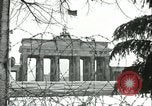
British soldiers on guard at the border near the Brandenburg Gate in Berlin, Germany.
The Brandenburg Gate or Brandenburger Tor (Pariser Platz, 10117 Berlin, Germany) as seen from behind barbed wire fence in Berlin, Germany. A snowman on the ground in West Berlin. Trucks passing on the street. British soldiers on guard at the border. They discuss amongst themselves.
German Chancellor Adolf Hitler returns to Berlin, Germany after the annexation of Czechoslovakia prior to World War II.
German Chancellor Adolf Hitler returns to Berlin, Germany. A train leaving Vienna, Austria. Nazi Germany flags in Vienna. Chancellor Hitler on a train from Vienna, Austria to Prague, Czechoslovakia. He waves from a window. Hitler gets off the train in Berlin and is greeted by a crowd giving Nazi salute. Fireworks at night in Berlin to celebrate the conquest of Czechoslovakia.
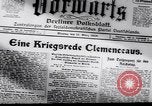
View from Berlin Germany, of events leading up to, and subsequent to, the Armistice in World War I.
Succession of Berlin, Germany, newspapers shown, from 1918 through 1919, chronicling progress of war towards the World War 1 Armistice, and subsequent problems and conditions in postwar Germany. Newspaper of November 12, 1918 addresses concerns about the conditions and the price of the truce. Crowd stands on a road covered with snow around statue of the Kaiser, with scaffold around it. Crowd in a square in War Bond rally. One of crowd carries a Communist red flag. Newspaper refers to gunfire in Berlin from Unter den Linden to Friedrichstrasse. Newspaper announces the Kaiser's abdication, which is then illustrated by reversed footage showing the Kaiser walking backwards and being lifted into his automobile, which then drives away backwards. Returning German soldiers are happy to see the war end, and sing in their returning trucks. An officer inspects war trenches that are now empty. Newspaper announce increasing domestic problems . Newspapers raise issue of German prisoners of War held in foreign countries. Troops are seen moving in streets and at checkpoints in Germany.
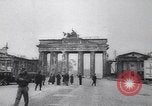
Ruins and damaged buildings in Berlin and Munich Germany at the end of World War II in Europe.
Opening scenes are of ruins in Berlin, Germany at the end of World War II in Europe. Damaged Brandenburg Gate and ruined buildings of Berlin. Damaged building of Adlon Hotel. Allied troops move forward in Germany to complete the Allied occupation of Germany. A truck loaded with Allied troops heads towards Berchtesgaden. Smoke rises from the Berghof, German Chancellor Adolf Hitler's mountain residence (Narrator refers to it as the Eagle's Nest, which is not correct. The Eagle's Nest or Kehlsteinhaus was not bombed and is not shown in this clip). Ruins and damaged buildings in Munich including exterior building facade, and arched stair entrance to festhall, marked with painted lettering by American soldiers, "157th infantry, 45th Division." Interior views of the Hofbräuhaus München beer hall (Hofbräuhaus am Platzl), including interior views of ruins inside its drinking room (trinkstube) with shattered windows and broken furniture. (Narrator refers to this as "the famous beer hall." At least two noteworthy NASDAP formative events occurred there: On February 25, 1920, Hitler presented the Nazi Party Twenty Five Point Program there. On November 4, 1921 the National Socialist party held a large public meeting at the Hofbräuhaus and fighting and protesting broke out after Hitler spoke. The Sturmabteilungen, or "SA", then in its infancy, attacked and ejected protestors.)
Berlin Wall separating East and West Germany and aircraft in flight between East and West Germany.
A contrast between East Berlin and West Berlin in Germany. The "Berlin wall" which separates East and West Germany with a wire fence on its top built by the Soviets. Workers in East Berlin constructing the wall. The streets of West Berlin and several dilapidated buildings in East Berlin, still not repaired following bombing during World War II, showing the contrast. Bernd Luenser who was shot down as he reached West Berlin after swimming across a canal from East Berlin. His body is hauled out by the West German guards. Wreaths laid in memoriam for Germans killed trying to escape to West Berlin. U.S. Air Force C-54 aircraft taking off from an airfield, connecting East and West Berlin. Bricked windows sealed over completely on buildings along the Berlin Wall. Khrushchev speaking at the UN, standing and waving his finger emphatically as he speaks.
History of Berlin before and after World War II showing zones of occupation and poor living conditions post-war.
Nazi soldiers at attention with guns drawn in Berlin during World War 2. U.S. soldiers on watch from damaged Berlin building. Man watching the Brandenburger Tor with binoculars while sitting in car. Pan American passenger airplane in flight after the war. Pan American passenger reading Time and other magazines onboard. Aerial view of Berlin early 1960s. Pan American plane landing at Tempelhof Airport. Pan American passengers descending to tarmac under sign that reads, "Today Pan American has completed 93153 Transatlantic Crossings". West German immigration officer inspects passport of tourist in Tempelhof Airport’s passport control. Brandenburg Gate from West Berlin during the early 1960s. A man observing the Brandenburger Tor from the Straße des 17. Juni street in West Berlin. Sign saying “Achtung! Sie verlassen jetzt West-Berlin” (“Warning! You are now leaving West-Berlin” in German). View of Berlin in 1920s and 1930 decades. Drive through Brandenburg Gate in the 1920s. Point of view shot driving through Berlin in the 1920s. Various street signs in Berlin showing “Unter Den Linden” and “Friedrichstraße”. Tourist bus flying American flag departs in Berlin 1920s. Humboldt University of Berlin (Humboldt-Universität zu Berlin) along the Unter den Linden boulevard during the 1920s. View of the Berlin Cathedral dome. View of the Gendarmenmarkt square showing the Konzerthaus and the French Church. Pedestrians in Friedrichstraße. Berliners in Lustgarten park on Museum Island. Early Nazis driving in Berlin streets in 1930s. Hitler saluting parade. Hitler addressing Germans. Berlin in ruins in Spring 1945 as occupying Allied tanks pass in front of Brandenburg Gate. Old starving woman walks on streets of Berlin amid ruins in 1945. Ruins of Berlin include Reichstag Building during 1945 Battle of Berlin. Women and children emerging from underground Berlin bunker in 1945, to a scene of devastation and rubble in the city. Ground view of the Kaiser Wilhelm Memorial Church (Kaiser-Wilhelm-Gedächtniskirche) after being bombed. Interior of ruined Reichstag Building. Potsdam Conference 1945, Map of WWII Europe. Berlin map, including official Berlin map with signatures showing Zones of Occupation. Germany allied control authority gathering including American, British, and Soviet representatives. French, American, Soviet flags in Germany. Rebuilding of Berlin mostly by women clearing rubble, using shovels, buckets, wheelbarrows and cleaning old bricks for reuse. Over-crowded train in Germany post-WWII filled with German civilian refugees abandoning the cities and heading to the countryside of Germany to resettle.
CRITICALPAST.COM: About Us | Contact Us | FAQs - How to Order | License Agreement | My Account | My Lightboxes | Shopping Cart | Advanced Search | Featured Collections | Website Terms & Conditions | Privacy Policy ©2026 CriticalPast LLC.
License Agreement |
Terms & Conditions |
Privacy Policy
©2026 CriticalPast LLC.