


 Francais
 Deutsch
 Italiano
Refine Your Search
Berlin Germany 1935 stock footage and images
- Showing 157 to 162 of 6795 results more
more Hide
Hide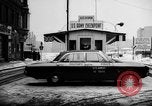
American Forces Network (AFN) radio reporter broadcasts news from checkpoint Charlie in West Berlin, Germany.
U.S. Military Police car parked in front of United States Army Checkpoint Charlie on Friedrichstrasse along Berlin Wall in West Berlin, Germany. A van from AFN ( American Forces Network) Berlin pulls up at the checkpoint. Army reporter Specialist Ted Shrady comes out to broadcast from Checkpoint Charlie. He stands on street and speaks over microphone about the weather conditions in Berlin.
View of the Autobahn and heating plant in Berlin, Germany.
Points of interest in Berlin, Germany. Berlin Bear statue along Autobahn. Car passes on the street. A sign board on right reads: 'You are now entering the U.S. sector of Berlin'. Other sign boards read: 'You are leaving the American sector' and 'You are entering Soviet zone'. The heating plant for Berlin area. Modern apartment buildings with channel in the foreground. Motorboat on canal. Coal pile and smoke stacks in the background.
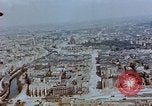
Bomb damaged Brandenburg Gate and railroad stations in Berlin, Germany after World War 2.
Aftermath of World War 2 in Berlin, Germany. Aerial views of bomb damage caused to the buildings in the city of Berlin including Reichstag and Tiergarden. Damage caused to Potsdamer railroad station (Berlin Potsdamer Bahnhof), Brandenburg Gate and damge to other railroad stations as a result of Allied bombings during World War II. Anhalter railroad station (Berlin Anhalter Bahnhof) and marshaling yards in its vicinity.
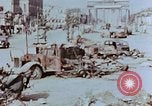
Wrecked burnt vehicles in the middle of Unter den Linden in Berlin, Germany.
Damage in Berlin after the Battle of Berlin in World War II. Brandenburg Gate (Brandenburger Tor, Pariser Platz, 10117 Berlin, Germany) in the background. Wrecked, burnt vehicles in the middle of the Unter den Linden, a boulevard in Berlin.
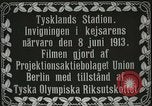
Kaiser Wilhelm II arrives to officially open Germany's new Olympic Stadium near Berlin.
Official opening of Germany's Olympic stadium (Deutsches Stadion Berlin, also at that time known as Grunewald-Stadion) on the 25th Anniversary of the Kaiser's coronation. Kaiser Wilhelm and Empress Augusta Viktoria, in their carriage, drive into the center of the new stadium grounds (Deutsches Stadion) built near Berlin, to host the 1916 Olympics. They are accompanied by several horse guards. The Kaiser is dressed in Hussar uniform including fur Busby adorned with Totenkopf (Death Head) emblem. The Royal couple step from their carriage. In next sequence, they are seen silhouetted with a number of dignitaries, under a canopy. Members of various athletic clubs parade across the grounds, carrying banners and flags, many adorned with award ribbons. The Kaiser watches from under the canopy, with Empress Augusta Viktoria, standing behind him. The Kaiser salutes some marchers. A large contingent of girls marches past, all dressed in dark skirts and white blouses. Bicyclists race around a track, as spectators watch from the stadium stands. Formation of German men and women perform calisthenics in unison on the field. Another glimpse under the canopy, shows the Empress conversing with an officer behind her, dressed in Hussar garb, similar to the Kaiser, who continues to salute as various groups pass in review. (The 1916 Olympic games were canceled due to World War 1, and the stadium was destroyed 20 years later and replaced by the Olympiastadion Berlin, or Berlin Olympic Stadium.)
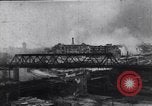
Soviet capture of Berlin and surrender of German Defense forces in Germany during World War II.
Combat footage filmed during the Soviet invasion and Battle of Berlin, Germany during World War 2. Smoke rises from damaged bridges and railroad lines. Ruined buildings of Berlin in aftermath of Soviet air and ground attacks. Piles of captured German weapons. German police officers and soldiers being taken as prisoners of war. Surrendering German troops march along a street. Grafitti on building wall says "Surrender - No." White surrender flags hang from windows and balconies of buildings. (These are contrasted by edited insert of German swastika flags covering the facades of buildings in the past.) German General Helmuth Weidling, commander of the Berlin Defense Area leads other Gernan officers from a bunker in the city, following their surrender to the Soviets on May 2, 1945. Large number of surrendering German soldiers marching, while General Weidling and other Berlin Defense Area officers quietly watch as their troops march past, as prisoners.
CRITICALPAST.COM: About Us | Contact Us | FAQs - How to Order | License Agreement | My Account | My Lightboxes | Shopping Cart | Advanced Search | Featured Collections | Website Terms & Conditions | Privacy Policy ©2026 CriticalPast LLC.
License Agreement |
Terms & Conditions |
Privacy Policy
©2026 CriticalPast LLC.