


 Francais
 Deutsch
 Italiano
Refine Your Search
Berlin Germany 1935 stock footage and images
- Showing 4219 to 4224 of 6795 results more
more Hide
Hide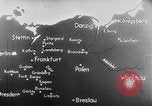
War-weary German soldiers returning from Budapest, during World War II
Map of Germany and Poland, with major cities marked. A German SdKfz 251 half-track armored personnel carrier (APC) enters a town in Germany, during World War 2. It is carrying about a dozen war-weary German soldiers that the narrator says just came from Budapest. They step down from the APC in front of a building displaying a sign identifying it as a refreshment hall for fighters back from Budapest, complements of the Waffen-SS. They receive hot cups of coffee (or some suitable refreshment). One soldier sits on a rock, eating a hot meal, in front of a sign telling vehicles to halt and report here. The weary fighters are mostly unshaven and a number have minor wounds covered by bandages. One has an eye patch. They converse and appear glad to get a rest. They board a bus. Others ride away in the back of an open truck. The road appears wet and icy. A large body of water is seen in the background.
German officers review German Army parade and the promulgation of new German constitution in Potsdam, Brandenburg.
German activities after World War I. Hans Von Seeckt, a German General, reviews parade of German Army infantry and artillery in Potsdam. Paul Von Hindenburg, a German General, reviews a parade. The German Army using cardboard tanks and fake weapons in maneuvers during period after World War I and before militarization of Germany under the Nazis. Promulgation of new German constitution in the Garrison Church of Potsdam in March of 1933 in the presence of Paul Von Hindenburg, Adolf Hitler and Franz Von Papen, a German Catholic Monarchist politician. Parade scenes of German soldiers in the early 1930s. Newly created Nazi Labor Corps and Adolf Hitler digging with a shovel at an inaugural ceremony. Shirtless labor corps members pulling together on ropes. Scenes of factories, manufacturing, industrialization and rebuilding of Germany and its military with remilitarization in the mid 1930s.
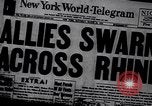
Newspaper headlines as Allies cross Rhine, dead concentration camp victims, German prisoners near end of World War II in Europe
Views of various newspaper headlines during world war 2. Headline announces that the Allies have crossed the Rhine River in Germany. View of U.S. Army soldiers in jeeps and trucks crossing a bridge over the Rhine. Point of view (POV) shot from inside open moving automobile crossing bridge. Dead Bodies of concentration camp victims in a camp following liberation by the Allies. German Army prisoners running in formation with their hands up, under guard by the Allies. Large group of Germany military prisoners in a queue. A young boy German soldier is seen crying. Nazi flag being burned: Flag with swastika mark of Nazis is on fire and seen burning.

Newsreel depicting victory of Allied military forces capturing German cities and Nazi officials to end World War II.
Newsreel titled 'Allied Drives Split Germany'. Allied troops, tanks and soldiers fight a fierce battle on the streets of Leipzig and gain the control. Allied soldiers seize and guard the radio station in Leipzig. Allied forces win Nuremberg and Braunschweig. Destroyed buildings and houses after the fight. A German commander surrenders to American Major General. Glimpses of Hitler's speech at Nuremberg in 1932. U.S. soldiers atop the same stadium building in 1944. British Army men prisoners liberated and given food and cigarettes. A camp near river Rhine where German prisoners are released and Nazi army officers surrender. German Generals arrested by the Allied Forces. Soldiers of the 3rd Army explore stashed gold and currency reserves of Germany hidden in a salt mine. They also recover stolen art and classic paintings from German museums. Civilians registered by Allied military officials. A crowd in market hears suspension of Nazi government. Nazi army uniforms, arms, caps and badges in a stack to be destroyed. A map showing German-Russian frontier. Russian tanks rushing into German borders after bombing their bases. Tanks advance between destroyed houses, rising smoke and explosion from fights. U.S. and British forces bombing Magdeburg on the Elba river.
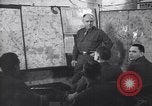
Colonel from G-2 (Intelligence) briefs Commander, 29th Infantry Division, and his staff, during World War II
Major General Charles Gerhardt, Commanding General, U.S. 29th Infantry Division, with members of his staff, at their Headquarters in occupied Germany, during World War 2. He stands in front of a series of maps and discusses the status and plan for the Allied offensive in Germany since the securing of bridgeheads across the Ruhr River. A Colonel from G-2 (Intelligence) explains the enemy capabilities and other details to the officers. He also answers General Gerhardt's questions.
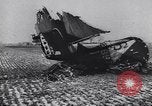
Remains of U.S. 8th Air Force aircraft shot down by German fighter aircraft and flak. U.S.flier POWs during World War II.
Tail and crushed wings of American B-17 bomber, one of several shot down over the Germany-Holland border, during World War 2. Bodies of two U.S. airmen lying on the ground next to the debris. Remains of crashed B-17, Serial number 42-39822, of the U.S. 333rd Bomb Squadron, 94th Bombardment Group, which was shot down by German FW-190s while returning from a mission to Brunswick (Braunschweig), Germany, on January 11, 1944. A fuselage from downed allied warplane being hauled away on a truck. A junkyard filled with American warplane parts, stacked by type, engines in one pile, tails in another, etc. One vertical fin, marked with the 'triangle A' of the 91st Bomb Group, is from B-17G, tail number 42-37737, named "Tennessee Toddy" of the 401st Bomb Squadron. It crash landed after losing two engines, on 10 October 1943, at Brocklanderweg, near Apeldoorn, Holland. Two U.S. Army Air Corps prisoners being interrogated by a German officer. Group of United States airmen prisoners of war, apparently showing personal identifications (dog tags) to a German interrogator.
CRITICALPAST.COM: About Us | Contact Us | FAQs - How to Order | License Agreement | My Account | My Lightboxes | Shopping Cart | Advanced Search | Featured Collections | Website Terms & Conditions | Privacy Policy ©2026 CriticalPast LLC.
License Agreement |
Terms & Conditions |
Privacy Policy
©2026 CriticalPast LLC.