


 Francais
 Deutsch
 Italiano
Refine Your Search
Berlin Germany 1935 stock footage and images
- Showing 4261 to 4266 of 6795 results more
more Hide
Hide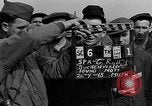
Long term captive of Buchenwald concentration camp, Otto Feuer, is interviewed after U.S. forces liberate camp.
Internees at a concentration camp in Buchenwald, Germany. Otto Feuer, a Jewish internee from Hamburg states how he has been in concentration camps for past so many years. He thanks the American Army for liberating them from the concentration camp in Buchenwald, Germany on April 11, 1945. Other internees in the background.
Opening statement of the prosecution at the Nuremberg Trials; flashback scenes of Nazi crimes and starving civilians in 1945
Events related the Nuremberg Trials held at the Palace of Justice in Nuremberg, Germany. Flashbacks of a variety of Nazi crimes against humanity during World War II. Europe during 1945. War devastation: buildings and cities laid in waste, people in hunger and despair emerge from shelters searching for the causes of the war and of the immediate human suffering. Deprived children and adults weep, starve and beg on the streets. November 21, 1945, Nuremberg, Palace of Justice, seat of the International Military Tribunal. List shows the names of the convicted Nazi criminals. Chief prosecutor from the United States, Robert Houghwout Jackson, makes the opening statement of the prosecution. He presents Count 1 of the indictment a conspiracy to commit war crimes and crimes against peace and humanity. He makes the statement that criminals who have done injustice to the laws of humanity must be brought to justice. Stenographers wearing headphones take down notes. Defendants stand in their dock including Herman Goring, Rudolf Hess, Joachim von Ribbentrop, Wilhelm Keitel, Karl Donitz, Erich Raeder, Baldur von Schirach and Fritz Sauckel. Faces of the convicted criminals. Scenes from mass burial of victims from German bombing of Coventry, England. Scenes from the end of World War 2, with women weeping and civilian victims of war in Europe, including Germany, seen scavenging on streets for food. Women and hungry children scrape out trash cans and metal lids for bites of food. Desperate civilians cut down remaining tree stumps from formerly tree-lined streets to use for fuel. A group of men and women struggle in a food relief line in Italy.
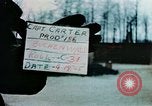
Dead bodies of prisoners from Buchenwald Concentration Camp seen piled up in a truck.
Dead bodies of prisoners from the Buchenwald Concentration Camp, operated by Nazi Germany in Ettersberg near Weimar Germany. World War 2 U.S. Army Cameraman slate indicates footage is from Buchenwald and was filmed on April 14, 1945, soon after the camp's liberation on April 11 by American forces. Dead bodies of prisoners lie on ground. Emaciated and tortured bodies of atrocity victims seen piled up in a truck. Dead man with a beard. Different bodies piled up in a truck. Faces of the dead bodies.
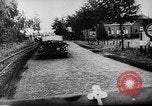
Nazi leader Dr. Joseph Goebbels visits General Model on Western front. He also addresses German workers in Cologne
Nazi German Minister of Propaganda Joseph Goebbels visits Field Marshal Walter Model on the Western Front during World War II. A staff car driving on a road, likely in Oosterbeek near Arnhem, Netherlands. Joseph Goebbels shakes hands with Marshal Model upon arrival at the latter’s headquarters. Marshal Model performs the Hitler Salute. Other visitors saluted back. A Nazi SS soldier stands guard, watching the arrival of Goebbels. Other officers perform the Nazi salute. Joseph Goebbels and Marshal Model greet each other with the Nazi salute. Goebbels returns to his staff car camouflaged with pine branches. Goebbels talks to Marshal Model before leaving Model’s headquarters. In another sequence, Nazi German Propaganda Minister Joseph Goebbels visits an armaments factory in Germany. Sign on the wall reads ‘Front und Heimat keen nur ein Ziel: Kampf bis zum Sieg!’ (‘Front and home have only one goal: fight to victory!’ in English). More Nazi factory signs reads ‘Unerschütterlich Kampfentschlossen Siegesgewiss!’ (‘Unshakable, determined to fight, certain to win!’) and ‘Mit dem Führer zum Sieg!’ (‘With the Führer to victory!’). Armaments workers perform the Nazi salute inside the factory. A Nazi German standard with the German name of Cologne ‘Köln’. Joseph Goebbels delivers a speech in front of German factory workers. Crowds of German factory workers and Nazi officers, including young men and women, listen to Goebbel’s speech. Goebbels gives encouragement to the workers during his speech. Goebbels talks about the war’s progress and Nazi Germany’s allies, such as Romania. He thanks them for their efforts. Goebbels ended his speech to the enthusiastic applause from the audience. The crowds began to sing a patriotic Nazi song, likely the Horst Wessel song. A Nazi standard representing ‘Rhein’.
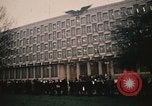
U.S. President Nixon at U.S. Embassy in London, German Chancellery and Villa Hammerschmidt in Bonn during his Europe visit.
U.S. President Richard Nixon in the U.S. Embassy in London and German Chancellery in West Germany during his visit to Europe. Motorcade of President Nixon departs from the U.S. Embassy in London. President Nixon and German Chancellor Kurt G Kiesinger arrive at the German Chancellery Palais Schaumburg in Bonn. President Nixon, West Germany President Heinrich Luebke and other officials and dignitaries pose for group photographs at the back portion of the Villa Hammerschmidt. President Nixon shakes hands with President Luebke. Dr Henry Kissinger and Chancellor Kurt G Kissinger discuss.
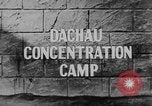
Aerial views of Dachau Concentration Camp soon after liberation; emaciated survivors and dead bodies of camp victims.
Scenes at the recently liberated Nazi German Concentration Camp in Dachau, Germany, near the end of World War II in Europe. Aerial views of the Dachau Concentration Camp showing barracks, grounds, perimeter fencing, and various buildings. The main entrance gate of the camp. Views of some of the surviving liberated inmates from Germany, Poland, Czechoslovakia, France and Holland. Many of the survivors are starved and emaciated. View of a railroad train car that had arrived at the camp, carrying prisoner victims, with more of them dead than alive in the packed train car. Corpses lie inside an open door of a prison train box car. Bodies of victims under a blanket of snow in an open top train car. Some surviving liberated prisoners move piled bodies of dead victims from carts to prepare them for burial.
CRITICALPAST.COM: About Us | Contact Us | FAQs - How to Order | License Agreement | My Account | My Lightboxes | Shopping Cart | Advanced Search | Featured Collections | Website Terms & Conditions | Privacy Policy ©2026 CriticalPast LLC.
License Agreement |
Terms & Conditions |
Privacy Policy
©2026 CriticalPast LLC.