


 Francais
 Deutsch
 Italiano
Refine Your Search
Berlin Germany 1935 stock footage and images
- Showing 4423 to 4428 of 6795 results more
more Hide
Hide
Pope Pius XII blesses crowds and various other officials display festive moods in separate events in the European Theater.
The film 'Two Down and One to Go' talks about the activities of the Axis powers Italy, Germany and Japan during World War II. United States Secretary of War Henry Lewis Stimson at a desk. Animation shows a swastika being exploded over Germany. Caricatures of the late Duce of the Italian Social Republic Benito Amilcare Andrea Mussolini, the late Chancellor of Germany Adolf Hitler and Hideki Tojo. A cross being superimposed on the two dictators. The head of the Roman Catholic Church, Pope Pius XII blesses the crowds in St. Peter's Square. 1st Military Governor of the American Occupation Zone in Germany Dwight David Eisenhower, the Prime Minister of the United Kingdom Winston Leonard Spencer-Churchill, the General Secretary of the Communist Party of the Soviet Union Joseph Stalin display festive moods in separate events. People cheer.
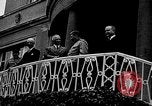
Allied National Leaders hold numerous conferences to plan and coordinate their efforts during World War II
First scene shows President Harry Truman shaking hands with Joseph Stalin on a porch of the Cecilienhof ( home of Crown Prince Wilhelm) in Potsdam, Germany. The two leaders are accompanied by their respective foreign ministers, James F. Byrnes, U.S. Secretary of State, and Soviet Minister of Foreign Affairs, Vyacheslav Molotov. Stalin descends steps from the building followed by Truman. View of the back lawn at Cecilienhof. View of its front entrance. Various views of the house and grounds. American, Soviet, and British flags flying from the building. Cars carrying the leaders on road to the Cecilienhof. President Truman and James Byrnes entering outside gate, followed by other attendees. Then Stalin is seen entering followed by Soviet officers and officials. U.S. General Dwight D. Eisenhower, Supreme Commander Allied Expeditionary Force (SCAEF) in Europea and U.S. Army Chief of Staff. George Marshall are seen walking together in a wooded glade on the meeting grounds. British Field Marshal Bernard Law Montgomery, entering the grounds for the meeting. British Prime Minister Winston Churchill, President Harry Truman, and Joseph Stalin stand on a step before an entrance to Cecilienhof. Truman places their hands together in a mutual handshake, at which Churchill and Stalin laugh. Views of the Kremlin and St. Basil's Cathedral, in Red Square, Moscow, Russia where foreign minsters of the United States, Britain, and the Soviet Union are seen meeting meeting in conference at the Spiridonovka Palace in October, 1943. Closeup of Soviet Prime Minister Vyacheslav Molotov, British Prime Minister, Anthony Eden, and U.S. Secretary of State, Warren Hull, successively signing a document. Scene shifts, to a C-47 transport aircraft flying over great pyramid of Giza in Cairo, Egypt. Next, the front of the Soviet Embassy in Teheran, Iran, is shown. The "Big Three" (Stalin, Roosevelt, and Churchill) sit on the porch of the building. Military officers from their countries stand behind them. Narrator (Franklin D. Roosevelt) says they agreed to launch a gigantic attack on Germany. Scene shifts to Germany, where German military is paraded on public display, showing artillery, Panzer I tanks carried aboard army trucks, Heinkel He 111 bombers in formation overhead, and marching troops giving Nazi salute silhouetted against bright pavement. View shifts to the Livadia Palace, in Yalta, Crimea, Russia. Brief view of the "Big Three" and their staffs sitting around a conference table. Change of location to San Francisco, California, where flags of many nations are displayed along with a United Nations Logo. Representatives of the many nations sign the Charter of the United Nations, founding the U.N. organization on 26 June 1945. Film shifts to Germany where victorious American, British and Soviet troops shake hands and celebrate victory. They share drinks and toast victory.
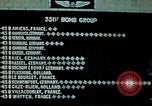
U.S. 351st Bomb Group is briefed before a bombing mission at the RAF base in Polebrook, Northamptonshire, England .
U.S. 351st Bomb Group at RAF Station Polebrook, Northamptonshire, England during World War II. A display board of the U.S. 351st Bomb Group, at RAF Station Polebrook, England, shows 15 principal targets and the number of times they've been struck by B-17s of the Group. The most missions were flown against Schweinfurt, Germany (25 times) and second most, against Hanover, Germany (17 times). Another recent status board records missions against Amiens and Evreux,and Romilly, France; Stuttgart, Germany; and Brussels,Belgium.Swastikas indicate German aircraft shot down during these raids. A C-45 aircraft lands and parks at the field. Major General Ira C. Eaker,Commander 8th Air Force, steps from the plane for a visit with the 351st Bomb Group. He proceeds to the briefing room, in a Quonset hut. Four Officers of the Group pose. View of heavy bombs in the bomb dump. Views of bombs hung wing racks of a B-17 to increase its bomb load. Bombs being transported on motorized dollies. Airmen writing in chalk on a bomb. It reads: "From the boys K of C #92 Jim, MH." Fliers at nighttime in their Quonset hut quarters. One writes a letter. Others trying to sleep, as sounds of aircraft engines are heard. Officer opens door of quarters and wakes crew members, telling them breakfast is at 3AM and briefing at 4AM. Briefing officer asks fliers to guess what the target of the day will be. Several make suggestions. The briefing officer removes a cover from the mission map, revealing target deep in Germany. The fliers respond with good-natured boos. Commander gives final instructions.,
Life in Britain on eve of War. Chamberlain, Hitler and Mussolini signing the Munich Agreement during World War II.
An Allied propaganda film to solidify Anglo-American solidarity within the ranks as well as to counter Nazi propaganda aimed at weakening the alliance shows British soldiers in Great Britain during World War 2. 1938: in the United States New York Yankees win the pennant in baseball; scene of Yankees team members shaking hands. View of aviator Douglas Corrigan nicknamed Wrong Way Corrigan after his accidental flight from New York to Ireland instead of California as planned. View of trains on the 6th Avenue Elevated (or Sixth Avenue El) before that service was halted in Manhattan New York City. British citizens go about their daily life. Derby horse race in a stadium. A British boy and his father shovel dirt for a backyard garden. Players play a football (soccer) game at Wembley Stadium in England as spectators cheer the 1938 FA Cup Final with Preston North End taking the Cup versus Huddersfield Town as George Mutch scores the winning goal. Scenes in Germany: People cheer for German Chancellor Adolf Hitler and give Nazi salute. Newspaper headlines about Czech occupation. Graves in a cemetery. British Prime Minister Arthur Neville Chamberlain, Adolf Hitler Italian Prime Minister Benito Mussolini sign the Munich Agreement. Despite a peace agreement Hitler invades Czechoslovakia. People read 'Military Training Act, 1939'. British soldiers march along a road. View of Adolf Hitler smiling and laughing. Artillery is fired. A poster reads 'Britain Declares War on Germany'. Airplanes in flight and drop leaflets over Germany. German airplanes in flight. Parachutists jump from the airplanes. Hitler talks to officers and considers the war to be over. Radio news broadcast of the British declaration of war on Germany by Neville Chamberlain. Many different British citizens and families shown in living rooms and work places gathered around radios to listen to the so called "We shall fight on the beaches" speech of Winston Churchill on June 4, 1940. Clip includes scenes from 1938 through 1940; from a film produced in 1943.
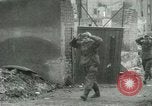
German prisoners of war surrender and led away after seize of Koblenz, Germany during World War II.
German prisoners of war led away by the U.S. soldiers capturing Coblenz during World War 2. German soldiers come out of a gate with their hands raised followed by an American soldier. German soldiers led away. U.S. soldiers try to break down a door. A German lady comes out of a building and a U.S. soldier points out the way to her. A soldier enters the police headquarters at Coblenz. German prisoners of war led away by United States soldiers. A German soldier with a paper in his hand. German soldiers walking and seated with their hands above their heads. American soldiers smiling.
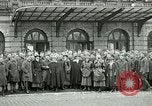
U.S. troops sightseeing on excursion steamer "City of Dusseldorf" along the Rhine River in Germany
U.S. troops, along with women volunteers sponsored by the YMCA ,take a sightseeing excursion by steamer,from Koblenz, in December, 1918.. Scenes of their visit to a monument. On board ship, U.S. army band musicians play music and a few couples dance. A few men dance with each other. At stopping place they visit and an army guide explains the site and its significance. (World War i; World War 1; WWI; WW1)
CRITICALPAST.COM: About Us | Contact Us | FAQs - How to Order | License Agreement | My Account | My Lightboxes | Shopping Cart | Advanced Search | Featured Collections | Website Terms & Conditions | Privacy Policy ©2026 CriticalPast LLC.
License Agreement |
Terms & Conditions |
Privacy Policy
©2026 CriticalPast LLC.