


 Francais
 Deutsch
 Italiano
Refine Your Search
Berlin Germany 1935 stock footage and images
- Showing 4489 to 4494 of 6795 results more
more Hide
Hide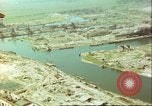
Aerial views of bomb damaged buildings in Rogensburg, Germany after World War II.
Scenes at end of World War II in Europe. Aerial view of the city of Rogensburg with its rivers. A harbor and a dockyard in the city. Bomb damaged buildings.
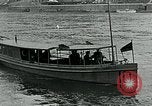
American troops in a patrol boat on the Rhine river at Deutsches Eck in Koblenz, Germany, at end of World War I
American troops patrol the Rhine river in European Theater around end of World War 1 following Armistice. United States Army forces in a patrol boat in the Rhine river at Deutsches Eck or the "German Corner" in Koblenz where the Moselle joins the Rhine. The boat approaches and slowly views a paddle wheel steamboat named Preussen that is flying the American flag and has United States soldiers aboard. The Preussen is docked at Deutsches Eck. Slow pan of the Preussen shows rescue boats and crew aboard. Crew show machine guns setup on the Preussen paddle ship. As boat slowly pulls away there is a view of the equestrian statue of German Emperor William I rising in background behind the moored Preussen. Next view shows same boat on Rhine and view of Fortress Ehrenbreitstein rising up from dock area. Railroad train visible near dock below Fortress Ehrenbreitstein. View changes to a group of American, French and German soldiers on land. A United States soldier lights up cigarette for a German soldier and he shows an insignia on his cap to the German soldier. The German Army soldier looks at the cap, turns and runs away with two fellow German soldiers following. The two remaining American soldiers and one French soldier stand and laugh.

Opening of the Kammerspiele theater in Munich, Germany at end of World War II
Views of the Schauspielhaus on the Maximilianstrasse in Munich, where the The Munich Kammerspiele (Münchner Kammerspiele) theater company is presenting a play. People entering the building. Inside,a U.S. Army Lieutenant shakes hands with the theater company director, Erich Engel, and presents him with a document, as some cast members and theater patrons watch. Closeup of Engel. Local officials converse at front of theater. American military personnel are among the audience seen in background. Scenes shift to cast members getting made up for their roles in Shakespeare's Macbeth. A man being attended by a makeup artist. A woman at her dressing table. Makeup being applied to another man. Backstage, a manager rings a warning bell for the cast and members hurry to take their positions onstage. The stage manager strikes a gong and men raise the curtain. The cast onstage performing.
British Operation Backfire. A V-2 rocket lifts off from a launch pad in Altenwalde/Cuxhaven, Germany.
At the end of World War 2, in a military-scientific endeavor called Operation Backfire, German rocket troops, under British control, built and test-fired three V-2 missiles at the former German naval station in Altenwalde, a district of Cuxhaven in Lower Saxony near the North Sea.. A V-2 rocket is seen igniting on its launch pad, rising into the air, and entering the stratosphere at a speed of 5 thousand kilometers per hour. Views of the rocket in flight. Finally, as the experiment ends, the V-2 shuts down and falls to the earth. (This footage is rare as it contains extra scenes not found in the official Operation Backfire Report film summary. It is also formatted for post-war German audiences.)

Scenes at an Orphanage in Dachau, Germany, at end of World War II.
The time is at end of World War 2. Slate describes this film as the Orphanage at Dachau. A bucolic scene shows horse-drawn wagon moving along country road, with twin spires of a church, visible in the background. Camera zooms in on church spires and roof, and then to a sign near the door reading,"DP Childrens Center, UNRRA, Team 182." (DP means Displaced Persons, UNRRA stands for United Nations Relief and Rehabilitation Administration.) At the entrance, itself, a sign reads:"Ausländer Kinderstation, UNRRA, Ausschuss 182 (Foreign children's ward, UNRRA, committee 182). Children run down the stairs of the building and are seen, next, outdoors in a grassy churchyard of the camp, where they form a circle, hold hands, and dance and sing. Scene shifts to indoors in a high-ceilinged room filled with daylight from several large windows where the children sit for a nourishing mid-day meal. Men in military-like uniforms pass trays of food to children standing in line. A similarly-dressed woman helps several very small children down the stairs. A line of babies sit at a long table and are fed by a Nun in habit. Closeups of the babies trying to feed themselves. Next scene shows a Nun washing the babies, in a nursery, with cribs in the background. View of many pre-school age babies seated on the floor playing together with toys. Outside, in the grounds, school age boys play football (soccer), while schoolmates watch from the sidelines and cheer.
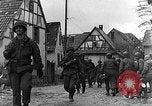
U.S. Infantry in Bitschhofen, Germany, during World War II
U.S. soldiers are seen walking into a village already occupied by U.S. infantrymen, who are lined up carrying their individual mess gear as they move in an outdoor chow line. A little smoke can be seen from an outdoor mess stove (unseen). A sign identifies the town as: "Bitschhofen, Kreis Hagenau." The arriving U.S. troops continue, walking through, and out of the town, along a wet muddy road. Other soldiers, in the town, bring their food back from their mess kitchen. The troops passing through, slog in the mud.
CRITICALPAST.COM: About Us | Contact Us | FAQs - How to Order | License Agreement | My Account | My Lightboxes | Shopping Cart | Advanced Search | Featured Collections | Website Terms & Conditions | Privacy Policy ©2026 CriticalPast LLC.
License Agreement |
Terms & Conditions |
Privacy Policy
©2026 CriticalPast LLC.