


 Francais
 Deutsch
 Italiano
Refine Your Search
Berlin Germany 1935 stock footage and images
- Showing 4603 to 4608 of 6795 results more
more Hide
Hide
German Kaiser Wilhelm II is greeted by British officialdom at Guildhall, in London, during a visit with King George V and Queen Mary
Film opens with scenes of British Horse Guards on parade along street in London, England, watched by crowds on the sidewalks. Next, an elaborate coach, bearing an image of the Coat of Arms of the city of London, is seen arriving at the Guildhall (71 Basinghall St, London EC2V 7HH, United Kingdom). Footmen step to the coach door, where one places a step stool while the other takes the ceremonial mace for bewigged Lord Mayor, Sir Thomas B. Crosby, who steps from the coach, followed by London Sheriff, Sir Charles Augustin Hanson, and other city officials. Four uniformed trumpeters stand in front of the Guildhall and play a fanfare announcing arrival of a royal open coach carrying the monarchs of Great Britain and Germany. When it arrives, King George V quickly steps from the coach and assists Queen Mary as she alights. They are followed by the King's cousin, Emperor (Kaiser) Wilhelm II, of Germany, who steps from the coach. The Kaiser is dressed in Hussar uniform including fur Busby adorned with Totenkopf (Death Head) emblem. A flurry of activity ensues as the King and Queen and the Kaiser engage in greeting various officials and dignitaries. The Kaiser recognizes a woman, likely a relative, in the group and hurries to greet and kiss her.
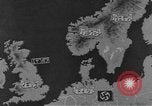
German paratroopers and cruiser Blucher in Oslo, Norway during the invasion of Norway by Hitler's Army.
Invasion of Oslo, Norway by the German Army during World War II. Japanese narration. A map shows the United Kingdom, Germany and Norway. The map shows airplanes advancing from Germany to Oslo. German Kriegsmarine Navy ships at sea shelling targets in Norway. View of guns on German navy ships firing. German Luftwaffe airplanes attack Norway. German ships advance towards Norway. Cruiser Blucher enters the Oslo Fjord. German intruder fires. Colonel Birger Erichsen, the commander of Oscarsborg Fortress, works on some papers. German military airplanes fly across a sea. Fallschirmjager, German paratroopers are airborne. German paratroops seen inside the aircraft, seated and talking to each other. View out aircraft window flying low over a German seaplane base with several seaplanes parked in water outside Oslo. View from ground of low-flying German troop transport aircraft coming in for landing. German occupied fort with German flag beside Norwegian town. German military equipment convoy rolls down a road in Norway .German military trucks advance on Oslo through towns with shops and homes. German guard outside a German aviator post. The Germans march into Oslo. Military vehicles with German soldiers move ahead.
Soviet-German non-aggression pact is signed in Moscow and the Germans and the Red Army invade Poland in the European Theater.
German aggression during World War II. German troops marching in formation. A large crowd on either side of a road watches the troops. German Chancellor Adolf Hitler delivering a speech in Germany. Troops standing in formation listen to Hitler. On August 23, 1939 : People holding banners that read 'Down with War and Racism' and 'Aid the Allies'. New York Times headline reads: 'Reich and Soviet Join for Peace -- or War; No Buffer State; New Pact Warns Allies; Estonia Gives Moscow Sea and Air Bases'. Soviet politician Vyacheslav Molotov, Soviet Union leader Joseph Stalin and German Foreign Minister Friedrich Wilhelm Ribbentrop with other officers during the signing of Soviet German non-aggression pact (also called Molotov–Ribbentrop Pact) in Moscow, Russia in August, 1939. German Stuka dive bombers in action, when Germany invades Poland in a "blitzkrieg.".German Heinkel He-111 bombers in action. Buildings being totally destroyed by bombs. Red Army tanks and troops moving in snow. Victorious German troops marching in occupation. German heavy artillery batteries firing.
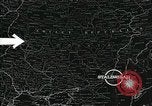
Expansion of Soviet and Communist Chinese territories from World War II through 1949
German invasion of Russia during World War II. A map showing German invasion path in Russia until defeat at siege of Stalingrad. A map showing Soviet postwar expansion into Eastern Poland, East Prussia, portions of Finland and other areas. Latvia, Lithuania and Estonia are incorporated as Republics into the Soviet Union. Russian zones of occupation in Germany, Austria and North Korea. Map depicts an "Iron Curtain" encompassing the Soviet postwar territories. Soviet troops and tanks occupying countries. Soviet ZSU-57-2 self-propelled anti-aircraft guns traveling along a city street. Crowds cheering in a stadium in Soviet East Germany. President Wilhelm Pieck of the German Democratic Republic is among people seen applauding in the stands. . Soviet cargo ships in a harbor operating under trade agreements. Chinese Communist forces moving with guns and artillery and tanks to expel Chiang Kai-Shek and Chinese Nationalists from mainland China to Taiwan, in 1949. Chinese refugees flee an area, carrying an injured civilian on a stretcher. A refugee child is shown with the group of people.
Animation and footage depict American strategies to attack the Nazis in the European Theater during World War II.
A film about U.S. response to the activities of the Axis powers Italy, Germany and Japan during World War II. U.S. Army Chief of Staff George Marshall praises the United States Military offensives in Europe and Africa. George Marshall narrates rest of the clip. Animation of a globe depicts the Allied forces in the middle east planning to isolate China and Russia. The animation depicts the German Forces crossing the British allies, joining Japan and then attacking America. It depicts U.S. plans to stop the collaboration of Germany and Japan. Scenes of American shipyards are shown, with workers building new war ships. Some workers welding. A sign reads, "Work must continue during launching. Positively." The animation depicts the shorter routes to the European Theater. Aerial footage of a large fleet of U.S. Navy Ships at sea, underway during World War 2. Next scenes shows smoke pouring from ships at Pearl Harbor in Hawaii following attack by Japan. View of Soviet Russian horse cavalry forces charging toward enemy German positions during a battle in World War 2. Scenes of Allied artillery being fired at night in North Africa. Animation depicts the need to establish American air bases closer to Japan before launching successful air attacks. Footage of U.S. soldiers running out of landing crafts and coming ashore at a beach head during World War 2. Animation depicts U.S. plan to defeat Japan. Animation depicts strong German Army. Animation depicts U.S. plan to defeat the Nazi and the Fascist power in Europe.
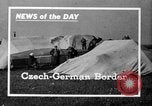
Refugees near tent houses and articles including tables, chairs and beds kept near the tents of a refugee camp in Europe.
A refugee camp at the Czech-German border in Europe, around time of German occupation of Sudetenland. Refugee people including many Jewish refugees in front of tents at the refugee camp where they have fled from violence in Germany. Tent houses in a line. A man stands near a bicycle. A woman comes out of a tent house. Women talk in front of the tents. Tables and other articles kept on the ground. A bed outside a tent house. The women talk. Close up views of faces of some of the women refugees. Vegetation in the foreground. Newspaper headlines about Nazi violence against jews in Germany including Kristallnacht events.
CRITICALPAST.COM: About Us | Contact Us | FAQs - How to Order | License Agreement | My Account | My Lightboxes | Shopping Cart | Advanced Search | Featured Collections | Website Terms & Conditions | Privacy Policy ©2026 CriticalPast LLC.
License Agreement |
Terms & Conditions |
Privacy Policy
©2026 CriticalPast LLC.