


 Francais
 Deutsch
 Italiano
Refine Your Search
Berlin Germany 1935 stock footage and images
- Showing 463 to 468 of 6795 results more
more Hide
Hide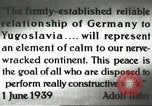
Tripartite Pact signed by Germany, Italy and Japan in Berlin, Germany. Ensuing attacks by Germany and Japan in World War II
This film is a scattering montage of World War 2 scenes from 1939 through 1945. Part of an agreement between Nazi Germany and Yugoslavia is shown in English. It is dated June 1, 1939 and ostensibly signed by Adolf Hitler. Next, German Ju 87, Stuka dive bomber aircraft are shown peeling off from formation, on April 6, 1941, to attack Yugoslavia. Bombs bursting on the ground. Closeup of a Stuka airplane in a dive, making its characteristic whine, and dropping bombs. Bombs exploding just outside some concrete walls. German infantry running along railroad tracks and entering backyard of house in a village. German soldiers observing from overlooking hill; climbing over rubble; and marching along a road toward a village. Animated map showing German invasion areas early in World War II, extending through most of Europe and into Norway, by 1941. Animated map shows further invasions into France, Belgium, low countries, the Balkans, and Eastern front towards the Soviet Union. Map highlights Tokyo, Rome, and Berlin. Delegations walking in hall of Reich Chancellery in Berlin, to sign Tripartite pact, on September 27, 1940. The group is led by by Count Galeazzo Ciano (Italian Foreign Minister, and Mussolini's son-in-law); Joachim von Ribbentrop, Germany's Foreign Minister and Japan’s Ambassador Saburō Kurusu. The diplomats are seen, next, standing near a table as Adolf Hitler enters rendering Nazi salute. He shakes hands with Count Ciano and Ambassador Kurusu. Hitler is seated to watch the proceedings. Von Ribbontrop is seen signing for Germany. Next scenes show German armored units heading East in Operation Barbarossa (June of 1941). A sign identifies the town of Eydtkau (Eydtkuhnen) on the German-Lithuanian border. German armor and artillery moving eastward. German troops destroying international crossing barriers. German troops firing siege guns. Montage with glimpses of German battle scenes showing tanks, guns, rockets in action with attendant explosions, fires, and destruction. Formations of German warplanes in flight, including Junkers Ju-52s that carry troops, including paratroops. View from above of Junkers Ju-87 Stuka dive bombers in formation. Battle of Britain scenes, with view of St. Paul's Cathedral in London, England (which miraculously survived the Blitz). The Tower Bridge in London, seen through a haze following blitzkrieg. German Junkers 87 Stuka dive bombers peeling off from formation to attack. British anti-aircraft searchlights shining beams skyward. Diving bombers illuminated by the lights. Anti-aircraft guns firing. Nighttime scenes showing gunfire flashes, explosions, tracer bullets and fires in London. British fire brigades fighting fires in London buildings as some collapse from the German bombing during the so-called "Blitz." Scene shifts to Pearl Harbor, December 7, 1941, as a Japanese bomb explodes on a U.S. Navy warship. The USS Arizona billowing smoke and listing as it succumbs to Japanese bombing. Another view of the Arizona sinking. Smoke rising from Battleship Row, at Pearl Harbor. Glimpse of postwar Nuremberg trial.

Thousands of Eastern Germans cross the border to enter Berlin in West Germany and fed at the refugee camps by policemen.
Thousands of refugees cross the borders and flee Eastern Germany to Berlin in West Germany. A registration center in West Germany with long lines of refugees at registration center. The refugees checked for disposition for West Germany. Refugees kept at a refugee camp in an exhibition center. Men, women and children during their daily activities at the refugee camp. West German police officers supply milk and ration to the refugees. Women feed their children at the refugee camp.
U.S. President John F Kennedy at Brandenburg Gate in West Berlin, Germany.
Scenes of persons moving a board on East Berlin side at Brandenburg Gate (Pariser Platz, 10117 Berlin, Germany). Scenes of press and official cars. President Kennedy arrives escorted by motorcycle police. President, British Army Commandant Major General David Peel-Yates, Chancellor Konrad Adenauer, Mayor Willy Brandt and USA Aide Brigadier General Clifton climbing steps to platform and overlooks East Berlin. Scenes of press, TV cameramen and spectators. President Kennedy's party and buses leaving. Spectators travel along the route.
U.S. President John F Kennedy at Check Point Charlie in West Berlin, Germany.
Scene of banner stating "Welcome John F Kennedy" and U.S. flag at Checkpoint Charlie (Friedrichstraße 43-45, 10117 Berlin, Germany). President John F. Kennedy walks past the Checkpoint Charlie at the American sector. An U.S. military personnel salute, and President talks to unidentified American Brigadier General with West Berlin Mayor Willy Brandt. Mayor Brandt, President Kennedy, and USA Major General Polk at vantage point looking toward East Berlin. Chancellor Adenauer, President Kennedy, Major General Polk and Brigadier General Clifton leaving platform. President standing in car with Chancellor and Mayor. Building showing spectators cheering and throwing shredded paper. Mayor Brandt, President Kennedy, and party leaving.
World tensions after World War II. The Baruch Plan. The Berlin Airlift. The Korean War. The Cold War. The Atomic age. Ballistic Missiles
Speaking before United Nations Atomic Energy Commission (UNAEC) in its first meeting in June 1946, Bernard Baruch proposes international control of all atomic energy -- the so-called Baruch Plan. Low level aerial view of ruined post World War 2 European city. Goods including heavy equipment, locomotives, being loaded aboard ships to aid in the postwar recovery of Europe (The Marshall Plan). Workers in Western Europe making use of Marshall Plan materials to rebuild their national infrastructures. West European farmers restoring agriculture. View from overflying light airplane of parts of postwar Berlin in 1948. Blocked roads and empty railroad tracks leading from East Germany to West Germany, blocked by the Soviet Union. Barge traffic at standstill due to Soviet actions. U.S. C-54 transport aircraft flying supplies into West Berlin (The Berlin Airlift) during the Soviet blockade of that city. West Berlin citizens watching U.S. transport aircraft bringing fuel, food and other essentials into the isolated city. A C-54 flying low over empty railroad lines, as it prepares to land in West Berlin. Supplies offloaded from a DC-3 ( AKA C-47 or British Dakota) equipped with unusual set of rear cargo doors. Supplies being moved on Tegel Airport with many C-54 aircraft in the background. Numerous C-47 aircraft operating at Tempelhof airport. An East German official opening a barricade as Soviet blockade of West Berlin ends on May 12, 1949, and supply trucks begin to move over roads again. Flags of Western nations flying on high flagpoles. Glimpse of Allied warships underway during the Cold War. Formation of P-38 Lightning aircraft in flight overhead. NATO troops marching and NATO armor on parade. Flashes of heavy artillery firing at night. Korean refugees moving South in 1950 with the outbreak of the Korean War. View of UN Security Council meeting in the absence of Soviet representative. U.S. tanks firing guns and American infantrymen in conflict with North Korea in Korean War. American wounded on stretchers.Delegates of both North and South Korea signing the Korean Armistice Agreement in P'anmunjŏm, on July 27, 1953. A rocket is launched. Images of earth from inside a space craft in orbit. Narrator mentions the first satellite to circle the earth, the soviet Sputnik 1 in 1957. View of Soviet pilots in low pressure altitude chamber. A test subject in an aircraft making a maneuver that allows him to experience "weightlessness." Objects in his cockpit float about. A military rocket launch monitored by arrays of radar. An object being retrieved from space by means of a parachute. A nuclear powered submarine. Rockets on display during a military parade in Red Square, Moscow, the Soviet Union. A U.S. Air Force B-52 bomber taxiing. More views of rockets seen during a Soviet military parade in Red Square, Moscow.
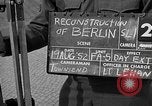
Shoppers shop at Kurfürstendamm street and a building under construction in post-war Germany under reconstruction.
Reconstruction of Berlin, Germany after World War 2. Quonset hut type barracks buildings in an area of Berlin. Buildings on Meringdam street. Buildings on Kurfürstendamm street in the British Zone including the heavily damaged Kaiser Wilhelm Memorial Church (Breitscheidplatz, 10789 Berlin, Germany) in the center of the Breitscheidplatz. Civilians walk in the streets and shop. Traffic on the streets. Cars parked in the background. A sidewalk displays a box. A building under construction. A hotel. Civilians ride bicycles on the road. The Rathaus Schöneberg (John-F.-Kennedy-Platz, 10825 Berlin, Germany) and civilians on the street.
CRITICALPAST.COM: About Us | Contact Us | FAQs - How to Order | License Agreement | My Account | My Lightboxes | Shopping Cart | Advanced Search | Featured Collections | Website Terms & Conditions | Privacy Policy ©2026 CriticalPast LLC.
License Agreement |
Terms & Conditions |
Privacy Policy
©2026 CriticalPast LLC.