


 Francais
 Deutsch
 Italiano
Refine Your Search
Berlin Germany 1935 stock footage and images
- Showing 4759 to 4764 of 6795 results more
more Hide
Hide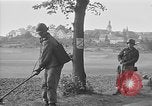
United States troops sweep for mines during mock combat in NATO "Exercise Monte Carlo"
An American soldier uses a mine detector while "protected" by another armed soldier, during NATO "Exercise Monte Carlo" in Germany. An area at the side of a road is cordoned off with triangular flags warning of mines.
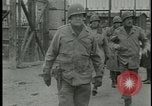
U.S. General Dwight Eisenhower, Archbishop of Canterbury, other officials tour Ohrdruf concentration camp after its liberation
U.S. General Dwight D. Eisenhower and other officials in the liberated Ohrdruf concentration camp in Germany near end of World War 2 in Europe. U.S. military officials enter the gates of the Ohrdruf concentration camp. The officials walk on a path inside the camp. U.S. General Dwight Eisenhower with other officials inside the camp. Inmates who had survived in the camp demonstrate a torture device where they are stretched across a wooden platform. General Eisenhower and officials watch. The ground covered with the dead bodies in some areas. Arch Bishop of Canterbury and other church dignitaries visit the camp and inspect. The civilians of the Allied Investigation Commission inspect the camp. The officers walk in front of the camp. They visit the dungeons, crematories, and there is a sign beside a rack of bunks: "5 men with operations in each box". Dead bodies of concentration camp victims piled up. The group of officials view. The officials inside the dungeons with piles of dead bodies of human beings. The remains of the bodies in an enclosure where they were burned in furnaces. The officials stand outside the enclosure.
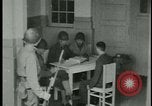
Concentration camp devastation scenes at many German camps including Hadamar, Landsberg, and Bergen-Belsen camps after liberation
Various concentration camps after liberation in Germany during World War 2. A few U.S. officials interrogate the commander and chief medical officer at the Hadamar Mental facility. Evidence of patient abuse, experiments, and extermination is reviewed. The bodies of the victims of the murder. The body of a woman. Soldiers carry bodies and place them on the ground. The bodies of prisoners who were starved to death and those tortured to death. Bodies piled up near a building. Bodies of victims at Dachau. Narrator accounts and scenes show murdered prisoners at many camps. The bodies of prisoners in Landsberg Concentration Camp. The dead bodies of prisoners in various concentration camps who were killed by burning, shooting, starvation or poison gas. The dead body of a mature human infant embyro. The dead bodies of prisoners who were shot or starved to death in concentration camps including Landsberg, Dachau, Mauthausen, Bergen-Belsen, Nordhausen, Leipzig, Auschwitz. Piles of dead prisoners who were burnt to death by high voltage wires. A few women are seen who survived the torture in the camps.
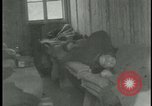
Liberated concentration camp victims including men, women, and children, are aided by physicians and soldiers
Gravely wounded and sick liberated concentration camp victims in Germany near the end of World War 2 in Europe. Several wounded women in a camp after liberation being attended to by physicians. At Auschwitz, children who lost their parents walk along a fenced corridor. The children show tattoos on their arms that are marks for identification. At other camps, two men who were survivors, one man whose eye was gouged out by the Nazis. Men behind barbed wire. Tortured men who could not walk or crawl being helped by soldiers. Naked, starved liberated victims stand in a line to receive aid. Man helps a starved man to walk. A man crawls. Bodies of prisoners who died . Officials beside the bodies.
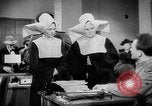
Reenactment of the activities at Russian occupation headquarters in German city at the end of World War II.
From a Russian feature film "Meeting on the Elbe" depicting East Meets West meeting of the American and Russian soldiers at the River Elbe in Germany on April 25 and April 26, 1945. The film is dubbed in Korean. Reenactment: The interiors of Russian occupation headquarters in a German city perhaps intended to be Torgau. An American officer talks to the Russian officer in the headquarters. Two nuns stand beside them and listen to the conversation. The American officer moves over and picks up the telephone and speaks over the telephone. The nuns and the Russian officer watch the American officer. The Russian officer sits down at the table and writes on a paper. The American officer leaves and the nuns bow to the officer. A woman in a bicycle approaches the American officer. The woman speaks to the officer. Other men and women move about in the headquarters. The American officer talks to a group of men. The officer talks to a couple of men. A Russian guard stands behind. The American officer outside a door to an office room.

Man place effigies on a float after the end of Europe's Gala Carnival.
As part of the cleanup, a week after the Carnival, workmen destroy floats used during pre-lenten festivities in Germany. The floats represent all manner of things from a person needing first aid, to caricatures of political figures. A sign reads "wohlstand fur alles" (Prosperity for everyone). Caricatures of Konrad Adenauer and Ludwig Erhard are among the floats being destroyed. One float depicts a gymnast, smoking a cigar, as he exercises on parallel bars.
CRITICALPAST.COM: About Us | Contact Us | FAQs - How to Order | License Agreement | My Account | My Lightboxes | Shopping Cart | Advanced Search | Featured Collections | Website Terms & Conditions | Privacy Policy ©2026 CriticalPast LLC.
License Agreement |
Terms & Conditions |
Privacy Policy
©2026 CriticalPast LLC.