


 Francais
 Deutsch
 Italiano
Refine Your Search
Berlin Germany 1935 stock footage and images
- Showing 5227 to 5232 of 6795 results more
more Hide
Hide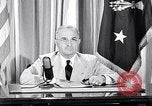
President Harry Truman of the United States speaks about dropping atom bomb on Hiroshima, hours before attack on Nagasaki.
President Harry S. Truman of United States addresses the United States following his return from the Potsdam Conference in Germany, during World War II. President sitting at a desk at the White House explains the choice of Hiroshima as a target for the atomic bomb due to its focus as an industrial rather than a residential center. (This speech is made on the same day as the dropping of the atomic bomb on Nagasaki, but either before the Nagasaki bombing occurred, or before it was confirmed and announced publicly). President Truman warns of additional atomic bomb attacks on more industries in Japan and says the Japanese can foresee what will happen in a future atomic bomb attack, based on what happened at Hiroshima. Truman reminds about the number of warnings issued to the Japanese by the US, Chinese and British governments and how the Japanese rejected them. In a foreshadowing of the attack on Nagasaki, Truman says "I urge Japanese civilians to leave industrial cities immediately, and save themselves from destruction."
Scenes of warfare using American technology, including submarines, aircraft bombing of London, atomic bomb use in Japan
Training regarding relief and rebuilding works in Germany and Japan by United States Army, after World War II. Narrator discussing adoption of American inventions during the war that were used against America and allies. Sketch of an early American submarine design, followed by view of German U-boats operating under sea, firing torpedoes and target ship is destroyed. Footage of Wright brothers with an early Wright Brothers airplane invention, as they prepare it for a flight. This is followed by a view of London burning after aerial blitz raids by German aircraft during World War 2. View of atomic bomb explosion over Japanese city of Nagasaki and mushroom cloud seen from the air. Also view of Trinity blast in New Mexico - the first U.S. atomic test. The atomic cloud rises high and vast in the sky. Narrator warning against the perils of a third world war.
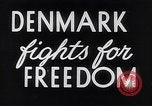
German occupation, martial law, and Danish resistance in Denmark during World War II
Film about Denmark after the Nazi German occupying force declared martial law and state of war with Denmark, in 1943-44 during World War 2. It was made by Danes and smuggled out of Denmark during that period. Opens with view of a church building and flocks of birds. Views of German army troops marching into Copenhagen, Denmark on April 9, 1940. SS troops dressed in black, marching. German soldiers carrying rifles with fixed bayonets, goosestepping. A fire burning at site sabotaged by Danish resistance elements in 1943. Derailed trains carrying goods to Germany. Fire at a German factory. Danish workers with bicycles staging a strike in protest German measures in response to resistance actions. Danes gathered in outdoor observance memorializing those killed by the Germans. A shop owned by German sympathizers (Quislings) destroyed by other Danes. People gathered on street on 29 August 1943, when the occupying German forces attacked the remaining Danish garrison and declared martial law. Announcement posted in Danish on a wall. View of Danish Naval vessels ordered scuttled by the Danish Admiralty, including the coastal defense ship,Peder-Skram, seen in front of a large building, the submarine, Havfruen (not seen) and others seen sunk at docks in Copenhagen harbor. Bullet hole through a glass window. A week later, on Sunday, 5 September, 1943, a German Panzer light tank is seen moving on a street, as pedestrians go about their business in Copenhagen. German soldiers patrolling on a motorcycle with sidecar. A man holding his hands up as he is hustled through a crowd under arrest by a German in black uniform (possibly Gestapo or SS). Motorcycle driving through pedestrians on the sidewalk. Spectators line a fence by an open field near a building labeled "Badstue Badminton." One, a woman, speaks through the fence to a Danish soldier interned there. View of the quarters of the Royal Guard at Rosenborg, occupied by German soldiers and with Nazi flag flying above it. Civilian relatives of interned men wait outside army headquarters for news about them. A courtyard, during a mass funeral, is filled with memorial flower wreaths covering the coffins of Danish soldiers and civilians killed by the Germans. Camera focuses on a wreath from King Christian of Denmark, among the many others. Two German soldiers march up a path at the Royal Residence Amalienborg, where King Christian is arrested. Views from moving camera as Danish flags are seen flying all over the city of Copenhagen, on 26 September, 1943, to celebrate the King's 73rd Birthday. The major exception is the Nazi Gestapo headquarters in the "Shellhus" (the prewar Shell Oil offices) shown in isolation. Views of people moving their belongings on hand carts after their homes were taken over by Germans. The slogan in English, "Do it well and do it now,"is seen left by Danish resistance fighters where they sabotaged a German military installation.
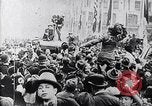
Post World War I political issues in the U.S.A. including Red Scare, anarchists, labor strife, and KKK
A huge crowd on streets of New York City cheering and celebrating victory over Germany in World War I after signing of the Armistice. A cemetery of U.S. soldiers died in World War I. Cross burning and views of hooded Klan members at a Ku Klux Klan (KKK) ceremony, with several uniformed U.S. Army soldiers in foreground, dimly lit (possibly at Stone Mountain Georgia but location not confirmed). Palmer Raid victims: Suspected leftists, left wing, and anarchists seen being led away in a group by police after their homes were raided and searched without search warrants, and some were deported, under program led by U.S. Attorney General A. Mitchell Palmer, during 1919 and 1920. (Second group shown is likely in Paterson, New Jersey; note sign for J.T. Doremus Hardware on building in background.) Palmer Raid arrestees seen behind barbed wire fences where they were held without charges for three months and denied legal representation. Some arrestees being escorted by U.S. soldiers in uniform. Vigilante businessmen and town leaders enforcing 12 hour work days at Steel factories in Pittsburgh Pennsylvania and Gary Indiana. Vigilantes (deputized and armed by local authorities) seen with rifles and shotguns marching down streets enforcing labor demands and countering steel workers on strike. They approach a striking worker on the road side and seize a stick he is holding. They beat a protestor with sticks. Together with police they begin to hit and beat back the protesting crowd of men. Someone fires a gun in the crowd and shooting starts on both sides during fight. An injured or dead steel worker on the ground is lifted up by a man and carried away.
America plunged into World War 2. Montage of various World War II scenes over the span of the war years
American Jitterbug dancers seen at a contest in 1938. View of feet in shoes, as wearers tap their feet and beat time to music. View of drummer using wire brush on drum. Stadium of people cheer for a dancing cinematographer who is using a motion picture camera to film the event. In contrast, Nazi troops seen parading by torchlight. Nazi flags everywhere and Nazi party ceremonies, overseen by Adolf Hitler, in Germany. Nazis burning books. "Attention Jews" with skull and crossbones painted on stores and business establishments. Nazi Storm Troopers intimidating Jewish businesses and advocating boycott. Glimpse of Heinrich Himmler, in foreground, and Hermann Goering, in center of group of Nazi officials. Junkers Ju-87 Stuka dive bombers attacking Poland in 1939. German artillerymen firing heavy guns. A German railroad gun firing. German paratroopers jumping from Ju-52 trimotor transport aircraft. In contrast, patrons are seen descending in parachutes on the Parachute Jump ride at Coney Island Steeplechase Park, in Brooklyn, New York. Life Savers company sponsorship sign seen atop the parachute jump tower. People eating hot dogs, and firing guns at the shooting gallery on Coney Island's boardwalk. Germans march Polish prisoners of war. German troops invading Denmark and Norway. German troops passing a road sign for Chemin des Dames in Picardy, Northern France. Bomb exploding at Pearl Harbor, Hawaii, on December 7, 1941. American forces engaged in war against japan in the Pacific and against the Axis powers in Europe. U.S. soldiers throwing hand grenades. American wounded being carried on litters. People cheering liberating Allied forces in a European town. British soldiers on a vehicle displaying cartoon of Prime Minister Winston Churchill. Soviet forces advancing in snow. U.S. steel and war plants in operation. Men and women war production workers in American defense plants and war materiel factories, using drills, lathes, and power tools in the spirit of "Rosie the riveter." C.I.O. Poster to promote voting, during the war. Closeup of Sidney Hillman, President of Amalgamated Clothing Workers of America. Spectators line sidewalks to get glimpse of President Franklin D.Roosevelt (FDR) in a motorcade. Silhouette of two soldiers helping wounded comrade. FDR's funeral cortege. U.S. troops taking a break, in a war zone. American school children run into a field. An atomic bomb explosion.
Infantry, artillery, and warplanes during the D-Day invasion by Allies in Normandy, France during World War 2.
The D-Day assault on Normandy by the Allies, against Germany's conquest in World War 2. Troops of infantry, artillery and tanks, warplanes ready assembled in south of England for attack at Normandy in France on June 06, 1944. Supreme Commander General Dwight D. Eisenhower and British General Montgomery in discussion with each other. B-17 bombers on mission to Nazi bases. Soldiers move from warships to landing crafts, and land on the coast of Normandy under enemy fire. Parachute troops jump from aircraft landing behind enemy lines. Surrendered German soldiers march, guarded by Allied soldiers. From a June 13, 1963 newsreel recounting events years earlier.
CRITICALPAST.COM: About Us | Contact Us | FAQs - How to Order | License Agreement | My Account | My Lightboxes | Shopping Cart | Advanced Search | Featured Collections | Website Terms & Conditions | Privacy Policy ©2026 CriticalPast LLC.
License Agreement |
Terms & Conditions |
Privacy Policy
©2026 CriticalPast LLC.