


 Francais
 Deutsch
 Italiano
Refine Your Search
Berlin Germany 1935 stock footage and images
- Showing 5287 to 5292 of 6795 results more
more Hide
Hide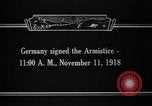
World War I armistice celebrations; Allied soldiers being decorated by General Pershing
People celebrate on the streets of New York after the Germans sign the armistice agreement ending World War 1 on November 11, 1918. People cheer and wave their caps. A French couple thanks Allied soldiers for rescuing them from Germany. Allied soldiers lined up in a field in France as U.S. General John J. Pershing decorates them. Troops of the United States 42nd Division march at a parade as General Pershing reviews them. Soldiers carry American flags at the parade.
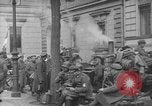
Central Powers troops at end of World War I
German soldiers relaxing on sidewalks of a city in Germany at end of World War 1. German Imperial flag with crest on display. Smoke rising from field kitchen stove. View of troops resting on sidewalk island. Arms are stacked and some troops are napping. Complete change of scene to Ottoman Empire Turkish troop bivouac in a valley during First World War. Numerous tents are erected. A soldier getting shaved in the foreground. Turkish troops eating at open air mess tables.
Scenes of World War 1 and the period between the wars, illuminating career of U.S. Air Force General Henry (Hap) Arnold.
Newspaper headline in Washington post reads 'United States and Germany at War'. Civilians recruited into the army. American pilots of the 103rd Aero Pursuit Squadron, in France, with their Spad aircraft. American airplane production factories in operation, with manny women war production workers seen assembling aircraft. People celebrate in the streets at end of World War I at time of armistice. Airplanes, under command of General Billy Mitchell bomb obsolete warships in demonstration of aircraft power in warfare. 1920s: Postwar flyers and stunt wing walkers perform in the roaring twenties. Developments and improvements in parachutes, and view as stunt men parachute from high buildings and airplanes. Aircraft flying forest fire patrols. Aerial view of burning forest fire below. Lieutenant Colonel Arnold commands emergency airlift and drop of food to snowbound Native American Indians in American Southwest, in 1932. World War I scene of American 103rd Aero Pursuit Squadron Spad airplanes taking off, in France. Lieutenant Colonel Hap Arnold with his family, including two young boys and a young girl (his sons and daughter) and his wife.
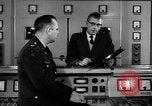
Lieutenant Colonel Robert Cranston at AFN (American Forces Network) radio station talks about its network coverage area.
Lieutenant Colonel Robert Cranston at AFN (American Forces Network) radio station. Animated map shows AFN transmitters and studios in Germany, France. Lieutenant Colonel Robert Cranston talks about the broadcast of AFN radio. Man walks through gate with 'American AFN Services in Europe' written on wall. View of a radio tower. AFN Munich Headquarters building. Sergeant Lloyd Eyre writes on a piece of paper. News readers operate controls and broadcast news from AFN Radio station. Includes various shots of radio studio equipment in control room and microphones in studio.

Church in Pisinimo, Arizona with traditional Native American Indian artwork, located on reservation of Tohono O'odham
Milestone arrow with Pisinimo written on it. Cactus plant with a cross over it in front of a church. View of a Native American Indian carpet that includes two swastika symbols, used commonly by the American Indian before its use by Germany. The murals on ceiling include 'The Last supper' done in traditional, centuries old geometric pottery design. Indian priests walk out of the church, located on the Tohono O'odham reservation (sometimes previously called the Papago Reservation), wearing white robes.
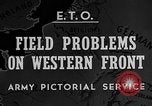
Montage of scenes during World War II on the Western front during January 1945
January, 1945, on the Western front during World War 2. Troops of the U.S. 8th Infantry Division test new white camouflage coveralls for use in snow. They patrol in snow covered forest areas on the Western Front. A sergeant makes outdoor field adjustments to the coveralls using a knife and captured German sewing machine. He helps a soldier who tries on his new coverall. The material used is from old mattress covers. Several soldiers are seen putting on the camouflage coveralls. Scene shifts to U.S. troops with a jeep towing a 20mm Italian dual purpose gun for use in Germany. On January 2, 1945, they set up and fire the gun at targets a half mile away. In Belgium, U.S. Army engineers of Company B, 238th Engineer Battalion, improvise remote controlled bazooka shells as road blocks. They set them up on fence posts and fire them by ordinary flashlight batteries. U.S. soldiers from a Signal Company of the 99th Infantry Division are seen using a Weasel vehicle (officially designated an M29C light cargo carrier) to lay communication cables through snow in the 1st Army Sector, Belgium. Views of the wire spool on back of the weasel, and soldiers pulling wire from it.
CRITICALPAST.COM: About Us | Contact Us | FAQs - How to Order | License Agreement | My Account | My Lightboxes | Shopping Cart | Advanced Search | Featured Collections | Website Terms & Conditions | Privacy Policy ©2026 CriticalPast LLC.
License Agreement |
Terms & Conditions |
Privacy Policy
©2026 CriticalPast LLC.