


 Francais
 Deutsch
 Italiano
Refine Your Search
Berlin Germany 1935 stock footage and images
- Showing 5323 to 5328 of 6795 results more
more Hide
Hide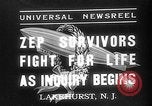
Rescue efforts and official persons being questioned after German Zeppelin Hindenburg disaster in Lakehurst, New Jersey.
Aerial views of the wreckage of German Zeppelin Hindenburg (D-LZ129) that crashed and burned while attempting to land at the U.S. Naval Air Station, Lakehurst, New Jersey, United States. Ambulances and other vehicles. Navy inspection board members walk around the zeppelin. Remains of the airship lying on ground. Ambassador of Germany Hans Luther walks down stairs and poses. Injured passenger being put into ambulances and transported From Lakehurst to major hospitals in New York City. Unharmed crew members at officer's mess of Naval station. Youngest crew member,13 year old Werner Franz, cabin boy on the Hindenburg, poses. U.S. Navy Commander Charles E. Rosendahl, head of the Naval Station being questioned by official from investigating committee of Bureau of Air Commerce Board. Inspection committee members seated.
Scenes of destruction from late 1939 in Finland during the Russo-Finish war
Film opens with a map of Europe showing black-shaded region of the Soviet Union, and pointing out Germany and Finland. Next, are shown moving images of rural buildings on fire in Finland, late in 1939, during the Russo-Finish war (or "Winter War"). (The Narrator comments that Finland's population was only 4 million while that of the soviets was 180 million.) Soviet bombers are seen high in the sky. A lone woman hurries along a street in Helsinki, Finland, past rubble of a bombed building. Smoke rises in the background. Finnish fire fighters man a hose to fight numerous huge fires in Helsinki.Various views of fires blazing in the capital.
Scenes of German invasion of Denmark and Norway in 1940
Invasion of Denmark and Norway by Germany on 9th April,1940 during World War II. First scenes show invasion of Denmark: German warships and troop ships underway towards Denmark. A Nazi Navy ensign flag flying and German soldiers on a German Navy ship deck. A large gun on the Kriegsmarine ship deck. German soldiers poised with MG34 machine guns, ready to fire. The soldiers look through binoculars. German Heinkel 111 bombers fly overhead. German tanks roll along street in Denmark. German troops unload from ships at a pier and parade through the streets of Denmark. German soldiers march in formation through the gate of the Kastellet fortress (Citadel) in Copenhagen, Denmark, during occupation of Denmark. Next scenes are from invasion of Norway: Interior view of German Ju 52 transport airplane loaded with troops and bicycles. An aerial view of Norway coast. Heinkel 111 aircraft in flight. Numerous German float planes or sea planes seen in harbor below. (Most appear to be Heinkel He 59 float planes). Aerial side view of a He 59 aircraft in flight. Ground view of very low flying Junkers Ju 52 aircraft as it passes over trees and comes in for landing. Several Ju 52 at an airport. German soldiers unload from one and march from the field. German troops take up positions. A radio tower being guarded. A Nazi soldier on guard at Oslo airport. Formations of Me bf 109 aircraft fly overhead. German troops in defensive positions overlooking a port. Ju 88 bombers overhead, and bombing coastal area. German troops marching in Oslo, Norway.
German Army invades Belgium and the Netherlands in 1940
Invasion of Belgium and the Netherlands by Germany on 10th May, 1940. Belgium: Nazi troops enter Belgian border crossing with armor and infantry, and invade Belgium. Netherlands: German Ju 52 trimotor transport aircraft carry paratroopers who jump over Rotterdam, Netherlands. They land and move against defenders on the ground. Defenders surrendering under white flags. German aircraft bomb parts of Rotterdam and cause a large conflagration at Rotterdam Port. Fires burning in Rotterdam. civilians leaving areas of fire carrying belongings. (World War II period).
Second Armistice at Compiegne in France, 1940.
The Second Armistice at Compiegne is signed between Nazi Germany and France at Compiegne, France on 22th June, 1940 during World War II. Seen are German Chancellor Adolf Hitler and German officers, including Deputy Fuhrer, Rudolf Hess; General Wilhelm Keitel; German Foreign Minister, Joachim von Ribbentrop; strolling past German Army honor guards on their way to railway carriage number 2419D, in which the First Armistice in World War I was signed. (Hitler had it removed from the museum where it had been stored, and brought to this location) A band plays the German National Anthem. French General Charles Huntziger, head of the French delegation, and Rear Admiral Maurice R. Leluc enter the railway carriage. Huntziger, Leluc, and French Ambassador Leon Noel are seen seated int the carriage. Huntziger signs the armistice document. General Wilhelm Keitel presents the document to Hitler, outside the train. He gives Hitler a pen, which they drop and pick up again, and Hitler signs. General Huntziger, Ambassador Noel, and Admiral Leluc leave the rail car. Hitler stretches his arms gleefully, rubs his stomach and kicks ups his heels.
German Chancellor Adolf Hitler meets Phillippe Henri Petain, Pierre Laval and Francisco Franco during a meeting in France.
Meeting with Petain, Laval, and Franco in France October 24, 1940 during World War II. German Chancellor Adolf Hitler meets with Prime Minister of France Phillippe Henri Petain, French politician Pierre Laval, and Spanish Head of State Francisco Franco in France. Petain gets out of car and shakes hands with Foreign minister of Germany Joachim Von Ribbentrop. Petain crosses train tracks and shakes Hitler's hand. They are being photographed. Hitler on train with a leading member of the Nazi party Hermann Goering and military officers; Hitler laughs. Train moves past a saluting officers at Hendaye station, close to French-Spanish border. Town signs. Hitler and officers at a platform as they await arrival of Franco. Spanish train pulls up and Franco gets off and he and Hitler warmly shake hands. Hitler salutes down line of Spanish officers and Franco salutes German honor guard. Hitler and Franco board a train.
CRITICALPAST.COM: About Us | Contact Us | FAQs - How to Order | License Agreement | My Account | My Lightboxes | Shopping Cart | Advanced Search | Featured Collections | Website Terms & Conditions | Privacy Policy ©2026 CriticalPast LLC.
License Agreement |
Terms & Conditions |
Privacy Policy
©2026 CriticalPast LLC.