


 Francais
 Deutsch
 Italiano
Refine Your Search
Berlin Germany 1937 stock footage and images
- Showing 655 to 660 of 6871 results more
more Hide
Hide
Russia agrees to lift blockade from Berlin during a conference in New York, United States.
Berlin blockade to be lifted. Public and press gathered outside United States Mission building to the United Nations in Lake Success New York, USA. Inside the building, Russian and American dignitaries and UN representatives negotiate an end to the blockade. Closeups of the negotiators, including American diplomat Philip Jessup, Soviet diplomat Yakov Malik, and Sir Alexander Cadogan and Jean Chauvel, the United Nations permanent representatives from England and France, respectively. During the talks, Russia agrees to lift blockade from Berlin, Germany, via the Jessup-Malik Agreement. Dignitaries leave after the conference concludes. A railroad yard in Germany with rail cars filled with coal and other supplies, but idle due to the blockade. View of a busy city street in Berlin and Kaiser Wilhelm Memorial Church in the distance. German pedestrian and vehicular traffic in Berlin.
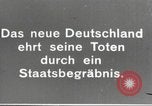
State Funeral for Nazi martyrs Hans Eberhard Maikowski, and Josef Zauritz
Slate states the new Germany honors its dead by means of State Funeral. Brief views of the Berlin Cathedral (Am Lustgarten, 10178 Berlin, Germany). View of a resting (dead) Hans Eberhard Maikowski, Leader of a Storm Trooper unit (SA Sturm 33), who was fatally shot, along with Police Sergeant, Josef Zauritz, January 30th, during a melee with Communists after parading to celebrate Hitler's appointment as chancellor. Hermann Göring (or Goering) talking with Nazi officials on steps of building. Adolf Hitler stands near a car with large contingent of Storm Troopers. View from a high point of a funeral procession surrounded by huge crowd. The procession includes the hearses of Maikowski and Sauritz, pulled by horses. Close view of elaborate hearse of Zauritz, drawn by covered horses and escorted by Berlin policemen, and that of Maikowski, escorted by Nazi Stormtroopers. Procession of mourners including Joseph Goebbels and Hermann Goering, followed by Stormtroopers carrying wreaths. Pallbearers in top hats carry a coffin.
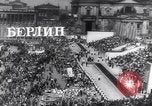
Marching workers and citizens salute German Democratic Republic President Wilhelm Pieck at the May Day celebrations in Berlin
May Day celebrations in Berlin, East Germany (German Democratic Republic or GDR). Parade of civilians and workers through the streets of Berlin. View of Brandenburg Gate in distance. The marching troops salute the German President, Wilhelm Pieck, at the reviewing stands. Among the spectators also are officials from China. The President waves at the workers and children. A huge crowd, nearly half are women, present to witness the parade.
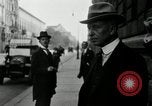
U.S. Charge' d'affaires, Ellis Loring Dresel, signs United States Peace treaty with Germany.
Ellis Loring Dresel, U.S. Charge' d'affaires stands on sidewalk in Berlin, Germany, with other diplomats, following the signing of Peace Treaty between the United States and Germany, after World War I. He enters a car along with other officials. View of signed Treaty of Peace, signed by Mr. Dresel and also by German Foreign Minister, Dr. Friedrich Rosen.
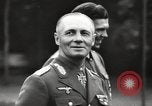
Field Marshal Erwin Rommel and Magda Goebels with her children at her estate in Berlin, Germany during World War II.
German Field Marshal Erwin Rommel visits with Mrs. Goebbels and her children, during a period between command assignments, during World War II. Rommel, standing with aides, in the garden of the Goebbels home in Schwanenwerder, Berlin, smiles as he watches the Goebbels children at play. Magda Goebbels, wife of Propaganda Minister Joseph Paul Goebbels, with her children gathered around a slide in the yard. Rommel watches as Magda helps her youngest daughter, Heidrun, down the slide using a wheeled board and help from another daughter. Field Marshal Rommel looks on and smiles. Rommel along with Magda, return to the house, holding hands with the children. Another view of the activities around the slide. Rommel examines the wheeled board with Mrs. Goebbels, who then helps Heidrun ride it down the slide. Marshal Rommel and Magda Goebbels hold hands with her daughters as they return along a path to the house.
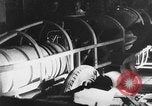
Rocket cars developed at the German Heylandt factory in Berlin-Britz, Germany
Momentary opening slate (in German) cites a new rocket car, the largest in the world, designed by German chief engineer Alfons Pietsch. Closeup of the liquid-fueled rocket car at the Heylandt factory in Berlin-Britz (Heylandt-Gesellschaft für Apparatebau mbH). The rocket engine is ignited and creates a huge flame behind the car. It travels for a while in the industrial yard of the Heylandt factory until the flame dies. (Note: At the beginning of 1930, rocket engineer Max Valier was given the opportunity to develop a liquid rocket engine at Heylandt in Britz. He was assisted by the Heylandt development engineers Alfons Pietsch, Walter Riedel and Arthur Rudolph, who built the rocket motor in a test vehicle called "hellhound" after Valier's accidental death in May, 1930.) Change of scene shows a rocket car of Max Dalier being refueled from a liquid oxygen tank. Next, the car, with "Heylandt" painted on its side, is seen with Max Valier at the controls, driving about the Heylandt factory grounds, propelled by a moderate thrust from its liquid fueled engine. It circles about the yard several times.
CRITICALPAST.COM: About Us | Contact Us | FAQs - How to Order | License Agreement | My Account | My Lightboxes | Shopping Cart | Advanced Search | Featured Collections | Website Terms & Conditions | Privacy Policy ©2026 CriticalPast LLC.
License Agreement |
Terms & Conditions |
Privacy Policy
©2026 CriticalPast LLC.