


 Francais
 Deutsch
 Italiano
Refine Your Search
Berlin Germany 1937 stock footage and images
- Showing 709 to 714 of 6871 results more
more Hide
Hide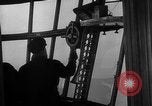
German airships Hindenburg and Graf Zeppelin I in flight over Germany.
German airship Hindenburg in flight over a city in Germany. Crewmen in the cockpit of the airship. It flies over a German city on the banks of the Danube River. The dining room of the Hindenburg. The German airship Graf Zeppelin I in flight. The tomb of Von Hindenburg. Crewmen inspect motor mounts on the Hindenburg. The Graf Zeppelin I in flight in the background. People eat and talk in the dining room of the Hindenburg. The Olympic stadium in Berlin, Germany (same year the Olympics were hosted there in 1936). People look out of the windows of the Hindenburg. Urban topography in the background. View of the Brandenburg Gate. The Hindenburg and the Graf Zeppelin I in flight in the background. An officer of the Hindenburg talks over a telephone in the control station. The famous Cologne Cathedral in the foreground. Several men wearing chefs' clothing look up at the sky and wave. A structural steel bridge in the foreground.
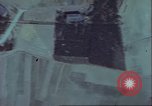
P-47, of U.S. 8th Air Force, 63rd Fighter Squadron, strafes Stendal Airfield, Germany, in final days of World War II in Europe
The Allies exercise air superiority over Germany in final days of World War 2. Gun camera footage from U.S. 8th Air Force P-47M, Number 44-21160, UN-F, "Devastatin' Deb, flown by Capt. John C Fahringer, Lima, Ohio. assigned to the 63rd Fighter Squadron of the 56th Fighter Group. He strafes German aircraft and hangars at Stendal airfield, near Berlin, Germany. Burning aircraft in front of a hangar.
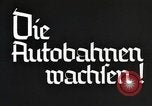
A steel structured bridge under construction as part of Autobahn in Germany.
An Autobahn bridge under construction in Germany. Steel frame structure of the bridge under construction. Views of the framework. Views of the completed autobahn between Berlin and Hanover, Germany.
Athletes train in preparation for the Berlin Olympics.
Italian release of 1936 Berlin Olympics film. Olympic village athlete camp in Elstal, Wustermark, Germany. Birds on trees and cranes on river bank. Athletes run through a forest and a wading stream to prepare for Berlin Olympics. They take steam bath and then dive and swim in a river or lake and lounge on a deck by the water.
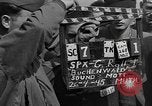
German Jewish internee George Henning, liberated from Buchenwald Concentration Camp, is interviewed in Germany.
Internees at a concentration camp in Buchenwald, Germany. A Jewish internee, George Henning from Berlin states how he was taken to a concentration camp near Berlin and later shifted to Buchenwald. He greets his mother in New York and other dear ones living in Bolivia. Other internees in the background.
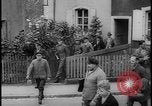
German men recruited as forced laborers travel to work on the Siegfred Line in western Nazi Germany
German villagers’ recruitment as laborers to work on Siegfried Line defense fortification. German villagers from the Rhineland-Palatinate area march out of town, most likely Saarlouis, Germany, given sign on street noting distances to Trier and Saarbrücken. German men board buses bearing signs in German that read, "Baugesellschaft C. Hallenbach, Berlin" (C. Hallenbach Construction Company, Berlin) Two young men smile and peer from their bus window. Men from all over German work on the Siegfried Line, march in the countryside. German men, holding spades, march past dragon's teeth tank barriers on their way to work on the Siegfried Line. Laborers march with spades in countryside amid mounds of soil.
CRITICALPAST.COM: About Us | Contact Us | FAQs - How to Order | License Agreement | My Account | My Lightboxes | Shopping Cart | Advanced Search | Featured Collections | Website Terms & Conditions | Privacy Policy ©2026 CriticalPast LLC.
License Agreement |
Terms & Conditions |
Privacy Policy
©2026 CriticalPast LLC.