


 Francais
 Deutsch
 Italiano
Refine Your Search
Berlin Germany 1937 stock footage and images
- Showing 829 to 834 of 6871 results more
more Hide
Hide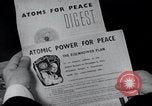
Voice of America broadcasts President's speech and USIS "Atoms for Peace" exhibits are presented worldwide
President Eisenhower of the United States addresses United Nations on December 8, 1953 about atomic bomb and atomic weapon dilemma in the nuclear age (part of Atoms for Peace initiative). Operators in radio transmission control rooms note down readings. View of time clocks of various places in the world including Honolulu, New York, London, Moscow, Calcutta, Bangkok and Tokyo displayed. The Voice of America broadcasts program in different languages by announcers. Scene of a family sitting in a living room as they listen to the president's speech on a console radio. People work at typing, printing, and translating the speech. USIA motion pictures service prepare newsreel of president's speech. A man views air mail of USIA films. Exterior views of several different United States embassy buildings worldwide. A guard standing outside the building. A Public Affairs Officer at the U.S. embassy in Japan, in Tokyo, meets with U.S. Ambassador to Japan Robert Murphy. USIA members seated around table for meeting, and, in Washington DC, creating publications about the Atoms for Peace program. People seated in a USIA library in Brazil read books and various USIA materials. Architects design 30 foot high Atoms for Peace exhibits. An exhibit being setup in a foreign country (possibly in North Africa). Exterior and interior views of the West Berlin, Germany Atoms for Peace exhibit. Prime Minister Jawahar Lal Nehru in India is seen arriving in a jeep to view the Atoms for Peace exhibit in India. Prime Minister Nehru inside the exhibit hall watching a presentation. In Japan, a woman operates remote-controlled robotic hands to hold radioactive materials, at a demonstration for Japanese citizens. In a city in Italy, a view of a mobile van unit carrying an Atoms for Peace exhibit. Scenes from a film "A is for Atom" that was translated into 30 languages and shown all over the world. Wide view of the Kremlin in Moscow, Russia, Soviet Union. A Russian radio commentator speaking at a microphone. Propaganda dramatization showing the Russian announcer attacking American plans for Atoms for Peace.

U.S. Women's Army Corps personnel training in different fields and given career advice at the training center
The role of women in the United States Army. A sign reads ' WAC Bivouac area'. Women carry heavy packs and march. During 10 minute break, they sit on ground and talk. Women's Army Corps (WAC) personnel set up tents and line up for chow, eating from mess kits. Women play softball. A woman reads letter from home. A woman drinks from a canteen. Women exercise and do calisthenics. They learn unarmed defense tactics. WAC military police march in formation. A woman being interviewed. Women in classrooms being given career guidance. A woman works on the punch card machine. A man and a woman drafting. Women work in the kitchen. Women work in laboratories. A woman on X ray machine and a solider lying on the table. Dentists check soldier. A woman being commissioned as an officer. Women disembark from a ship. WAC assigned to Japan, Paris or Germany. Views of a Shinto shrine in Japan, the Arc de Triomphe in Paris, and people in Berlin walking through Brandenburg gate British Sector and heading to other side, as German police officers watch. Woman assists male officers in a meeting, as the men view early television screen. View of Patton tank on the move.
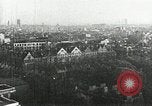
Devastation and clean-up efforts in London on a morning following German blitzkrieg (blitz) air raid attack during World War 2
Views of a London morning after the German air raid during World War II. Wrecked city and destroyed buildings are seen. Workers rake up debris and extinguish fires as citizens go to work as usual. Men and women emerging from underground tube and taking to streets to go to work amidst rubble. Man in suit going to work with briefcase observes the damage and devastation and workers clean up streets. Train passes overhead spanning a partially destroyed overpass trestle. Workers sit on the back of a motorized open air cart that helps shuttle them to work through the debris of the bombing. Views of a crowded London street. A woman goes shopping and steps directly into a formerly glass-enclosed display window at a clothing store to hand the proprietor an article of clothing that she wishes to buy or to assist him in cleaning up his wares. Brief view of royalty (King George VI) and Queen visiting ruins. A clean-up brigade wearing hard helmets digs through rubble with pick axes. Double-decker bus and cars and pedestrians passing by on street near bombed out building. Views of rubble among prominent London landmarks. Street view of citizens walking to work, and St. Paul's Cathedral dome in distance. Fire fighting crews train hoses on a fire from the bombing; view of exhausted and dirty fire fighters at work. Citizens with children gather at a civic center to load children into buses and evacuate them out of the city for their protection. A man with a megaphone addresses the crowd of parents and children to be evacuated to give them instructions. Men, women, and children are seen among the crowd. Line of double-decker buses departing from a queue, carrying children to safety, as parents look on and wave goodbye. Royal Air Force (RAF) crew loads a bomb into the underside of a British aircraft bound for Berlin. Views of three British airplanes in flight bound for bombing run over Germany. More scenes of rubble in British streets, and dirtied workers cleaning up after the bombing raids of the blitz. A man passes a rescued cat to another red cross rescue worker, amidst the rubble of a building. Worker gets cigarette lit.
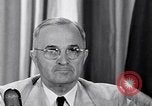
President Harry S Truman of United States thanks the Soviet Union for its efforts in World War II
President Harry S. Truman of the United States addresses the American people by radio, from Washington DC, following his return from the Potsdam Conference. President Truman at the White House giving his speech. He talks about the Berlin conference. He thanks the Soviet Union for its allied role against Germany and against Imperial Japan.

Universal Pictures beats McPherson Globe Refiners in basketball to win Olympics final in New York City
A newsreel titled "Universal five wins Olympics basketball final" shows a game between the company team from Universal Pictures and the McPherson Globe Refiners from Globe Oil and Refining Co. of McPherson, Kansas. The McPherson team is sometimes also referred to as the Oilers, or the Refiners. The teams are seen playing in the Olympics Qualifying basketball final in New York's Madison Square Garden. People cheer the two teams. Universal defeats the McPherson Globe Refiners to win the Olympics final. The win entitled the Universal Pictures team to name 7 players to the Olympic basketball team representing the United States in the 1936 Olympics held in Berlin Germany, and McPherson Globe Refiners was able to name 6 players to the team. These two teams beat out five U.S. college teams to earn the spots in the final and determine the makeup of the U.S. Olympic Basketball team. Players in the game in this video clip include Globe Refiners forward Francis Johnson, Centers Willard Schmidt and Joe Fortenberry, and Universal forward Carl Knowles. Universal beat the Globe Refiners by a score of 44 to 43. According to a Time Magazine article of April 13, 1936, the Globe Oil & Refining team, "...have perfected a technique called dunking with which they score by jumping up above the basket, dropping the ball into it." This may be one of the earliest references to dunking, now a staple technique in basketball. The same Time article further stated of the Oilers, "On the defense, they prevent opponents from scoring by batting the ball out of the basket." Again, the Globe Refiners were demonstrating play that later became standard in modern basketball. The idea for the Globe Refiners was a company promotion scheme, thought up in 1934 by Gene Johnson, the Sales Manager of Globe Oil who had several years experience coaching basketball. The Olympic team also included Washington State Huskey player Ralph Bishop. The USA went on to win the gold, defeating Canada 19-8.

The United States Army presence in Europe and America during the Cold War era.
Opening scene shows Headquarters, United States Army, Europe (USAREUR) at Campbell Barracks, Heidelberg, Germany. A line of U.S. 7th Army M48 Patton tanks contributing to NATO defenses. One backs out of position. A line of M113 Armored personnel carriers proceeding along a dirt field. A tank destroyer followed by M113 APC. M113s of a U.S. Armored Brigade drive in Berlin, affirming allied rights in the city. Bridge in Italy displays logo of U.S. Army Southern European Task Force (SETAF). A Sergeant Missile Battalion of SETAF provides nuclear capable support to NATO. One of its Sergeant missiles is seen maneuvering on its mobile launch platform. Two Italian soldiers are seen being trained in missile operations. A motorized tractor pulls several wheeled containers of military supplies stockpiled at one of NATO's European storage facilities. More supplies are seen being moved outside a warehouse. Army personnel using keyboards and computer tape drives to keep track of war materiel. Yards full of military hardware, including lines of jeeps, provide backup for military operations. A sign at the Headquarters United States Southern Command in Quarry Heights, Panama. A ship is seen moving through the Miraflores locks of the Panama Canal. U.S. and allied soldiers are seen working with ropes to traverse a river, during Jungle Warfare training. Soldiers seen moving through jungle underbrush during training at the Southern Command School of the Americas. Scene shifts to U.S. Army, Alaska at Fort Richardson, near Anchorage. A U.S. M113 APC is seen driving and firing its weapon on a snowy field. Its stops and soldiers in white arctic gear step from a rear hatch to take up positions. A Piasecki H-21 Army helicopter is seen flying low above the terrain. It is equipped with landing gear skis. Rear view of tank moving in snow.
CRITICALPAST.COM: About Us | Contact Us | FAQs - How to Order | License Agreement | My Account | My Lightboxes | Shopping Cart | Advanced Search | Featured Collections | Website Terms & Conditions | Privacy Policy ©2026 CriticalPast LLC.
License Agreement |
Terms & Conditions |
Privacy Policy
©2026 CriticalPast LLC.