


 Francais
 Deutsch
 Italiano
Refine Your Search
Berlin Germany 1937 stock footage and images
- Showing 1135 to 1140 of 6871 results more
more Hide
Hide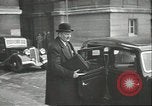
German Chancellor Adolf Hitler re militarizes the Rhineland, Germany and denounces the Locarno Pact.
German Chancellor Adolf Hitler reoccupies the Rhineland and denounces the Locarno Pact in 1936. The signing of the Locarno Treaties in London, England in 1925. Officials arrive at the building where the Locarno Treaties are to be signed. Chancellor Hans Luther of Germany affixes his signature to the Locarno Treaty assuring peace to all the principal countries of Europe. At the head of the table in the center are Stanley Baldwin and Sir Austin Chamberlain, leaders of the British Delegation. German Chancellor Adolf Hitler violates the Treaty of Versailles on 7th March 1936 by sending German military forces into the Rhineland demilitarized zone along the Rhine River in western Germany. Mobilized German troops march over the Hohenzollern bridge in Cologne, Germany. The troops march along a road. Cologne Cathedral in the background. A German crowd cheers as the German soldiers parade. Swastika banners hang from buildings. German troops parading in Dusseldorf. The troops on horseback and horse-carriages pass along narrow streets of Dusseldorf. Parading troops are cheered by a crowd in Frankfurt am Main. German troops parade in front of a building during a wreath laying ceremony followed by Chancellor Hitler and other Nazi officials. Newspaper headlines about Hitler denouncing the Locarno Pact. A government minister with press. French Prime Minister Albert Sarraut at a microphone reassures the security of France. Belgium soldiers march along a street.

Flight testing of a bi-wing Berliner Helicopter in Washington DC.
Test flight of a Berliner helicopter by Henry Berliner. A hybrid airplane helicopter built by Emile Berliner and his son Henry Berliner is shown during a Washington DC test flight. It rises and move forward in short hops. The lighter weight design and high incidence large camber lower wing indicates it was likely built in 1924 or 1925 as one of the last Berliner models, following after a triplane version that was test flown in February 1924.

During a presidential election debate in the US, John F Kennedy and Richard Nixon comment on the necessity to defend Berlin.
The third Kennedy-Nixon Presidential Debate in the United States. Moderator Bill Shadel introduces the candidates and tells that candidates will not share the same platform. Republican candidate U.S. Vice President Richard M Nixon is in a Los Angeles studio and Democratic candidate Senator John F Kennedy is in New York. He also introduces the panel of correspondents who will question the candidates. The panel includes Frank McGee from NBC News, Charles Van Fremd from CBS News, Douglass Cater from Reporter magazine and Roscoe Drummond from New York Herald Tribune. Frank McGee asks Kennedy whether he would take military action to defend Berlin. Kennedy answers and says that the U.S. has contractual right to be in Berlin coming out of the conversations at Potsdam and of World War II. He states that the United States must meet its commitment on Berlin in order protect the security of Western Europe. He concludes by saying that the U.S. will meet its commitments to maintain the freedom and independence of West Berlin. Nixon disagrees with Kennedy's statement that the Republicans are trigger-happy and lead the nation into wars. He talks about the Democratic presidents who led the U.S. into wars. He concludes and states that he thinks there isn't any question about the necessity of defending Berlin.
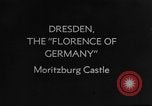
The Moritzburg Castle, the Opera House and the Zwinger Museum in Dresden, Germany.
Famous tourist destinations and architecture in Saxony, Germany, before World War 2. Views of the Moritzburg Castle (Schloss Moritzburg, Schloßallee, 01468 Moritzburg, Germany) and the Semperoper Opera House building (Semperoper Dresden Schinkelwache Theaterplatz 2 01067 Dresden) in Dresden, Germany. View of the world-famous Zwinger Museum (Zwinger Theaterplatz 1 01067 Dresden). Trains passes by on a track. Buildings in the background.

The Alster River, the Chile Haus, Hamburg Airport and St. Pauli in Hamburg Germany.
Famous tourist destinations and architecture in Hamburg, Germany, before World War 2. The Alster River in Hamburg. A train runs on a bridge over the river. Trees in the background. People row boats in the river. Buildings seen on either side of a stream in Hamburg. View of the Chilehaus (Chile House Fischertwiete 2A, 20095 Hamburg, Germany) in the modern Kontorhaus District, Hamburg. People walk outside the modern Hamburg Airport (Flughafenstr. 1-3, 22335 Hamburg, Germany). Flags on either side of the airport. A Zepellin airship seen. Scenes of St. Pauli, the entertainment district of Hamburg, during the night. A Hamburg American line steamer seen.
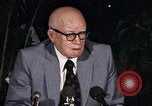
General Omar N. Bradley talks about the occupation of Berlin during World War 2 at a press conference in Hawaii.
General Omar N. Bradley visits Hawaii. The General at a press conference. He answers reporters' questions during the conference. He talks about the occupation of Berlin and dealings with Russians during World War II. Mrs Bradley is seated next to him. He speaks of fact that while U.S. forces were capable of taking Berlin, they did not because it had been pre-arranged for the Soviets to take Berlin and for the allied forces to occupy a divided city. Bradley notes that he was not going to take on 100,000 casualties by taking Berlin, only to give it back to the Soviets. With regard to the Soviets, he says, "they're not easy people to deal with."
CRITICALPAST.COM: About Us | Contact Us | FAQs - How to Order | License Agreement | My Account | My Lightboxes | Shopping Cart | Advanced Search | Featured Collections | Website Terms & Conditions | Privacy Policy ©2026 CriticalPast LLC.
License Agreement |
Terms & Conditions |
Privacy Policy
©2026 CriticalPast LLC.