


 Francais
 Deutsch
 Italiano
Refine Your Search
Berlin Germany 1937 stock footage and images
- Showing 1171 to 1176 of 6871 results more
more Hide
Hide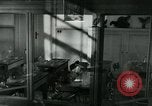
Children in a classroom write with steel pens in Germany, and various consumer goods in Germany made from steel.
Children in a classroom write with steel pens in Germany. Teacher writes on a black board. Montage scene of objects made with steel including pens, paper clips, nails, utensils, nuts, bolts, screws, buckets, tools, lamp, ashtrays, knives, model planes, toys and pots displayed. A cobbler pounds nails on bottom of a boot. Close up of a man using a metal file. A woman uses a hot iron on an ironing board to iron clothes. A woman seated and using a sewing machine. Various industrial machines shown with inner cogs, wheels, rods, pistons, and parts made from steel.
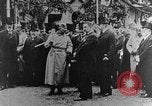
Kaiser Wilhelm II of Germany reviews his marching troops, Germany.
Kaiser Wilhelm II of Germany, with officials in top hats, and German military officers, in formal uniforms, outside a building. They review goose-stepping German troops on parade. Garlands of greens are strung throughout the town. (World War i; World War 1; WWI; WW1)
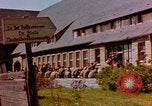
American airmen in Germany share a cake to celebrate the Victory in Europe Day in Germany at end of World War II.
United States airmen celebrate the Victory in Europe Day in Germany after World War II. United States airmen sit on terrace,outside recreation building. A band of airmen play music. United States Red Cross women bring out a large decorated sheet cake to celebrate the Victory in Europe Day. They place the cake on the table. Other refreshments and drinks are on the table. An Air Force Captain cuts the cake.
Heinkel He 280 turbojet fighter aircraft, designed by Germany during World War II, is flown over grasslands in Germany.
In Germany, a demonstration of a Heinkel He 280 aircraft, the first turbojet-powered fighter aircraft in the world. Animated drawing of German Heinkel He 280 turbojet fighter aircraft. View of a He 280 fighter aircraft on an airfield, preparing for takeoff. It makes an extremely long flat takeoff. Trees in the background. Men on an airfield. Buildings in the background. Vehicles parked on the airfield. He 280 fighter aircraft in flight over grasslands. The He 280 aircraft lands. The aircraft parked on the airfield in the background. (This was one of only nine He 280 prototypes built by Heinkel, following on its experience with the He 178 prototype)
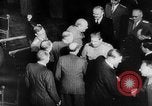
Allied leaders at the Potsdam Conference and military and police patrol East Germany after the partition of Germany.
New government formed in Germany after the defeat of Nazis during the World War II. Leaders of the Allied nations meet and talk during the Potsdam Conference. Stalin, Truman, and Churchill seen greeting each other. Soviet Marshall Joseph Stalin's partition plans and aspirations shown on a map. Russian troops march in East Germany and Stalin and Khrushchev with other communist leaders of East Germany review a parade. Military and Civil Police guards march on roads of East Germany. Women police officers during the patrols. An investigative police officer or Stasi police escorts a detained civilian through a doorway marked, "Untersuchungs Haftanstalt Wittenberge" (Investigative Detention Wittenberg).
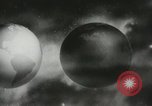
Rise of Fascism in Italy and Germany after World War I
Animated map depicts the spread of Fascism in Japan, Germany and its neighboring countries, and Italy. Views of Italian Fascist "Black Shirts" marching bearing flags and rendering the fascist Roman Salute. Fascists participating in the famous "March on Rome" (“Marcia su Roma”) in October 27, 1922. Spectators line the sidewalks and side of the road. Brief (jerky) views of unrest and desperate crowds of citizens in post-war Italy circa 1919 and 1920 following World War I, due to unemployment and hard times. Italian people getting food at an outdoor soup kitchen. Fascists promising better times are seen parading and riding in jammed open cars. Benito Mussolini, who was elected to Parliament in 1921, is seen in a top hat, arms akimbo, standing with other officials. Glimpse of Black Shirts marching in front of the Palazzo Venezia (Via del Plebiscito, 118, 00186 Roma RM, Italy). Back to Mussolini, again, who now makes some remarks to those standing with him and expresses himself with exaggerated body language. Another glimpse of Black Shirts marching. Film transitions to Germany, where Adolf Hitler is seen walking through a dense crowd of supporters and some brownshirts or SA stormtroopers. Hitler's clothes resemble a military uniform. Next, scenes illustrating the terrible post-World War 1 hyperinflation suffered by Germany during the Weimar Republic. Various Deutschmark (Deutsche Mark) banknotes in ridiculous denominations are shown. Baker puts a 460 billion Deutschmark price on bread. People trying to buy groceries during this period. German militaristic marchers. Fascists giving arm salutes as they parade in a city street. General Field Marshal Paul von Hindenburg (President of Germany) is seen standing in front of Germany's top military leaders. Directly behind him is Marshal August von Mackensen, in a fur busby hat with Totenkopf (death head) insignia. Other Generals wear pickelhaube spiked helmets. Hindenburg's closest associate, General Erich Ludendorff stands just behind and to the left of Hindenburg. Glimpse of German soldiers in more modern uniforms. Next, Hindenburg is seen reviewing troops in the company of their commander. Next, Hitler is seen with a group of German civilian industrialists whose interests he promises to support. Alfred Krupp Jr. sits, with his legs crossed, next to Hitler. Glimpse of Hitler, in uniform, waving from a window. People running as a cadre of mounted police canter in formation down the street.
CRITICALPAST.COM: About Us | Contact Us | FAQs - How to Order | License Agreement | My Account | My Lightboxes | Shopping Cart | Advanced Search | Featured Collections | Website Terms & Conditions | Privacy Policy ©2026 CriticalPast LLC.
License Agreement |
Terms & Conditions |
Privacy Policy
©2026 CriticalPast LLC.