


 Francais
 Deutsch
 Italiano
Refine Your Search
Berlin Germany 1937 stock footage and images
- Showing 1549 to 1554 of 6871 results more
more Hide
Hide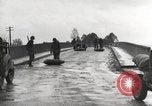
U.S. Army 12th Armored Division soldiers cross the Danube River bridge at Dillingen, Germany during World War II.
U.S. Army 12th Armored Division on the move in Dillingen, Germany during World War II. U.S. soldiers roll 500 pound bombs over the intact Danube River bridge at Dillingen in Bavaria Germany. U.S. medium tanks with soldiers loaded onto it as they cross the bridge at Dillingen.
German Generalleutnant Dittmar formally surrenders to U.S. soldiers in Magdeburg, Germany during World War II.
German General (Generalleutnant) Kurt Dittmar surrenders in Magdeburg, Germany during World War 2. German military commander General Dittmar, who was also Official Military Commentator of the German Armed Forces, stands with his party, including his son, young German soldier Berend Dittmar, Major Pluskat, and Major Werner, as American soldiers escort them. General Dittmar carries on an extended conversation with a French war corresondent. View of destroyed bridge span over the Elbe River, Magdeburg, Germany. German General Dittmar and his son, the boy soldier carrying a white flag with Red Cross on it, walk along sandy shore. They are met by U.S. Army soldiers of the 117th Regiment, 30th Infantry Division, including Captain Henry Abbes of Glendale, Long Island, New York, Commander of 'K' Company, who escort them. German General Dittmar conversing with captors while smoking a pipe, and then walking with his son, accompanied by American officers, through rubble strewn street of Magdeburg. (Records indicate that General Dittmar had traveled across the Elbe to ask for assistance in evacuating injured German soldiers and civilians from the east bank of the Elbe. U.S. Major General Leland Hobbs refused, and rather than returning across the River Elbe, Dittmar surrendered.)
U.S. 95th Infantry Division troops on vehicles entering Saarlautern, Germany, in World War II
U.S. 95th Infantry Division troops in Saarlautern Germany during World War 2. A sign reads 'you are now entering Germany through the courtesy of 95th Div'. Two U.S. troops stand beside the sign. The soldier on the right is Technician Fourth Grade (T/4) Julian Koentz, of Trenton, Illinois, a member of the 378th Infantry Regiment, 95th Division. A road sign identifies the town of 'Saarlautern'. The troops in vehicles enter the town. A sign posted on a a tree reads 'Danger Beware of Mines and Booby Traps'. The soldier on the left is Sgt Andrew Rauch of Chicago,Illinois, also of the 378th Infantry. (Note: Rauch was identified by Julian Koentz, while looking over still photos of this event with his son Robert L Koentz, who provided this information.)
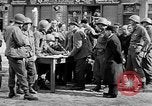
U.S. soldiers interact with German civilians in Munich during occupation of Germany after World War II.
Training film for U.S. soldiers during occupation of Germany after World War 2, guiding them on their role of "reeducation" and restoring normal life to civilians in Germany after World War II. U.S. soldiers seated and Germans standing around them talking to the solders. A German MG Police officer outside a building. A German police officer monitors citizens in a line. Germans talk to U.S. soldiers outside the Office of Military Government for Bavaria, in Munich. The U.S. soldier reviews their identification papers and questions them. German children at play. A smiling American soldier seated with a group of young German children around him. A group of German boys plays baseball on the lawn in front of the largely destroyed Altes Armeemuseum in Munich (later home to the Bayerische Staatskanzlei or Bavarian State Chancellery) in Greek architectural style with six prominent ionic columns. A U.S. soldier talks to German civilians. Soldiers talking with German men , women and children. A soldier frisks men and women entering a secure area. German police grab and restrain a German citizen for some offense and escort him away. Young children seated and learning at an outdoor class. The children standing and smiling.
German civilians purchase and read the first American newspaper printed in Aachen, Germany.
The first American newspaper in Aachen, Germany is printed during World War II. Crowds in the streets of Allied-occupied Aachen. A U.S. General speaks as the first American newspaper to be printed in Germany is dedicated. Presses roll and the first copies are produced which are then purchased and read by German civilians.

Adolf Hitler, in a car, travels through streets of Nuremberg and German SA troops marching, in Germany.
German civilians welcome Adolf Hitler in Nuremberg, Germany. Swastika signs. Adolf Hitler, ruler of Germany, in a car, travels through streets of Nuremberg as civilians lean from windows to cheer him. Banners and decorations float from the buildings of the city. A band plays musical instruments. German Sturmabteilung (SA) troops marching on the street passing before Hitler who stands in his car.
CRITICALPAST.COM: About Us | Contact Us | FAQs - How to Order | License Agreement | My Account | My Lightboxes | Shopping Cart | Advanced Search | Featured Collections | Website Terms & Conditions | Privacy Policy ©2026 CriticalPast LLC.
License Agreement |
Terms & Conditions |
Privacy Policy
©2026 CriticalPast LLC.