


 Francais
 Deutsch
 Italiano
Refine Your Search
Berlin Germany 1937 stock footage and images
- Showing 1663 to 1668 of 6871 results more
more Hide
Hide
A manned rocket sled is tested in April, 1931 in Germany.
April, 1931 in Germany. View of a closed sled resembling a small airplane fuselage, fitted with runners underneath and bundles of rockets on each side. It sits on a frozen lake. BR-1 is painted on its side. A man arrives and climbs into the cockpit. The rockets ignite and accelerate the plane somewhat erratically, as it moves along the lake surface.
Models and full scale airplanes using solid powder rockets for propulsion, in Germany
Descriptions and diagrams of various model airplanes used in experiments with solid powder propulsion, in Germany starting in 1927. Diagram of a 'Storch' model airplane. Diagram of "Ente"(Duck) model airplane. An Opel full scale model "Ent" airplane being checked out on a launching rail at an airfield. Fritz von Opel makes adjustments at the rear of the airplane and, assisted by several other men, moves the airplane along the launch ramp and back again. On the side of the plane is written: "Sander AK-1." Photographers take pictures. The first manned test of an Opel "ent" airplane is undertaken by the Research Institute of the RhonRossitten-Gesellschaft (RRG) under the direction of Fritz Stamer. In the first three trials the airplane fails to rise and simply skids along the ground. However, on the 4th try, it successfully flies off the launch rail in an extended high speed flight, for three-quarters of a mile in just under one minute. The successful flight is then shown in slow motion from two different camera angles.
The first German Post office mail rocket is successfully tested at Dummersee, Germany, on April 15,1931.
Successful test of the first German Post office mail rocket at Dummersee, Germany, on April 15,1931. It carries 180 pieces of mail (postcards). Reinhold Tiling is seen with his mechanic, Friedrich Kuhr, who holds the rocket, as Tiling inserts a cylinder containing compressed powder fuel. They then invert the rocket and Tiling affixes its nose cone. A post office official hands pieces of mail to Tiling, who places them into the rocket. They position the rocket on its launch stand and fire it. Uniformed Postal officials (and some military officers) watch the rocket as it rises smoothly after launch. Larger, better, and lighter metal (aluminum) are developed in 1931-32. Friedrich Kuhr standing next to a huge rocket with a wing span of 4 meters.

Valier R6 and Valier-Heylandt cars move using liquid fueled rockets in Germany.
A Valier R6 and Valier-Heylandt car move using liquid fueled rockets in Germany. A liquid fueled model of rocket. A Valier R6 car with 'Rockstoss-Versuchs-Wagen' written on it. A man sits in it. People stand around him. Rocket boosters in the car. The man wears helmet. He drives the car on road. People stand on sides of road to watch him. A Valier-Heylandt car in fueled from a tank. The car moves on road. Picture of scientist Max Valier.
Testing of "Vierstabers" and "Zweistabers" rockets at lake in Germany in 1933
Testing of the "Vierstabers" rockets at the Schwielowsee (lake in State of Brandenburg Germany) by Klaus Riedel and associates, in September, 1933. The rocket set up on its four legs aboard a motor launch in the lake. It launches and flies a short distance to fall into the lake. Another attempt shows a rocket doing the same, except this one explodes upon impact with the water. Scene shifts to October, 1933, with testing of the "Zweistabers" rockets. A motor launch sits in the water, next to a point of land where launch crew is setting up a two-legged rocket.
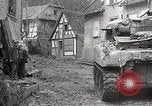
U.S. troops entering Germany during World War II. Rain causes much mud. General Eisenhower visits troops in the mud.
Allied forces entering Germany during World War 2. The German population is not welcoming. Rainy weather makes it difficult for armor and vehicles to move. U.S. soldier bailing water out of his trench. Troops slogging through mud with their mess kits. General Dwight D. Eisenhower visiting U.S. infantry at the front in the mud.
CRITICALPAST.COM: About Us | Contact Us | FAQs - How to Order | License Agreement | My Account | My Lightboxes | Shopping Cart | Advanced Search | Featured Collections | Website Terms & Conditions | Privacy Policy ©2026 CriticalPast LLC.
License Agreement |
Terms & Conditions |
Privacy Policy
©2026 CriticalPast LLC.