


 Francais
 Deutsch
 Italiano
Refine Your Search
Berlin Germany 1937 stock footage and images
- Showing 1681 to 1686 of 6871 results more
more Hide
Hide
Men work at an ammunition factory in Germany.
German men work at ammunition, weapons, and aircraft factories in Germany during World War 2. Men work on the machines to manufacture weapons. They construct artillery. Stockpiles of rifles, heavy artillery, antiaircraft guns and shells on the factory floor and storage areas. German soldiers hold rifles. Closeup views of faces of German soldiers holding weaponry. Bomb shells in the factory being produced. Men building and assembly German aircraft sections including cockpits and gun turrets.

Dress designers at a building in Germany.
Dress designers at a building in Germany. Women make sketches of the dresses on the sheets. Officers move towards the building. They sit in the conference room.
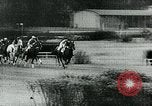
Spectators watch horse-race in Germany.
Spectators watch horse-race in Germany. Men on horses in the street. Bicycle race on the street. Houses asides the street. Men watch. Boxing match in a ring. Referee intermediates between the boxers. A large crowd gathers in a stadium to watch a football match.
Men working in a gun factory in Germany.
German men working in a munitions and war materiel factory in Nazi Germany during World War 2. Industrial steel melting operations. Metal being melted and molded in the factory. Artillery and gun barrels being manufactured. Metal ingots in process in the factory. Close up views of workers watching the whole process and working. Manufacturing of ordnance shells in the factory. The metal ingots inserted into a container and manufacture of shells takes place.
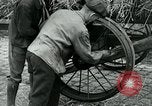
Farm machinery made with steel in Germany, and various machines and transportation equipment made with steel.
A wheel cart on a farm in Germany. A child and a man adjust the wheel. Harvesting of wheat in the farm by farmers. Men work in the farm to harvest the grain. Views of traditional farm hand tools like scythes and industrial farm machinery used to plant and harvest on farms. A house in the farm. Men load grain with pitchforks. A threshing machine in operation. Rapid montage scenes of various transportation machines made with steel in operation, including biplane aircraft, ships at sea, closeup of tire of car running at speed, and frame and tires of bicycles being pedaled, and of Formula 1 (F1) automobiles in a race car competition, railroad trains in a city cross paths on tracks of different heights, close up view of car tire running at high speed, a train races by, a car on a city street. Clip ends with scene of traditional blacksmith worker wearing heavy apron and pounding steel with hammer.
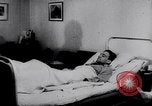
German pilot, Hans-Ulrich Rudel, in hospital recovering from wounds, receives Germany's highest award and is promoted, during World War II
Germany's most famous pilot of Stuka dive bombers (Junkers Ju 87) Hans-Ulrich Rudel, seen in hospital, after being wounded in the thigh, during World War 2. His doctor visits and asks how he is doing. He replies "ausgezeichnet" (excellent). His wife comes to the bedside and speaks with him briefly. Rudel's hospital chart is seen, with his rank shown as Oberst (Colonel).This is notable, when downed in November, he had been a Lieutenant Colonel with Schlachtgeschwader 2 "Immelmann" (Battle Squadron 2 "Immelmann.") Another German officer sits at his bedside and inquires about his experience. Colonel Rüdel explains how he was downed by flak while attacking Soviets tanks on the Eastern Front. He speaks about his comrade fliers. Next, the award of "Knight's Cross with Golden Oak Leaves, Swords and Diamonds"is shown. (This award was created by act of the Reichstag, solely for Rudel, on December 29, 1944. He was also promoted to Colonel, the same day.) The film concludes with additional comments by Colonel Rudel.
CRITICALPAST.COM: About Us | Contact Us | FAQs - How to Order | License Agreement | My Account | My Lightboxes | Shopping Cart | Advanced Search | Featured Collections | Website Terms & Conditions | Privacy Policy ©2026 CriticalPast LLC.
License Agreement |
Terms & Conditions |
Privacy Policy
©2026 CriticalPast LLC.