


 Francais
 Deutsch
 Italiano
Refine Your Search
Berlin Germany 1937 stock footage and images
- Showing 4129 to 4134 of 6879 results more
more Hide
Hide
German Chancellor Adolf Hitler talks about Anschluss to the Reichstag
On 18th March,1938, Adolf Hitler speaks about the Anschluss, to the Reichstag (meeting in the Kroll Opera House), Berlin. Views of various groups of German civilians listening to his speech on loudspeakers and on the radio. Some of the civilians are gathered in outdoor squares, others are seen in workplaces and restaurants or bars, sitting quietly and listening to the speech by Hitler.
Montage of scenes from the air war between U.S. and German warplanes during World war 2
Montage of scenes from air war in Europe, covering period from about 1943 through 1945 during World War Two. U.S. P-47 and P-38 fighter aircraft being unloaded from a ship at a port in Europe during the Second World War. A line of P-47s on an airfield. German aircraft taking off and inflight, including: Me-109; He-111 bombers; Me-110 fighters; and Fw-190 fighters. U.S. P-51s firing at and destroying German aircraft. Multiple aerial dogfight scenes with gun camera footage showing dramatic mid air explosions of various enemy German aircraft. U.S. B-17s flying to Berlin and back again, with P-51 fighter escorts. P-38 aircraft flying in formation and returning from escort duty, seeking targets of opportunity, strafe German airfields, and fire on German aerodromes and parked aircraft, destroying many airplanes.
Daily routine of German boys and girls in Bavarian camps.
German children leave Berlin and board train for Bavarian Camps early in World War 2. Children look out from the windows of the train and carry Nazi flags. A horse ridden carriage on road. A German officer with children sitting in his carriage arrives at a house and exchanges Nazi salutes with people there. A family sits in a dining room and a girl joins them enjoying food and drink. Life of Hitler Youth children in camps. Boys eat food in a mess. Boys go out for an outing. Boys sit on horses. Girls sleep on bunk beds. In the morning they get ready for the day. Girls wash their faces and take bath. Girls sit on benches and learn stitching. A view of a classroom. Girls eat food in mess and play table tennis. Children sleep on beds.
German Kaiser Wilhelm II pose with military officials together for a photograph
German Emperor Kaiser Wilhelm II walks with German military officers at a garden in Potsdam, near Berlin. Kaiser Wilhelm II and military officials, wearing Pickelhaube helmets, position themselves on a flight of stairs for a photograph. German honor guards march in a military parade.
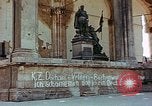
Feldherrnhalle, the Odeonsplatz, Hitler's house and Munich buildings damaged by Allied bombers (WW2)
The Feldherrnhalle (Residenzstraße 1, 80333 München, Germany) in Munich, Germany shortly after end of World War II in Europe. Statues of emperors and warriors. White lettering in German, on side of the building saying 'Concentration Camp Dachau - Belsen - Buchenwald. I am ashamed that I am a German.' Nazi swastika symbol and a statue in front of a building destroyed by Allied bombers. Adolf Hitler's original Brown House (NS-Dokumentationszentrum München, Max-Mannheimer-Platz 1, 80333 München, Germany) in ruins from bombing of the Allied bombers. Damage done nearby Odeonsplatz (Odeonspl. 1, 80539 München, Germany). Women on bicycles pass by the Feldherrnhalle.
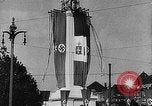
Italian fascist leader Benito Mussolini arrives by train at Munich Central Station where he is welcomed by Adolf Hitler
Italian fascist leader Benito Mussolini visits Munich, Germany. Flags of Nazi Germany and the Kingdom of Italy hang in the streets of Munich. Nazi flags hung from buildings. A Bundesadler eagle metal plate adorns a wall. Cars move along the roads. Italian leader Benito Mussolini arrives at Munich Central Station (München Hauptbahnhof, Bayerstraße 10A, 80335 München, Germany). He shakes hands with Adolf Hitler. Benito Mussolini and Adolf Hitler walk on the railway platform, the officers follow them. Military troops in formation on the platform. The two Axis leaders review formations of soldiers and sailors as military brass band plays the German and Italian national anthems (“Marcia Reale Italiana” and “Deutschlandlied”). Spectators line the streets. Benito Mussolini and Adolf Hitler enter open cars. Nazi banners and decorations adorn the Munich New Torn Hall and Marienplatz (Marienplatz 8, 80331 München, Germany). Hitler and Mussolini in Marienplatz. Crowds cheer and wave, as their cars drive down the streets of Munich, which are festooned with Nazi and Italian banners.
CRITICALPAST.COM: About Us | Contact Us | FAQs - How to Order | License Agreement | My Account | My Lightboxes | Shopping Cart | Advanced Search | Featured Collections | Website Terms & Conditions | Privacy Policy ©2026 CriticalPast LLC.
License Agreement |
Terms & Conditions |
Privacy Policy
©2026 CriticalPast LLC.