


 Francais
 Deutsch
 Italiano
Refine Your Search
Berlin Germany 1937 stock footage and images
- Showing 4309 to 4314 of 6879 results more
more Hide
Hide
German Oberstleutnant Baron Friedrich August von der Heydte placed in U.S. ambulance after surrendering in World War II
German Paratroop Commander, Oberstleutnant (Lieutenant Colonel) Baron Friedrich August von der Heydte is seen following his surrender to U.S. forces at Monschau, Germany, during World War 2. He has a bandaged right arm, injured when he led a contingent of paratroopers in a nighttime drop during German Operation Stösser. He is being carried on a stretcher and placed aboard a U.S. Army field ambulance. ( Note: Von der Heydte commanded German paratroopers in the ill-fated parachute landings of Operation Stösser, on the Hautes Fagnes, Belgium, during the Ardennes counter-offensive. After attempting, for a couple of days, to return to German lines,through thickly forested area, the exhausted Von der Heydte gave himself up to the Americans at Monschau, Germany.)

Unescorted B-17 Flying Fortress planes under heavy attack by German FW-190s during Schweinfurt raid in World War II.
Scenes of the first daylight strategic bombing by the United States Air Forces against targets in German-controlled Europe. A dozen B-17s execute the first mission against railroad marshaling yards in German-held Rouen, France, on August 17, 1942. A year later, large numbers of U.S. bombers attack Schweinfurt, Germany during World War II. U.S. B-17 Flying Fortress planes take off from U.S. Air Base in England. A formation of B-17s in flight. They head towards Germany. U.S. General Dwight D. Eisenhower and his aides confer. Unescorted B-17s over Schweinfurt under heavy attack by German FW-190 fighter planes. The B-17s drop bombs over the target area. Ruins of Schweinfurt after bombings. A FW-190 goes down after facing attack. Dead and wounded men unloaded from B-17s which return from the Schweinfurt raid. Panoramic views of ruined Schweinfurt on August 20, 1943.
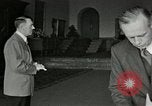
Adolf Hitler speaks to Nazi official Martin Bormann and Reich Minister Joachim von Ribbentrop in Berghof hall, Berchtesgaden.
German Chancelor Adolf Hitler's mountain retreat Berghof in Berchtesgaden, Germany. Adolf Hitler with Nazi officials at Berghof, Berchtesgaden in Germany. Hitler speaks to Nazi official Martin Bormann and Reich Minister Joachim von Ribbentrop in Berghof hall.
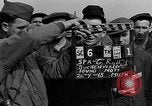
Long term captive of Buchenwald concentration camp, Otto Feuer, is interviewed after U.S. forces liberate camp.
Internees at a concentration camp in Buchenwald, Germany. Otto Feuer, a Jewish internee from Hamburg states how he has been in concentration camps for past so many years. He thanks the American Army for liberating them from the concentration camp in Buchenwald, Germany on April 11, 1945. Other internees in the background.
Opening statement of the prosecution at the Nuremberg Trials; flashback scenes of Nazi crimes and starving civilians in 1945
Events related the Nuremberg Trials held at the Palace of Justice in Nuremberg, Germany. Flashbacks of a variety of Nazi crimes against humanity during World War II. Europe during 1945. War devastation: buildings and cities laid in waste, people in hunger and despair emerge from shelters searching for the causes of the war and of the immediate human suffering. Deprived children and adults weep, starve and beg on the streets. November 21, 1945, Nuremberg, Palace of Justice, seat of the International Military Tribunal. List shows the names of the convicted Nazi criminals. Chief prosecutor from the United States, Robert Houghwout Jackson, makes the opening statement of the prosecution. He presents Count 1 of the indictment a conspiracy to commit war crimes and crimes against peace and humanity. He makes the statement that criminals who have done injustice to the laws of humanity must be brought to justice. Stenographers wearing headphones take down notes. Defendants stand in their dock including Herman Goring, Rudolf Hess, Joachim von Ribbentrop, Wilhelm Keitel, Karl Donitz, Erich Raeder, Baldur von Schirach and Fritz Sauckel. Faces of the convicted criminals. Scenes from mass burial of victims from German bombing of Coventry, England. Scenes from the end of World War 2, with women weeping and civilian victims of war in Europe, including Germany, seen scavenging on streets for food. Women and hungry children scrape out trash cans and metal lids for bites of food. Desperate civilians cut down remaining tree stumps from formerly tree-lined streets to use for fuel. A group of men and women struggle in a food relief line in Italy.
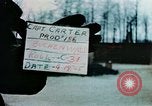
Dead bodies of prisoners from Buchenwald Concentration Camp seen piled up in a truck.
Dead bodies of prisoners from the Buchenwald Concentration Camp, operated by Nazi Germany in Ettersberg near Weimar Germany. World War 2 U.S. Army Cameraman slate indicates footage is from Buchenwald and was filmed on April 14, 1945, soon after the camp's liberation on April 11 by American forces. Dead bodies of prisoners lie on ground. Emaciated and tortured bodies of atrocity victims seen piled up in a truck. Dead man with a beard. Different bodies piled up in a truck. Faces of the dead bodies.
CRITICALPAST.COM: About Us | Contact Us | FAQs - How to Order | License Agreement | My Account | My Lightboxes | Shopping Cart | Advanced Search | Featured Collections | Website Terms & Conditions | Privacy Policy ©2026 CriticalPast LLC.
License Agreement |
Terms & Conditions |
Privacy Policy
©2026 CriticalPast LLC.