


 Francais
 Deutsch
 Italiano
Refine Your Search
Berlin Germany 1937 stock footage and images
- Showing 4915 to 4920 of 6879 results more
more Hide
Hide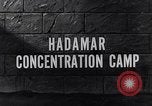
Major Herman Bolker of the U.S. military and his subordinates visit atrocities at Hadamar concentration camp after World War II.
Hadamar concentration camp in Germany visited after World War II. Major Herman Bolker and his sub-ordinates step out of a U.S. military truck and move into the camp. Disease-stricken, weak and starved prisoners at the camp. Guards dig a common grave and pull out corpses of the victims of this concentration camp. Doctors and priests at the place. Guards make notes about the dead. Chief physician of the camp, Adolf Wahlmann, with head nurse, Karl Willig, are interrogated by Major Walker. He shows a bottle of morphine, as morphine injection was commonly used to murder the inmates. Soldiers arrest Wahlmann.
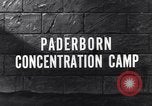
Russian prisoners at the Paderborn concentration camp raid the food stores after being liberated by Allied army during WW II.
Paderborn concentration camp in Germany visited after World War II. The 2nd division of the 9th Army of the Allied military forces arrive at the camp with their tanks and weapons. The liberated Russian prisoners raid food stores for stealing baking flour kept at the stores. Prisoners break the door of store. Man eating baking flour. Men fight over a little flour. Soldiers control the prisoners.
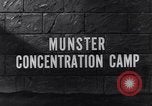
Prisoners at the Munster concentration camp liberated and given food by 9th Army of Allied military during World War II.
Munster concentration camp in Germany after World War II. The 9th Army of the Allied military forces arrives at the camp with their tanks and weapons and liberates prisoners of the camp. An inmate washes his wounds. Inmates cook food for them, supplied by the Allied troops. The liberated French and Belgian prisoners. Water tanker for prisoners. A happy old man smiles.
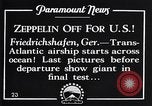
German dirigible Graf Zeppelin taken out of its hanger and flies over Friedrichshaven, for its flight to the United States.
German dirigible Graf Zeppelin starts from Friedrichshaven, Germany and during its flight for the United States, Graf Zeppelin brought out of its hanger and moved over by its ground handling crew. The cabin on the dirigible. Sailing at dusk in an overcast sky. Flying above harbor of Friedrichshaven. Harbor watch tower, buildings and coastline.
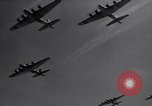
Bombing of rail roads in Bremen by United States B-17 bombers and atom bomb testing during WWII
United States Boeing B-17 Flying Fortress bomber drops bombs on railway tracks in Bremen, Germany during World War II. Bombs making an impact. Low-level strafing and bombing of targets in Europe by low flying U.S. Army Air Force aircraft during World War 2. Bridge is struck by bomb. Explosions on other targets. Separate unrelated shot of United States conducting an early Atomic bomb test (Trinity test is shown on July 16, 1945. The first detonation of a nuclear device). Nuclear explosion and mushroom cloud is seen.
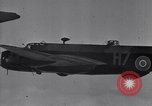
British Royal Air Force aircraft conduct 700-airplane bombing raid over Cologne during World War II
Narrator states that on March 2, 1945, during World War 2, 700 Lancaster and Halifax bombers of the British Royal Air Force fly over Cologne, Germany, to bomb roads and bridges leading across the Rhine River. Closeup aerial view of a British Halifax bomber with H7 painted on its fuselage, identifying it as belonging to No.346 Squadron RAF. (This is a Free French bomber squadron incorporated into the Royal Air Force and operating out of RAF Station Elvington.) View from one of the aircraft looking down on the city below as bombs fall from the plane. Narrator refers to U.S. 1st Army attacking Cologne and this bombing to strike German forces fleeing the city. Heavy smoke seen rising from bomb explosions below. A huge black cloud is seen in the air as a German scarecrow bomb hits a Lancaster bomber and destroys it (Narrator calls it a scarecrow bomb. Later analysis concluded that "scarecrow" bombs may have been attacks by Luftwaffe aircraft equipped with upward facing cannons, or so called "Schräge Musik" attacks.) Smoke rising from the city. Narrator emphasizes that the Cologne Cathedral is not touched.
CRITICALPAST.COM: About Us | Contact Us | FAQs - How to Order | License Agreement | My Account | My Lightboxes | Shopping Cart | Advanced Search | Featured Collections | Website Terms & Conditions | Privacy Policy ©2026 CriticalPast LLC.
License Agreement |
Terms & Conditions |
Privacy Policy
©2026 CriticalPast LLC.