


 Francais
 Deutsch
 Italiano
Refine Your Search
Berlin Germany 1952 stock footage and images
- Showing 1093 to 1098 of 6470 results more
more Hide
Hide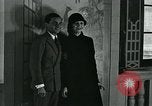
Newly wed Irving Berlin and wife (former Ellin Mackay) during their honeymoon in Atlantic City.
Newly wed American song writer, Irving Berlin, and his wife (former Ellin Mackay) pose for photographer indoors during their honeymoon in Atlantic City, New Jersey. Camera flashes. Berlin and wife pose on porch.
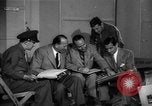
Michael Curtiz, Hal B. Wallis and Irving Berlin discuss during shooting of film "This Is The Army" in Hollywood, California.
The shooting of the movie "This Is The Army" at Warner Bros Studio in Hollywood, California. Soldier Blatt, film maker Michael Curtiz, Hal B. Wallis and Irving Berlin seated with pictures and registers. Curtiz, Wallis and Berlin in discussion. The camera and crew. Actors and extras on the film set enter Marquee- Broadway Theater. A sign: "This Is The Army, Soldier Show, Opens Tonight." People in a street on the movie set. A camera boom in the foreground. The camera boom goes from one side to another. (World War II period).
Allied leaders at the Potsdam Conference and military and police patrol East Germany after the partition of Germany.
New government formed in Germany after the defeat of Nazis during the World War II. Leaders of the Allied nations meet and talk during the Potsdam Conference. Stalin, Truman, and Churchill seen greeting each other. Soviet Marshall Joseph Stalin's partition plans and aspirations shown on a map. Russian troops march in East Germany and Stalin and Khrushchev with other communist leaders of East Germany review a parade. Military and Civil Police guards march on roads of East Germany. Women police officers during the patrols. An investigative police officer or Stasi police escorts a detained civilian through a doorway marked, "Untersuchungs Haftanstalt Wittenberge" (Investigative Detention Wittenberg).
Rise of Fascism in Italy and Germany after World War I
Animated map depicts the spread of Fascism in Japan, Germany and its neighboring countries, and Italy. Views of Italian Fascist "Black Shirts" marching bearing flags and rendering the fascist Roman Salute. Fascists participating in the famous "March on Rome" (“Marcia su Roma”) in October 27, 1922. Spectators line the sidewalks and side of the road. Brief (jerky) views of unrest and desperate crowds of citizens in post-war Italy circa 1919 and 1920 following World War I, due to unemployment and hard times. Italian people getting food at an outdoor soup kitchen. Fascists promising better times are seen parading and riding in jammed open cars. Benito Mussolini, who was elected to Parliament in 1921, is seen in a top hat, arms akimbo, standing with other officials. Glimpse of Black Shirts marching in front of the Palazzo Venezia (Via del Plebiscito, 118, 00186 Roma RM, Italy). Back to Mussolini, again, who now makes some remarks to those standing with him and expresses himself with exaggerated body language. Another glimpse of Black Shirts marching. Film transitions to Germany, where Adolf Hitler is seen walking through a dense crowd of supporters and some brownshirts or SA stormtroopers. Hitler's clothes resemble a military uniform. Next, scenes illustrating the terrible post-World War 1 hyperinflation suffered by Germany during the Weimar Republic. Various Deutschmark (Deutsche Mark) banknotes in ridiculous denominations are shown. Baker puts a 460 billion Deutschmark price on bread. People trying to buy groceries during this period. German militaristic marchers. Fascists giving arm salutes as they parade in a city street. General Field Marshal Paul von Hindenburg (President of Germany) is seen standing in front of Germany's top military leaders. Directly behind him is Marshal August von Mackensen, in a fur busby hat with Totenkopf (death head) insignia. Other Generals wear pickelhaube spiked helmets. Hindenburg's closest associate, General Erich Ludendorff stands just behind and to the left of Hindenburg. Glimpse of German soldiers in more modern uniforms. Next, Hindenburg is seen reviewing troops in the company of their commander. Next, Hitler is seen with a group of German civilian industrialists whose interests he promises to support. Alfred Krupp Jr. sits, with his legs crossed, next to Hitler. Glimpse of Hitler, in uniform, waving from a window. People running as a cadre of mounted police canter in formation down the street.

Atrocities against prisoners in Nazi concentration camps at different places in and near Germany.
Atrocities against prisoners in Nazi camps at different places in and occupied by Nazi Germany during World War 2. Wounded and emaciated Americans are fed and given medical care by Yank Armies of Liberation in Grasleben, Germany. Masked grave diggers open graves in Hadamar, Germany. Around 35,000 political prisoners found buried. Soldiers question Nazi German Chief physician Adolf Wahlmann at Hadamar Killing Centre. General Eisenhower, General Patton and General Bradley inspect Camp Ohrdruf (a Nazi Camp) in Germany. Heaps of human bodies and lime pits filled with corpses can be seen. 21,000 prisoners stumble around with their broken skulls in Buchenwald Concentration Camp (a Nazi camp in Germany). Corpses lie everywhere with large tattooed numbers on their stomachs. Two crematory ovens that were used. Starved people loaded into ambulances for treatment. (World War II period).
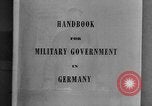
Allied headquarters in Germany and people being informed through notices.
Allied Military Government ( AGM ) activities in Germany very soon after end of World War II in Europe. The cover of a book titled ' Handbook of military government in Germany '. The text indicates rules of governance in Germany. Closeup of street signs on building at corner of Wilhelmstrasse and Kaiserplatz in Düren Germany. Building of AGM headquarters in Germany. U.S. Army soldiers on a balcony of a government building remove a Nazi flag and setup a United States flag in its place. Men and women killed due to Nazi atrocities. Military Policemen question the Nazis. German citizens milling about on a street. They are being informed about Allied laws and orders through notices and other means. German citizens read an Allied notice. A court hearing being conducted for persons accused of impersonating Allied officals. A man disposes of weapons which are illegal and for which possession is punishable by death, according to the narrator.
CRITICALPAST.COM: About Us | Contact Us | FAQs - How to Order | License Agreement | My Account | My Lightboxes | Shopping Cart | Advanced Search | Featured Collections | Website Terms & Conditions | Privacy Policy ©2026 CriticalPast LLC.
License Agreement |
Terms & Conditions |
Privacy Policy
©2026 CriticalPast LLC.