


 Francais
 Deutsch
 Italiano
Refine Your Search
Berlin Germany 1952 stock footage and images
- Showing 2209 to 2214 of 6470 results more
more Hide
Hide
Notable persons after being set free from Nazi prison camps in Germany at end of World War II.
Former prisoners seen after being set free from Nazi prison camps in Germany at end of World War 2. The prisoners shake hands after being set free. The prisoners include Prince Frederick Leopold of Prussia, Baroness Schuschnugg, German industrialist Fritz Thyssen and Baron Schell. The Baroness stands with a young girl and a man as she smiles after being set free. Other prisoners include Bishop of Clermont-Ferrand Gabriel Piquet, former Prime Minister of Hungary Miklos Kallay and Commanding officer of Greek Army General Alexandros Papagos. German Army General Franz Halder and his wife after being set free. Prince Leopold raises his coat collar to reveal his prisoner number. German General Franz Halder stands with his wife.

Women take out earrings from a glass cabinet and wear magnet earrings in Germany.
Models try on fashionable earrings in Germany. Women take out modern and antique earrings from an antique glass cabinet. Jewelry on display inside the cabinet. The women wear earrings as they look into the mirror. A pair of clip-on earrings. A person shows a magnetic earring. A model puts on stylish magnetic earrings and looks in the mirror. Objects get attracted to the magnetic earrings as the model walks.

People crowd outside a building and a woman distributes butter to people in Germany.
Butter distributed to people in Germany. People crowd in a large number in a street. They enter a building. A woman distributes butter to the people. An old woman walks out of the building with butter in her hands. An old man holds butter in his hand and walks.

Scattered wreckage and wrecked train cars at the site of an accident of two trains in Germany.
Collision between two trains on a same track during the repair work in Germany. The wrecked train cars. A view of the wreckage. A sign board reads 'Stuttgart Waibilngen'. The scattered wreckage where the accident took place. U.S. Army personnel walk in between the wreckage. The personnel cover a coffin. The rescue workers stand in the background. The personnel carry the coffin through the railway tracks. The scattered wreckage.
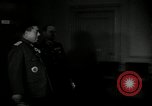
Japanese Imperial Army General Tomoyuki Yamashita presents a sword to a German officer in Germany during World War II.
General of the Japanese Imperial Army Tomoyuki Yamashita on official vist in Germany during World War II. The Japanese General Tomoyuki Yamashita enters a room. The General shakes hand with a German officer. General Yamashita presents a sword to the German officer. Other Japanese delegation officers and German officers stand in the background. The German General speaks to the Japanese General. Both of them shake hands. A Japanese officer takes out the sword from its cover. General Yamashita holds the sword in his hands. Japanese script written on the sword. The officer holds the sword in his hand.
U.S. Army soldier greet the Russians and Polish prisoners from a concentration camp in Julich, Germany.
Allied troops in Germany during World War II. Allied troops walk on a street. Damaged buildings on either side of the street. Rubble on the street. The troops on tanks and trucks advance. First U.S. Army troops in a trench with guns. The troops on tanks fire and advance. The troops on a tank advance. An insignia of the United States on a tank. The U.S. 9th Army troops on jeeps cross the Rhine river. A troop on a bridge crosses the river. The troops enter a German town Lich. The damaged buildings. A soldier fires a gun. The dead German soldiers. The captured German troops raise their hands and advance. The German people stand. A view of the damaged and wreckage in Julich. Allied Supreme Commander General Dwight D. Eisenhower and the U.S. 9th Army Commander W.H. Simpson inspect positions near Julich. A view of the damaged town. The civilians walk on a street. The captured German soldiers walk on the street. Russian and Polish prisoners are liberated. The U.S. Army soldier greet the Russians and Polish prisoners. The prisoners are liberated and meet each other. A soldier stands with a woman. A view of a German concentration camp. The buildings at the camp. Barbed wire fence around the camp.
CRITICALPAST.COM: About Us | Contact Us | FAQs - How to Order | License Agreement | My Account | My Lightboxes | Shopping Cart | Advanced Search | Featured Collections | Website Terms & Conditions | Privacy Policy ©2026 CriticalPast LLC.
License Agreement |
Terms & Conditions |
Privacy Policy
©2026 CriticalPast LLC.