


 Francais
 Deutsch
 Italiano
Refine Your Search
Berlin Germany 1952 stock footage and images
- Showing 2455 to 2460 of 6470 results more
more Hide
Hide
Victims of Penig concentration camp receive medical aid at a German hospital in Germany during World War II.
Liberated victims of a Penig Concentration Camp in Germany during World War II. German uniformed medics carry women victims and place them on stretchers. Women lying on litters smile. Stretchers carried inside a hospital. Red Cross ambulances drive down a road. Ambulances pull up at the hospital. Litters unloaded from the ambulance. German medics lead wounded on foot inside the hospital. German nurses at the hospital. The wounded lying in beds. U.S. Army medics examine victims. A medic wraps a bandage around a woman's leg. A medic cleans a wound on a victim's back.
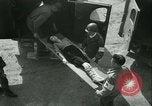
Victims of Penig Concentration Camp being taken to a hospital in Germany during World War II.
Jewish victims of Penig concentration camp in Germany during World War II. Victims on stretchers being placed in ambulances. A U.S. Army soldier leads a wounded to an ambulance. Soldiers bring women out of the concentration camp building. Stretchers being loaded into ambulances. The wounded feet of a victim. Wounds and lesions on buttocks of a victim. U.S. Army medics examine women lying in beds. Ambulances pull away from the concentration camp.

British Prime Minister Neville Chamberlain and Chancellor Adolf Hitler discuss peace terms at Berchtesgaden, Germany.
British Prime Minister Neville Chamberlain arrives at Chancellor Adolf Hitler's Berghof residence in Berchtesgaden, Germany. They discuss peace terms. Hitler's answer is Stiffening of Annexation demands.
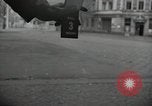
United States Infantry troops patrol with Sherman Tanks on streets of Leipzig, Germany (WW2)
United States Infantry troops patrol on streets of Leipzig, Germany during World War II. Sherman tanks advance on streets. Huge German civilian crowd comes out of homes with white flags in hand.

United States Infantry troops patrol on streets of Leipzig, Germany and civilians with white flags (WW2)
United States Infantry troops patrol in streets of Leipzig, Germany during World War II. Sherman tanks advance on streets. Troops with rifles in hand march on road. German civilians stand with white flags in hand. Empty street in Leipzig.
German civilians dig graves and bury Nazi atrocity victims in Gardelegen, Germany.
German civilians forced by U.S. Army soldiers in World War 2 to dig mass graves for Nazi atrocity victims of the Gardelegen Massacre, in Gardelegen, Germany. Bodies of slave laborer political prisoners on the ground, including Russians, Poles, and French, many of whom had come from the Mittelbau-Dora Concentration Camp and the Hannover-Stöcken Concentration Camp . A large barn in the background on the Isenschnibbe estate, showing evidence of fire damage, where many victims were found by the U.S. Army 102nd Infantry Division on April 14, 1945, after having been locked in the barn which was then set on fire on April 13, 1945. German civilians uncover nearby existing hastily dug mass graves containing piled victims. Dead bodies placed in new graves and covered with dirt. Civilians under U.S. Army direction dig long, mass grave trenches to bury the dead.
CRITICALPAST.COM: About Us | Contact Us | FAQs - How to Order | License Agreement | My Account | My Lightboxes | Shopping Cart | Advanced Search | Featured Collections | Website Terms & Conditions | Privacy Policy ©2026 CriticalPast LLC.
License Agreement |
Terms & Conditions |
Privacy Policy
©2026 CriticalPast LLC.