


 Francais
 Deutsch
 Italiano
Refine Your Search
Berlin Germany 1952 stock footage and images
- Showing 3181 to 3186 of 6470 results more
more Hide
Hide
A soldier talks over a handie talkie and prisoners march down a street during a street fighting in Koblenz, Germany.
Street fighting between U.S. soldiers and prisoners in Koblenz, Germany during World War II. The prisoners with their hands on the heads. A soldier talks over a handie talkie near a damaged building. The prisoners march down a street. Damaged buildings in the background. A sign board reads "Koblenz".
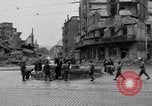
German civilians build a barricade around a French machine gun position at a street intersection in Stuttgart, Germany.
German civilians build a barricade at a street intersection in Stuttgart, Germany during World War II. German civilians carry bricks and rubble. They build a barricade around a French machine gun position at the street intersection. Damaged buildings on either side of the streets. A French soldier directs the work of German civilians. Men walk down the streets. They pick up bricks from heaps of rubble. They level the mud around the barricade using shovels.
Russian prisoners hold May Day celebration at prisoner of war camp"Stalag 6" in Hemer, Germany.
May Day celebrations at a prisoner of war camp in Hemer, Germany during World War II. Russian prisoners of war (POWs) hold May Day celebrations in the camp "Stalag 6" after the liberation by United States Forces. Russian soldiers carry a banner in Russian and English which reads "long live Americans which liberated us from the Nazi captivity." Portraits of General Secretary of the Communist Party of the Soviet Union Joseph Vissarionovich Stalin, the President of the United States Harry S. Truman and the Prime Minister of the United Kingdom Winston Churchill. United States Major General Ray Edison Porter, Commanding General of the United States 75th Infantry Division ; Camp Commandant Major N. Mironof and other Russian officials on a speakers' platform. A large crowd of Russian prisoners gathered during the celebration..
Soldiers march past and a Russian Army band plays during May Day celebrations at a prisoner of war camp in Hemer, Germany.
May Day celebrations at prisoner of war camp "Stalag 6" in Hemer, Germany during World War II. Portraits placed at the doorway of a building. Tents at the campsite. Mountains in the background. Russian officers salute. Soldiers march past holding flags and guns. A Russian Army band plays.
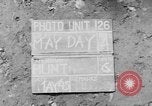
Ration and cigarettes are issued to released prisoners at a prisoner of war camp in Hemer, Germany.
May Day celebrations at prisoner of war camp "Stalag 6" in Hemer, Germany during World War II. Russian prisoners and nurses march past a review stand. A truck loaded with American ration and cigarette cartons. The ration and cigarettes are issued to the released prisoners. The prisoners carry the ration cartons.
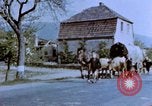
German civilians with their belongings loaded on horse drawn wagons move through the streets in Trier, Germany.
German civilians evacuate Trier,Germany with their belongings during World War II. The civilians move with horses and oxen pulled covered wagons through streets. Women ride bicycles. A gate in the city of Trier. A sign reads Trier. Wagons pulled by horses and team of oxen. Trees on either side of the streets. A horse drawn wagon loaded with the belongings of a family. Departing Germans. A tractor pulls a wagon. A stream of civilians move with their belongings. American trucks drive past civilian wagons. The civilians cart their belongings away. German civilians stand with an ox. A wagon filled with belongings.
CRITICALPAST.COM: About Us | Contact Us | FAQs - How to Order | License Agreement | My Account | My Lightboxes | Shopping Cart | Advanced Search | Featured Collections | Website Terms & Conditions | Privacy Policy ©2026 CriticalPast LLC.
License Agreement |
Terms & Conditions |
Privacy Policy
©2026 CriticalPast LLC.