


 Francais
 Deutsch
 Italiano
Refine Your Search
Berlin Germany 1952 stock footage and images
- Showing 4759 to 4764 of 6470 results more
more Hide
Hide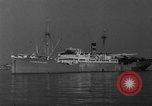
The S.S. Schwabenland catapults a 10 ton Dornier Do-18 flying boat.
Launch of a Dornier Do-18 seaplane from the S.S. Schwabenland (Bremen) in Germany. The mother ship underway. A man stands on the wing of a Dornier Do-18 seaplane. Closeup of catapult controls. The seaplane takes off from the Schwabenland. Men on deck look at the aircraft as it takes off.
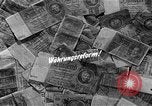
German citizens exchange old currency for new in German Currency Reform of 1948.
German citizens exchange old money for new money in Germany during Currency Reform of 1948. Pedestrian walk on a street in the rain. Crowded street cars in the background. People look at Münchner Merkur newspaper and posters in Munich announcing the currency exchange. People wait in line to get Deutschmark for old Reichmark. Various closed storefronts in a German city. The crowd assembles in a street waiting to get the new currency. Crowds in front of the main railroad station in Frankfurt. Newspapers being unloaded from printing presses of Münchner Merkur newspaper production plant after workers change type casts. Printed newspapers being stacked. People in Odeonsplatz in Munich rush after a newspaper truck to get the latest news on the money change. German people standing and seated reading the newspapers. Boxes with Deutsche Marks are stacked in banks and checked. Packages of newly printed currency on a counter. Money bags sealed and loaded into a bus. View of Marienplatz town square in Munich. Long lines of people carrying umbrellas stand in rain waiting to exchange money. The money being transferred and exchanged. People sign papers after the exchange. Old money dropped into a wooden box. People comparing the new with the old currency. A man changing prices in store windows. Merchants arranging goods for display in previously empty shop windows (due to prevalence of black market before the reform). Ober Director Dr. Puender speaks on the money reform.
German factory workers manufacturing arms including rifles, artillery, shells, aircraft, and tanks during World War II
Manufacturing of German weapons in Germany during World War 2. Opening scene shows steam and smoke rising from a German industrial complex in 1941. Inside the plant, men and women are at work in arms manufacture. A woman rides on a traveling crane, moving a large steel wheel suspended by a chain. Another woman operates a grinder from which sparks fly. A woman welder uses a torch on slabs of steel and another removes parts from a machine press. An array of new rifles moves past the camera, revealing men fitting barrels into rifle stocks. Closeup of a worker examining a rifle stock for symmetry. A man in protective clothing uses a long pole near a steel furnace. Bessemer-type furnaces emit flames as they are charged with oxygen. Caldrons filled with molten steel move while suspended below an overhead conveyer. A machinist turns the nose section of a large shell. A man uses white tape to tie finished munitions for shipment. Men working on several 122mm field pieces and others working on a line of 88mm anti-aircraft guns. Camera pans over assortment of shiny finished artillery shells. A container is raised up from an annealing operation. Men tend others where flame can be seen. Many workers walk in unison to a row of Junkers JU-88 aircraft fuselages. A 1,340 Junkers Jumo 211J twelve-cylinder engine for one is seen moving on an overhead conveyer. Assembled and painted Ju-88s are rolled through a hangar. One sits at the door of the hangar. A production line of Panzer tanks in various stages of completion. One moves through the plant on an overhead conveyer.

B-17 aircraft of the U.S. 351st Bomb Group run gauntlet of attacks from German fighters and Flak in World War II
View inside a B-17 of the U.S. 351st Bomb Group, enroute to target in Germany during World War 2. Gunners looking out their window as escorting P-47 fighters of the U.S. 487th Fighter Squadron (352nd Fighter Group) turn back (for lack of fuel endurance) and head home to their base at RAF Station Bodney. The B-17s continuing unescorted in tight formation, displaying high altitude contrails. German fighters are spotted at 9 O'Clock high. Contrails from German fighters are seen. Gunners rotating their turrets as they look out for enemy attacks. American gunner fire at attacking German fighters. Sky filled with swirling contrails from the attackers. German fighter disables lead ship which begins to descend with number 4 engine smoking. Crew inside B-17 watches as some of the stricken crew bail out with parachutes. German fighters continue relentless attacks on the B-17s. B-17 Flying Fortress is seen falling into a flat spin and descending rapidly toward the ground, out of control. German FW-190 fighter join in the attack. B-17 gunners hit one and it explodes and falls. Another B-17 is hit and falls out of control. German fighters regroup in formation as the B-17s enter an area of concentrated antiaircraft ground fire. Black bursts of flak surround the B-17s. Soon the German fighter attacks resume.
6th Armored Division of the U.S. Army advances on a German road during World War II.
Armored fighting vehicles of the U.S. 6th Armored Division move up a road in Germany during World War 2. Vehicles including trucks, jeeps, M8 armored cars, half tracks and tanks advancing on the road. 15th armored regiment tanks in column. Large white tactical numbers synonymous with the 6th Armored Division displayed. Smoke rises from fire in the background. A T34 rocket launcher mounted on an M4 medium tank beside the road. A M4(105) tank of HQ company rounds a corner throwing up dust. A tank with a rocket launcher moves along the road. Jeeps loaded with medics move up with the armored spearhead (heading to their assembly area prior to the Rhine crossing the following day).
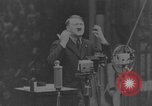
Several brief scenes of Adolf Hitler making impassioned speeches to the German people.
Hitler speaking (in civilian clothes) as he seeks appointment as Chancellor of Germany, in 1933, and speaking outdoors, against backdrop of massed flags, as he pledges to fight for the German people.
CRITICALPAST.COM: About Us | Contact Us | FAQs - How to Order | License Agreement | My Account | My Lightboxes | Shopping Cart | Advanced Search | Featured Collections | Website Terms & Conditions | Privacy Policy ©2026 CriticalPast LLC.
License Agreement |
Terms & Conditions |
Privacy Policy
©2026 CriticalPast LLC.