


 Francais
 Deutsch
 Italiano
Refine Your Search
Berlin Germany 1952 stock footage and images
- Showing 4813 to 4818 of 6470 results more
more Hide
Hide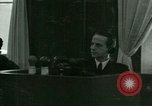
James E. Heath questions Otto Ohlendorf and Michael A Mussmanno makes a statement in the Einsatzgruppen Case, Nuremberg.
The Einsatzgruppen Case in Nuremberg, Germany, following World War 2. The chief defendant in trial in the case, Otto Ohlendorf, tells his story on the witness stand, relating that the records indicate where his Nazi German death squad group put to death more than 90,00 persons. Mr. James E Heath, prosecution lawyer questions Otto Ohlendorf about the 90,000 killings by Einsatzgruppen. Judge Michael A. Mussmanno makes a statement related to the above talks.
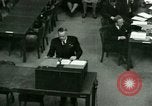
Otto Ohlendorf, the Einsatzgruppen leader, talks about the corpses and killing of Jews during War Crimes Trials in Nuremberg.
The Einsatzgruppen Case in Nuremberg, Germany. The member of prosecution reads the indictment. Prisoner Otto Ohlendorf gives reports that the group of corpses were first buried in the snow and then later buried by the Army. Einsatzgruppen Case reports the extermination of Jews by the death squad after the capture of Kiev. Report goes on to say that not only the Jews were considered politically dangerous but others such as Russians, Georgians, Poles etc. were also considered to have Bolshevistic tendencies. Otto Ohlendorf, the commander of the Einsatzgruppen death squad unit destroyed over 90,000 Jews. One Einsatzgruppen killed 700 people.
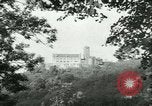
Reich Minister of Public Enlightenment and Propaganda Joseph Goebbels addresses German writers and artists in Weimar.
Weimar, Germany during World War 2. The Wartburg Castle atop a hill an hour from Weimar, Thuringia. Officials and dignitaries visit the Wartburg Castle (Wartburg-Stiftung Auf der Wartburg 1 99817 Eisenach). They take a tour through the hallways. Elderly men explore the castle. Pillars, arches, and other characteristic Romanesque style architecture. A garden at the castle. Reich Minister of Public Enlightenment and Propaganda Joseph Goebbels addresses German writers and artists in Weimar. The guests seated in a hall hear his speech. The German Swastika symbol on stage.
American soldiers cope with snipers in City of Leipzig, near end of World War II in Europe
Opening scene of film shows war damage with rubble at sides of street in Leipzig, Germany, during final days of World War 2, in Europe. American soldiers are hunkered down on sidewalks near buildings, attempting to combat snipers from across the street. Smoke rises from part of the building, and a white flag is seen in the window of another part of the building. Several American soldiers fire their rifles at the building. A puff of white smoke rises from the building. A Sherman tank is seen parked on the street. Shaky closeups of the target building with smoke coming from several windows. Change of scene shows a Sherman tank moving along the pathway of a tram. Closeup from behind of an American soldier firing his rifle from the corner of a building. Camera moves back showing another soldier speaking on a field telephone. Several German civilians walking past the area. Several soldiers patrolling along a sidewalk. German civilians congregating in small groups on a sidewalk. A man in one group waves a white handkerchief. Two Sherman tanks moving along a street. An American soldier hunkered down by a building corner while a uniformed German Sergeant stands calmly, next to him. A Sherman tank turns a corner on a street.
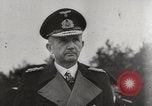
Testing of German one-man torpedo-carrying craft in World War II
View of German Grand Admiral Karl Doenitz. Complete change of scene shows a torpedo being loaded on a German Neger torpedo-carrying craft for a demonstration at Flender-Werke in Lübeck, Germany,during World War 2. Designed by Richard Mohr (whose surname means blackamoor),this craft cannot submerge but runs low, awash in the water. It is seen moving that way in the water and firing its torpedo. Back at the base, the operator, wearing an iron cross, climbs out of the craft. (Note: Not surprisingly, this little torpedo-carrier was sometimes called a human torpedo.)
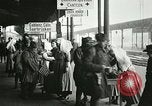
Welfare activities by Red Cross people at conclusion of World War I.
Coffee and sandwiches are served to American Army troops in Trier, Germany by the Red Cross activists. U.S. soldiers approach Red Cross women at a table in the train station and receive food. Signs beside tracks name various German cities. Two different groups of women red cross workers pose for cameras in front of the "Army Red Cross Enlisted Mens Club." Inside, U.S. Army soldiers check in at the club desk, staffed by Red Cross women workers. U.S. troops gather around a piano played by a Red Cross worker and the group sings along with the piano. Soldiers dance with Red Cross women in a dance hall at the club.
CRITICALPAST.COM: About Us | Contact Us | FAQs - How to Order | License Agreement | My Account | My Lightboxes | Shopping Cart | Advanced Search | Featured Collections | Website Terms & Conditions | Privacy Policy ©2026 CriticalPast LLC.
License Agreement |
Terms & Conditions |
Privacy Policy
©2026 CriticalPast LLC.