


 Francais
 Deutsch
 Italiano
Refine Your Search
Berlin Germany 1952 stock footage and images
- Showing 5347 to 5352 of 6470 results more
more Hide
Hide
United States Army Operations in European Theater.
A map of Europe. 1st United States Army tanks advance in Duren, Germany. 2nd Army troops fire artillery shells in Sarreguemines, France. 7th Army in Strasboug captures small towns. U.S. Mine Exploders on road. Troops on field. German civilians evacuated. Wounded prisoners carried on stretchers. The U.S. troops firing. Smoke due to explosion. Men observe through binoculars. (World War II period).
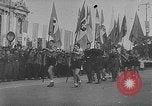
Nazi youth Leader Baldur Von Schirach at International Youth Conference in Vienna, Austria
International Youth Conference in Vienna, Austria. Youth delegates from 14 European countries carry flags in a parade. Uniformed officials from various countries review parade. They give a Nazi salute. Nazi youth Leader Baldur Von Schirach among officials. Public buildings with Stephans Cathedral in the background. Officials enter public building. Conference in session. Speakers, delegates and audience in the conference. Baldur Von Schirach , Leader of Hitler Youth, Arthur Ozman of Germany, Jenasen of Denmark, Vidisoni of Italy and Blolo of Spain in view.
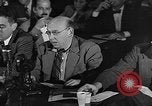
Musician, Composer, and film maker, Hanns Eisler, appears before Subcommittee of House Un-American Activities Committee
Subcommittee of House Un-American Activities Committee (HUAC) holds hearing in Los Angeles, California, United States. Johannes (Hanns) Eisler, musician, composer and film maker, is being questioned. He is questioned about his associations with the Communist Party and the Soviet Union. The witness spells his full name for the Committee, and states that he was born July 5, 1898, in Leipsig, Germany. He states his occupation, as composer and that he studied in Vienna and was a student of Arnold Schonberg. In response to questions, he recalls visiting the Soviet Union several times in the early 1930s, for film making and musical publishing. He denies ever receiving any monies from the Soviet Government.
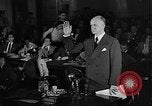
Hearings of House Un-American Activities Committee. Former Undersecretary of State, Sumner Welles testifies
House Committee on Un-American Activities hearings (HUAC) in Washington, DC, the United States. Former Undersecretary of State, Sumner Welles, is sworn in and sits during the hearings. Several men sit in the background. The defendant is asked questions about a note from Eleanor Roosevelt, on January 11, 1939,about the rejection of a U.S. visa for Mr. and Mrs. Hanns Eisler, by the U.S. Consul in Cuba, which was subsequently reviewed again. Defending against implications of negligence, Mr. Welles reminds the Committee of the context in which these decisions were being made. He talks about the atrocities committed in Germany.
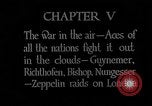
World War 1 aviators Richthofen, Billy Bishop, Georges Guynemer, Charles Nungesser, others, decorated in various ceremonies
Famous World War 1 aviators from various countries. Several aviators stand on airfield in Belgium. Aviators of World War I are decorated, seen in footage from several different ceremonies. Includes French aviators Georges Guynemer and Charles Nungesser, German pilot Manfred Richthofen (the Red Baron), and Canadian aviator Billy Bishop in ceremonies. A plane on the airfield. King Albert of Belgium is taken for a flight over Germany. Planes in flight. View of aviator Lt. Quentin Roosevelt, son of President Theodore Roosevelt, smiling beside a barracks building. View of soldiers gathered at Quentin Roosevelt's grave with primitive cross marker dated July 14, 1918.
J.Edgar Hoover describes the problem of enemy agents and Nazi sympathizers in the United States in 1940.
Director of the U.S Federal Bureau of Investigation (FBI), J.Edgar Hoover, addresses Americans in military service in 1940. He speaks about enemy agents sent to the United States to undermine the war effort. Scene shifts to a 1940 nighttime view of New York City with lights on in its buildings. Sound of Benny Goodman's orchestra in background. Glimpse of water displays at the New York World's Fair. Brooklyn Dodgers Baseball team playing a game at Ebbets Field. A large field of wheat being harvested by a mechanical reaper, in an American western state. American soldiers putting on civilian clothes for weekend passes. Views of various American cities and towns with cars driving on parkways, shoppers and pedestrians walking in business districts. Closeup of a German agent, ostensibly being apprehended while beaming information to Germany via shortwave radio. German documents are on his desk. A submarine periscope tracks across surface of water. A torpedo races through the water leaving a trail of bubbles. An American ship, ostensibly being torpedoed in the Caribbean. Letters being mailed to so-called "mail drops" in Spain and South America. An intercepted letter with military information being highlighted. A brick house, outside Los Angeles, where an unidentified man is seen, whom narrator (J.Edgar Hoover) describes as " This self-appointed Dictator, who set himself up in the business of promoting Nazism." A picture of Adolf Hitler is seen on his wall. Near Chicago, a wooden sign reads, "Camp Hindenburg., Two miles." American Nazi youth are seen parading there. A newspaper shows a picture of Nazi youth at Camp Nordland, in New Jersey where young American Nazi girls are seen parading. In Yaphank, on long Island, New York, American Nazis are seen parading. The head of the German-American Bund, Fritz Kuhn, is seen at an outdoor podium giving a speech, while surrounded and guarded by uniformed Bund members. He is enthusiastically applauded by members of the audience. Several women with babies in carriages, cross at a corner in New York City. Some receive notices being passed out by a young man, announcing a "Mass Demonstration for true Americans" (to be held at Madison Square Garden). A swastika appears on each notice. View from a high point overlooking a crowd of 22 thousand American Nazis gathered in Madison Square Garden, on Feb. 20, 1939. An honor guard parades as drummers play from the stage. A mass of men holding American flags, and one holding a banner showing a swastika and words in German. Audience members all render the Nazi salute and shout "Heil." Files in the FBI offices labeled "German Agents." The file of Walter Kappe, one of the leaders of the Chicago Free Society of Teutonia and German American Bund is shown. Narrator, Hoover, says, " he was a Lieutenant in the German Army and the Leader of German sabotage in the United States." View of a vast array of desks and files in the FBI where men and women work on fingerprints. A man projects fingerprints on a screen, as Hoover speaks of the files revealing that "innocent appearing persons, applying for work in United States war plants, had been convicted of espionage in the last world war."Two men look over an FBI chart showing the location of every key spy and mail drop in North and South America
CRITICALPAST.COM: About Us | Contact Us | FAQs - How to Order | License Agreement | My Account | My Lightboxes | Shopping Cart | Advanced Search | Featured Collections | Website Terms & Conditions | Privacy Policy ©2026 CriticalPast LLC.
License Agreement |
Terms & Conditions |
Privacy Policy
©2026 CriticalPast LLC.