


 Francais
 Deutsch
 Italiano
Refine Your Search
Berlin Germany 1952 stock footage and images
- Showing 5545 to 5550 of 6470 results more
more Hide
Hide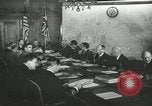
Landing craft, tanks, munitions, and gasoline supplies assembled in England for D-day invasion in World War II
Preparations in year 1943 for the June 1944 invasion of Western Europe by Allied Force during World War 2. Conference at Supreme Headquarters Allied Expeditionary Force in London. U.S. Generals George Marshall, Henry H. Arnold and British Field Marshal Bernard L. Montgomery meet at SHAEF (Supreme Headquarters Allied Expeditionary Force). Montage of war scenes: British Lancaster bombers taking off. British men and women monitors working in a British Command and Intelligence Center, tracking aircraft positions on maps. U.S. B-17 bombers in daylight missions over Germany. Allied pilots and crew members in aircraft. U.S. Army Air Force B-17 aircraft at high altitudes leaving contrails behind. Bombs bursting on German industrial targets. Allied agents being airdropped over France. Allied one-man submarines or solo submarines, torpedo boats and Commandos sampling French beaches and soil conditions in the Normandy region for ability to support 30-ton tanks for the invasion of France. British airman loading reconnaissance camera into a British Spitfire reconnaissance aircraft for photographing the planned invasion region. Woman operating microscope analyzing film. Aerial reconnaissance film images being laid out and attached together to create a large overhead viewing map. Arms and equipment being air dropped to indigenous resistance forces in Nazi-occupied Europe. Mulberry floating harbor segments being designed and built to create invasion ports. Allied landing craft training in Devon, England. Allied aircraft strafing a German ship. Meteorological equipment assessing weather along the invasion coast. Wire netting to pave the beaches. Underwater pipelines to carry gasoline or petrol to France. Allied armored vehicles bearing the White Star. Troops being inoculated or vaccinated. Newly built ship going down the ways at an Allied ship yard that builds Navy warships. View of British intelligence officers with headsets at radio equipment, and personnel monitoring German radio broadcasts. Soviet Embassy in Tehran, Iran, where the Big Three are seen meeting at Tehran Conference to finalize invasion plans. Stalin, Roosevelt, and Churchill sitting on the porch of the Embassy building, in 1943. General Eisenhower and Allied Military leaders planning the D-Day invasion. General Omar Bradley, sitting with a British admiral. General Bernard Law Montgomery Aerial view of formation of U.S. Army Air Force B-17 aircraft, flying through Flak bursts. Pilots in B-17 cockpit .Bombs striking German targets. Polish, Scenes including gun camera footage of Czech, and British in Spitfire aircraft striking German railroads and marshaling yards. B-26 bombers and gunner attacking German Luftwaffe Me-109 aircraft.
German officers board United States C-47 Skytrain for air evacuation to England in European Theater.
German officers await air evacuation in European Theater during World War II. German officers await air evacuation to England. Germany officer boards U.S. Army Air Forces C-47 Skytrain plane parked at an airfield. U.S. soldiers stand around as German officer boards C-47. Door of C-47 closes.
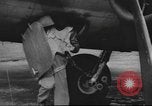
United States Air Force operations in the European Theater during World War II.
U.S. Air Force operations in the European Theater during World War 2. A bombardier gets out of the nose of a U.S. B-17 Flying Fortress bomber plane. Pilots talk beside a B-17. An animation of number of sorties and tons of bomb drops over enemy target. Aerial point of view (POV) shots from cockpit of a US Army air force aircraft in flight on an attack run flying low over houses and industry of enemy territory in Europe during World War 2. An aerial formation of B-17s, P-39 Airacobra fighters, B-24 Liberator bombers and P-38 Lightning fighters. Chancellor of Germany Adolf Hitler giving an impassioned, animated, emotional speech. German Propaganda Minister Joseph Goebbels in a conference. American men and women war production workers inside a factory making war materiel. U.S. firing squad fires salute over a grave. An airplane burns and a crew member face down on the grass. U.S. Army Air Force fighters and bombers in flight and bombs away views as bombers drop bombs on German targets .
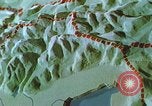
Transportation progress in Europe during the nineteenth century and into middle of 20th century after World War 2.
A model Relief map of Western Europe, with country borders marked in red. Animals used in rural areas. Italian farmers transporting milk cans and other things by donkey. A farm wagon being pulled by a horse. Road through the Simplon Pass, in Switzerland (constructed by Napoleon to transport artillery between the Rhône valley and Italy). Views of the mountainous area. Sketch of early English steam railroad train and of others in other countries, embraced enthusiastically by the local citizenry . Illustrations recording construction of the Britannia bridge across the Menai Strait between the island of Anglesey and the mainland of Wales. (It opened March 5, 1850.) Relief map of Europe focuses on Basle (Basel)in Northwest Switzerland. A modern-day signpost showing directions to France, Germany, and Switzerland. Freight trains arriving and cargoes being transferred by cranes of the Canal Barge operating company, Schweizerische Reederei. View of open storage yards, rail lines and a river. Freight trains carrying various loads to many different European destinations. Wrecked transport facilities left from World War II.
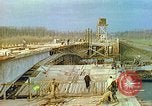
Road transport becomes the dominant mode of transport in post World War II Europe under reconstruction.
Road transportation system in post World War II Europe, supporting reconstruction efforts. European workers work at a bridge being bulit. Workers work on constructing a highway in Belgium. Diesel trailer trucks along with cars and Volkswagen bus or van vehicles move along a road in Germany. A truck stop at a gas station to refuel. Men load a truck with parts for construction of a power plant, and another truck with containers containing refrigerated fish. A truck pulls semi-trailers. A trailer truck loaded with Swedish furniture moves bringing new furnishings to homes in a town on the Polders of Holland. Boom in tourism begins. Signs at a Tourism office in Milan, Italy. European people at a Swiss railroad station. Swedish and Italian International tourism buses traveling in Europe providing a way to tour and sleep without needing to stay in hotels.
Air Force pilots of the Fascist Republic of Italy are greeted in Italy after returning from a raid on Gibraltar.
Air Force airplanes of the Fascist Republic of Italy return from a raid on Gibraltar during World War II. The airplanes in flight. Airmen and officials greet Italian pilots, in the service of Germany, as they deplane.They are decorated for their service. Torpedo bomber aces Marino Marini (with jumpsuit) and Carlo Faggioni (with white beret) are visible.
CRITICALPAST.COM: About Us | Contact Us | FAQs - How to Order | License Agreement | My Account | My Lightboxes | Shopping Cart | Advanced Search | Featured Collections | Website Terms & Conditions | Privacy Policy ©2026 CriticalPast LLC.
License Agreement |
Terms & Conditions |
Privacy Policy
©2026 CriticalPast LLC.