


 Francais
 Deutsch
 Italiano
Refine Your Search
Bien Hoa Vietnam 1966 stock footage and images
- Showing 2047 to 2052 of 4320 results more
more Hide
Hide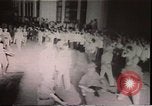
North Vietnamese guards flank U.S. prisoners who are marched through a waiting crowd in Hanoi, Vietnam.
U.S. prisoners of war are marched in Hanoi, Vietnam during the Vietnam War. U.S. prisoners are marched by North Vietnamese soldiers along a street. The prisoners march along the street lined up by screaming spectators. The prisoners are handcuffed in pairs and they wear numbered shirts. One pair of handcuffed Americans wear the numbers 399 (Edward Alan Brudno) and 381 (WIlliam Micahel Tschudy) on their backs. A crowd of North Vietnamese surround soldiers carrying an unconscious injured American captive. The soldiers try to hold back the crowd. One soldier waves a pistol in one hand as he helps carry the American captive with the other. Photographers take pictures as the soldiers place the captive American in a covered truck and drive away through the crowd.

U.S. President Richard Nixon addresses people in the United States on withdrawal of remaining U.S. troops from Vietnam.
Television broadcast of U.S. President Richard Nixon's speech from the White House in Washington DC, United States on the withdrawal of remaining U.S. troops from Vietnam on 29th March 1973 during the Vietnam War. The White House. The Seal of the President of the United States. The President talks about that period of the Vietnam War when he joined the office and speaks about the program he initiated to end the war. He says American prisoners are on their way from Vietnam and people of South Vietnam are now free to choose their government. He says North Vietnam is not complying with few provisions of the Peace Agreement. He says that they should honor all those American soldiers who died during the Vietnam War. He refers to the difficult days of the war including the moratorium to end the war which was organized on October 15, 1969 when millions of Americans took day off from work and schools to participate in local demonstrations against the war. Nixon refers to the period of April 1971 when he ordered attacks on Communist bases in Cambodia. He talks about the period of May 1972 when he ordered air strikes in North Vietnam and the period of December 1972 when he ordered more air strikes.
United States President Richard Nixon's address to the nation about ceasefire in Vietnam, for "Peace with honor."
President of United States Richard M Nixon's address to the nation from White House, Washington DC. He speaks about the cease fire agreement reached between North Vietnam and the United States. President Nixon delivers his "Peace with honor" speech about the cease fire in Vietnam. He speaks about the developments in Paris Peace Talks to end the Vietnam War. Nixon details the schedule of ceasefire and withdrawal of American Forces from Vietnam. Nixon admires the courage and sacrifice of the people of South Vietnam. He admires the U.S. soldiers, Prisoners of War and their relatives. (Vietnam War period).
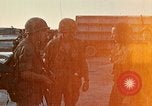
UH-1D helicopters of the United States Army take soldiers to Nui Ba Den Mountain during Vietnam War.
At start of film, a U.S. Army officer is seen talking with some soldiers preparing to depart Tay Ninh airfield for Nui-Ba-Den mountain, Vietnam. Next, the troops head across the field to helicopters of the 187th Assault Helicopter Co. (the Crusaders), waiting on marsden matting pavement at the field. A line of helicopters with troops aboard and engines running. They take off sequentially in trail formation. (Vietnam War period).
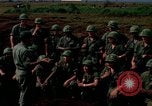
Indoctrination course in grenade handling for the soldiers of Fourth Infantry Division of the U.S. Army at Camp Enari in Vietnam.
Soldiers of the Fourth Infantry Division of the U.S. Army undergo indoctrination course in grenade handling at Camp Enari in Vietnam. The instructor explains to the soldiers the proper handling of a grenade. The instructor throws a grenade. Smoke arises as the grenade hits the ground. The soldiers throw explosives and grenades. (Vietnam War period).
United States Marines adjust range on 105 mm Howitzer at Khe Sanh, Vietnam.
United States Marines with bullet proof vests and helmets adjust range on 105 mm Howitzer at Khe Sanh, Vietnam. Platoon leader 1st Lieutenant David Pearce of Rochester, stands atop ammunition crates aiming circle to lay C battery. United States soldiers lift sandbags. Number of parachutes descends. (Vietnam War period).