


 Francais
 Deutsch
 Italiano
Refine Your Search
Bien Hoa Vietnam 1966 stock footage and images
- Showing 3763 to 3768 of 4320 results more
more Hide
Hide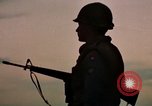
Visual saga of the American Soldier from 1945 to 1970: WWII; Korea; Berlin Crisis;Cuban Missile Crisis; Red China
Review of conflicts involving U.S. from World War 2 to 1970. A U.S. soldier with rifle and binoculars, on guard. German Chancellor Adolf Hitler speaks in Germany to mass audience. German mobilization and blitzkrieg. U.S. troops firing small arms on island in Pacific, battling Japanese. U.S. soldiers on half-track firing artillery. Explosive destruction of Nazi swastika and Eagle symbol on top of building in Zeppelin Field, Nuremberg, Germany. General Douglas MacArthur stands as Japanese General signs surrender documents aboard USS Missouri, ending World War II. Times Square in New York City on Victory over Japan Day (VJ Day) marking end of World War 2. American troops firing artillery and small arms in Korean War. Soviet leader Nikita Khrushchev speaking at the United Nations. Newspaper headlines about postwar Berlin Crisis. Soviet missiles on display in military parade in Red Square in Moscow, Russia, Soviet Union. Soviet General Georgy Zhukov and Nikita Khrushchev, at Kremlin, reviewing the parade. Cuban President Fidel Castro giving a speech. A newspaper headline reading: "Khrushchev orders removal of missiles" ending the Cuban Missile Crisis. Soviet cargo ship with covered missiles on its deck. Red flag with image of Lenin and message: 'Partido Communista Dominicano' and a crowd chanting support for the Communist party in the Dominican Republic. Communist Chinese people marching with massed flags in the People’s Republic of China. Chairman Mao Zedong waving to a crowd of young supporters and Red Guards in China as they chant. A United States soldier in South Vietnam during Vietnam War looks through binoculars and then walks carrying his M-16 rifle. A map of Vietnam.
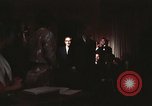
The U.S. Secretary of State Dr Henry Kissinger addresses a press conference after signing a peace agreement in Paris, France.
The U.S. Secretary of State Dr Henry Kissinger addresses a press conference after signing a peace agreement in Paris, France. Dr Kissinger arrives at a press conference and takes his chair. He talks to press photographers about the happenings of the peace talks, ceasefire in Vietnam and troops withdrawal from Laos and Cambodia. He expresses satisfaction on the progress of treaty and resuming peace conditions in Vietnam. Press photographers take photos and make notes of Kissinger's speech. He speaks about the cease fire agreement, need for free elections and resumption of peace. (Vietnam War period).
American soldiers shout slogans outside the National Archives Building in Washington DC.
American military soldiers and other men and women protest and demonstrate in Washington DC during a moratorium to end the Vietnam War. Men wearing caps with signs on them. Some hippies in the crowd. Anti-war American soldiers (veterans of prior wars) shout slogans as they demonstrate against the Vietnam War outside the National Archives Building (700 Pennsylvania Avenue, NW Washington, DC 20408-0001). They carry banners and posters that read 'Vote for Servicemen' and 'GIs against Vietnam'. A demonstrator with a peace sign flag walks toward the steps of the Archives Building and other demonstrators follow him. A peace activist or pacifist demonstrator who is a serviceman stands on the stairs of the building. Other soldiers walk down the steps.
Brutalities against prisoners, officials gathered in 1949 in Palace of Nations for Third Geneva Convention; discussion of Geneva Conventions.
Film from 1965 shows scenes that span from early 1940s through mid 1960s. Film opens showing armed conflict in Laos and South America. Soldiers firing rifles in jungle areas. Armed men running across a field and in a town in Cyprus. Heavy armor engaged in conflict and buildings burning in undisclosed location. Riots in Congo with a crowd of men beating another man. Armed Republic of South Vietnam soldiers (ARVN) moving through jungle in Vietnam War. A Viet Cong fighter shot as ARVN troops attack a hut. People fleeing in streets of Cuba as government soldiers engage armed revolutionaries under Castro. A civilian woman suffering a seizure as Red Cross workers attempt to carry her. Burned body of dead tank crew soldier atop a tank. Medical corps persons moving wounded on a stretcher. Various views of ARVN with captured Viet Cong in Vietnam. Narrator discussion about Geneva Conventions and Counterinsurgency. View of the Palace of Nations building in Geneva Switzerland. Scene shifts to inside, in 1949, where delegates of 59 nations are gathered to develop new rules expanding the original 1929 Geneva Conventions, in order to better protect prisoners of war, wounded prisoners, noncombatants and others caught up such internal conflicts. View from ground of German paratroopers during World War 2, jumping from Junkers Ju-52 trimotor transport planes. Closeup of German soldiers leaping from a plane and descending in parachutes. Japanese soldiers surrendering to Americans on a Pacific Island in World War 2. Several scenes of massacre victims lying on the ground, victims of Nazi German brutality in Europe during World War II. Survivors of a Nazi concentration camp near the time of its liberation in 1945. A U.S. Army medical corpsmen help one to a stretcher. Executed prisoners of war. Courtroom of the Nuremberg trials. Seen in the front row of Nazi leaders are: Hermann Göring, Rudolf Hess, Joachim von Ribbentrop, Wilhelm Keitel, Ernst Kaltenbrunner, Alfred Rosenberg, Hans Frank, Wilhelm Frick, and Julius Streicher. Seated behind them are: Karl Dönitz, Erich Raeder, Baldur von Schirach, Fritz Sauckel, Alfred Jodl, Franz von Papen, Arthur Seyss-Inquart, Albert Speer, and Konstantin von Neurath. Scene shifts to the postwar trial of Japanese Lieutenant General Masaharu Homma, in the Philippines. Prisoners with hands bound, in an unidentified Asian conflict, being herded into an open truck. Views of the document constituting the 3rd Geneva Convention of 1949, addressing treatment of prisoners and of parts directed to "conflicts not of an international character." Views of a traumatized civilian driver wounded and a female passenger killed in in his car (appears to be in Cuba or Latin America). Armed gunmen have the man leave the car. A man lays the body of the woman beside the car. Scene shifts to a group of surrendered Vietcong fighters with their weapons stacked. Wounded combatants being carried on stretchers. American survivors of a Japanese prison camp receiving a good meal after being rescued - this is possibly in the Philippines in 1945. Many of the American prisoners are gaunt and emaciated and malnourished. Narrator recites list of activities prohibited by Geneva conventions, as images show these activities: A ditch filled with victims of massacre. Hostages being taken in an internal conflict in an African country. Prisoners being beaten by non-uniformed civilians in and humiliated in public. A recently liberated prison with a former prisoner in striped uniform beating a man as a group is marched away (likely a World War 2 concentration camp with a liberated prisoner beating a former Nazi guard). Death sentences being rendered without due process. A court in Cuba. A boy pointing at a lineup of prisoners. A prisoner shot.
College students at University of California., Berkeley, during 1980 U.S. Presidential elections.
Film showing students at the University of California, Berkeley, principally in 1980. It also shows glimpses of Vietnam war era background events. Opening shows students on a college campus. Two of them sit and converse. Scene shifts to National Guard troops and police near the University of California campus, in May, 1969, when Governor Ronald Reagan declared a state of emergency and sent 2,200 National Guard troops into Berkeley, California. Next, students are seen handing out voting information from booths on the Berkeley campus during the 1980 U.S. Presidential elections. Students massed on campus and some having lively conversations with others. The entrance gates to the campus are seen in the background. Students moving about on the campus and some seated at outdoor tables having snacks and conversing. A student being interviewed who speaks about employment. Complete shift of scene to American soldiers jumping from a UH-1 Huey helicopter in Vietnam. President Richard Nixon waving enthusiastically in front of the Presidential helicopter. President Lyndon Johnson glad-handing spectators as he walks along the streets of a city. Glimpse of American hostages being taken from the embassy in Tehran, Iran, November 4, 1979 during Iran hostage crisis. U.S soldiers firing a howitzer field piece in Vietnam. Returning American hostages leaving an U.S.Air Force transport plane. A woman student being interviewed at Berkeley campus about the 1980 Presidential race between Jimmy Carter and Ronald Reagan. Students seated on a long bench in a room where a picture of motion picture star, John Wayne, is displayed on a wall. A male student says Ronald Reagan has brought a new spirit into everybody in America. A Berkeley political science professor comments on the new voters. Students speaking positively about President Reagan. More views of students and voting information on campus. (Note: film is silent except for occasional interviews.)
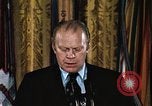
President Ford addresses gathering and awards Medal of Honor to Louis R. Rocco and Jon R. Cavaiani in Washington DC.
President of the United States Gerald R. Ford, Jr awards medals to soldiers of Vietnam War during a ceremony in White House in Washington DC. President of the United States Gerald Rudolph Ford, Jr speaks about American support to peace and about honoring the officers of Vietnam war. United States Secretary of the Army, Howard Hollis Callaway reads the citation while President Ford decorates the heroes of Vietnam War. President Ford pins medals of Honor to United States Army soldiers Louis R. Rocco and Jon R. Cavaiani. He greets the family members of the soldiers.